

Last week, we welcomed clients to Google’s London offices for an exclusive Hallam & Google AI Summit. The day was dedicated to unpacking how AI is reshaping search, brand-building and performance marketing. Five Hallam speakers and two Google specialists took to the stage, and the common thread running through every talk was impossible to ignore: brand and performance, once treated as separate disciplines, are being forced back together by the way AI now mediates discovery.
Below, we’ve pulled together the key learnings from each Hallam session, plus a summary of the latest from Google on the day (which was actually Google’s 28th birthday!)
“The great recoupling”: How AI Search is forcing brand and performance back together
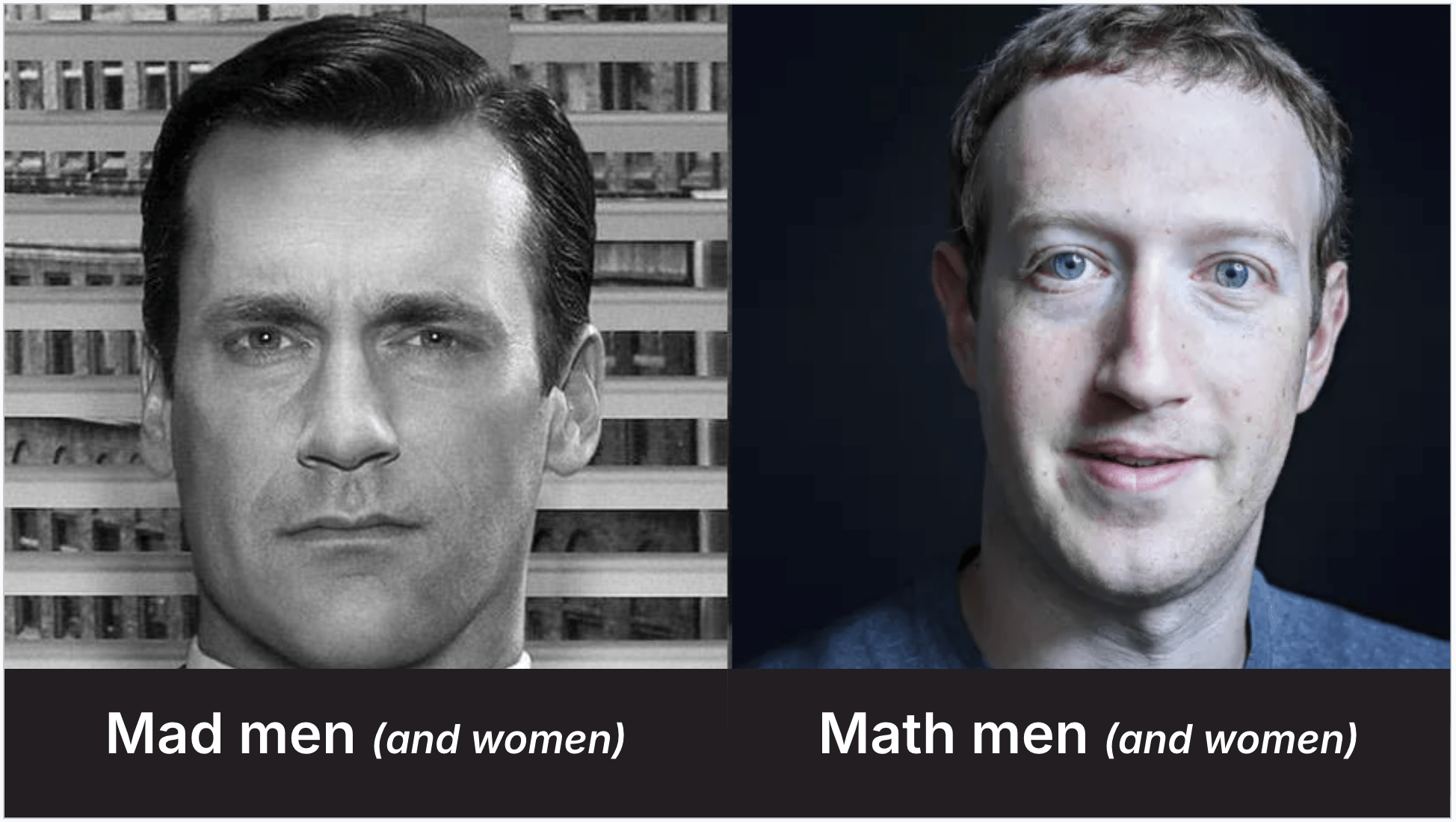
Ben Wood, Hallam’s Strategy & Performance Director, opened the day by framing a tension that’s shaped marketing for two decades: “Mad men” (the marketers who push message, meaning, persuasion) versus “Math men” (the marketers who live and breathe measurement, systems, delivery). For years, performance marketing’s measurability gave it the upper hand. Ben’s argument was that AI search is quietly reversing that trend, calling it “the great recoupling.”
Source: Hallam.Agency
The reasoning comes down to how large language models actually work and how they draw on two distinct kinds of knowledge:
- Parametric knowledge – Associations baked into a model’s weights through training. If a brand and a category term appear together often enough, across enough independent sources, the model learns the association. This can’t be bought or bypassed; it only shifts with a new training run, months to years away, and entirely outside any brand’s direct control.
- RAG (retrieval-augmented generation) – The real-time layer, where a model runs a search, pulls documents into context and reasons over them for that single conversation. This is fast, temporary and much closer to classic SEO.
The implication is that showing up in AI answers isn’t just a technical SEO exercise. In actual fact it depends on the same broad, sustained brand-building work that earns a place in a model’s underlying training data, from YouTube presence to backlinks to press coverage.
This connects to a distinction Ben drew between mental availability (coming to mind when a person enters a category) and model availability (coming up when a model is asked the same question). Crucially, AI-generated shortlists are increasingly becoming human shortlists too: when an agent or assistant recommends a shortlist of vendors, that shortlist shapes what the human considers next, whether or not a person searches independently.
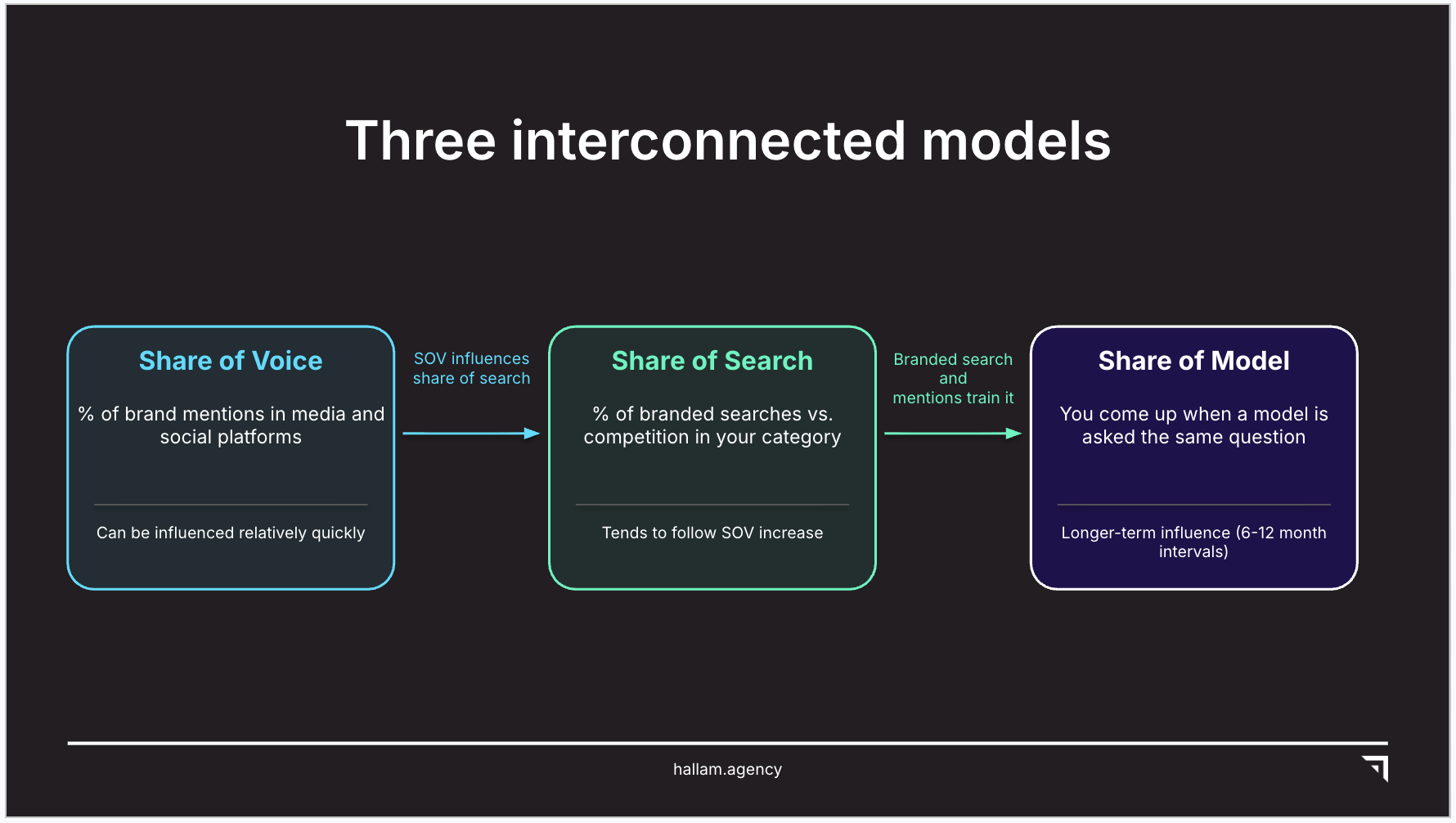
Ben set out three interconnected metrics brands should be tracking together as we do for our clients at Hallam:
- Share of Voice – Brand mentions across media and social, which can shift relatively quickly.
- Share of Search – Branded search volume relative to competitors, which tends to follow SOV.
- Share of Model – How often a brand is surfaced when a model is asked a relevant question, which moves more slowly, typically over six-to-twelve-month intervals, and is trained by branded search and mentions.
Source: Hallam.Agency
Practically, Hallam is approaching these metrics for clients through three pillars:
- Category authority. Defining what a brand stands for and which buying situations it wants to own. The example used was CovertSwarm, who chose to own “offensive cybersecurity” rather than compete as a generalist in cybersecurity. As Ben put it, if you can’t define what you’re the answer to, a model can’t either.
- Content authority. Going deep rather than wide. Reference-grade explainers, original research and primary data, built to be cited and reused rather than regurgitated. This is genuinely useful in a world increasingly wary of AI-generated content sameness and “model collapse.”
- Distributed authority. The hardest lever to pull, and arguably the most important: presence in the places a brand doesn’t fully control, from forums and reviews to citations and press coverage. As Ben summarised it, this is about influencing a narrative you don’t fully own.
He closed with a reminder from Kimberly Storin, CMO of Zoom, who noted her team can’t yet prove a direct causal link between these efforts and AI visibility outcomes, but are actively testing for one. It’s a fair signal of where the entire industry currently stands: directionally confident, whilst still building the measurement to prove it.
Hallam launches Conversational Analytics.
Jonathan Catton, Hallam’s Head of Data & Analytics, tackled a more operational question: is manual marketing analysis still a good use of anyone’s time?
He broke down the traditional analytics workflow for a single question – extract, transform, visualise, interpret – as roughly four hours of work, of which only 30 minutes was genuine thinking time. The rest was labour: pulling data, reconciling it, building the chart. With an AI-powered flow, that same question takes around two hours total, but the balance flips: 30 minutes of labour, 30 minutes for the AI to build the output, and a full hour of interpretation. Total time halves, and thinking time doubles.
The framing he offered was simple but useful as a working principle: don’t ask AI to do your thinking for you. Instead, get it to do your labour, so you have more capacity to actually think. Because iteration becomes cheap, teams can go back and interrogate results further rather than settling for “the best answer we had time for.” Jonathan shared a real example whereby a first-pass of data reconciliation was satisfied because overall totals matched, even though individual transactions didn’t line up. It took a specific instruction to dig further before an order inflation issue actually surfaced. Iterating meant the team caught something a single manual pass would likely have missed.
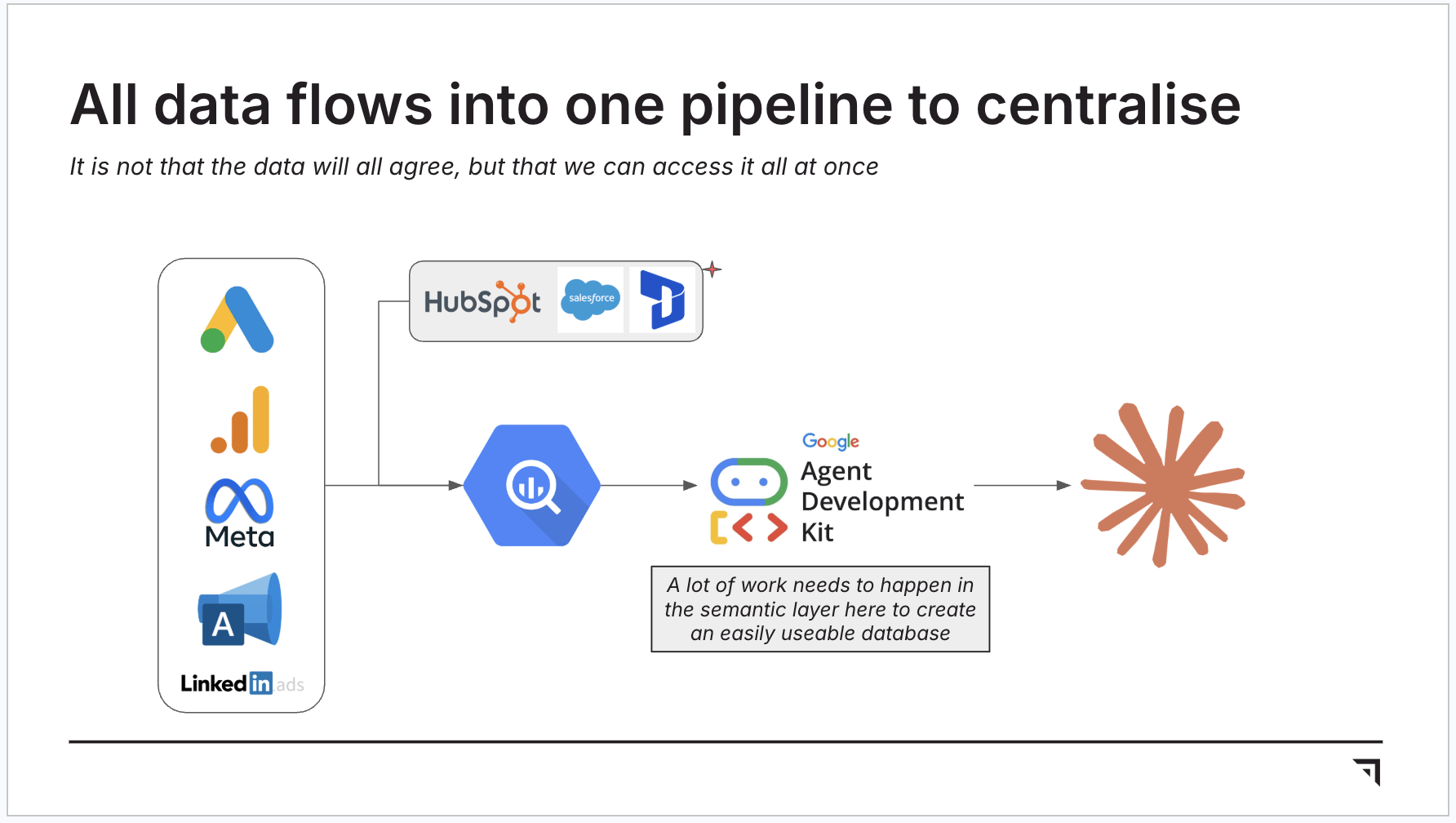
This is the thinking behind the Hallam Brain, the agency’s Conversational Analytics layer, built on a central data warehouse that consolidates client performance data into one queryable source, removing the need to download and reconcile CSVs across multiple ad and analytics platforms. It’s already supporting internal use cases: catching cross-platform discrepancies, building full-funnel progression views, and correlating brand spend with traffic movement.
Source: Hallam.Agency
The rollout: beta testing for selected clients from Q4 2026, with launch to all clients targeted for Q1 2027, included in retainer at no extra cost throughout the beta. More on this coming soon!
Jonathan was careful to flag a genuine risk with this shift, sharing a (slightly alarming) real prompt from a colleague after connecting HubSpot to Claude: essentially asking the AI to analyse the entire CRM and identify every profit leak with zero margin for error. His point: running the analysis is no longer the hard part. Knowing which analysis is actually useful to run, and interrogating an AI’s answer with the same scepticism you’d apply to a junior analyst’s first draft, is where the real skill now sits.
Fixing B2B’s creativity deficit
Mark Newton, Hallam’s Head of Brand Strategy, made the case that B2B marketing has a creativity problem, and that the data-obsessed, platform-metric-driven approach many teams have adopted is partly to blame.
He introduced the concept of “value capture,” borrowed from philosopher C. Thi Nguyen: rich, complex personal values get replaced by simplified, quantified metrics, and over time the metric itself becomes the goal rather than the outcome it was meant to represent. Applied to marketing platforms, this means CTR, CPL, open rate and ROAS are countable and immediate, but they measure demand capture, not demand creation, and they say nothing about the roughly 95% of buyers who aren’t currently in-market.
The numbers Mark shared painted a clear picture of the cost of sameness:
- 62% of B2B buyers increasingly perceive brands as indistinct, with marketing messages sounding interchangeable across competitors.
- Brands that aren’t distinctly different need to spend roughly 3X as much on advertising as those that are.
- 71% of B2B buyers say memorable creative meaningfully influences their perception of a brand.
Source: Hallam.Agency
His response to “can’t you just use AI?” felt familiar to everyone. The reality is that generative tools compress available information into an average, actively contributing to a “sea of sameness” rather than solving it. The answer, he argued, is a return to timeless marketing principles, with creativity redefined plainly as the manufacture of distinctiveness and the engineering of memory.
Mark walked through the building blocks:
- Distinctive brand assets. Non-name elements (colour, logo, tagline, character, sonic branding) that buyers use as memory shortcuts, reinforced by the Mere Exposure Effect (Zajonc, 1968): repeated exposure to any stimulus is enough to build preference for it.
- (Relative) differentiation. Owning more of an attribute that genuinely matters to buyers than your competitors do.
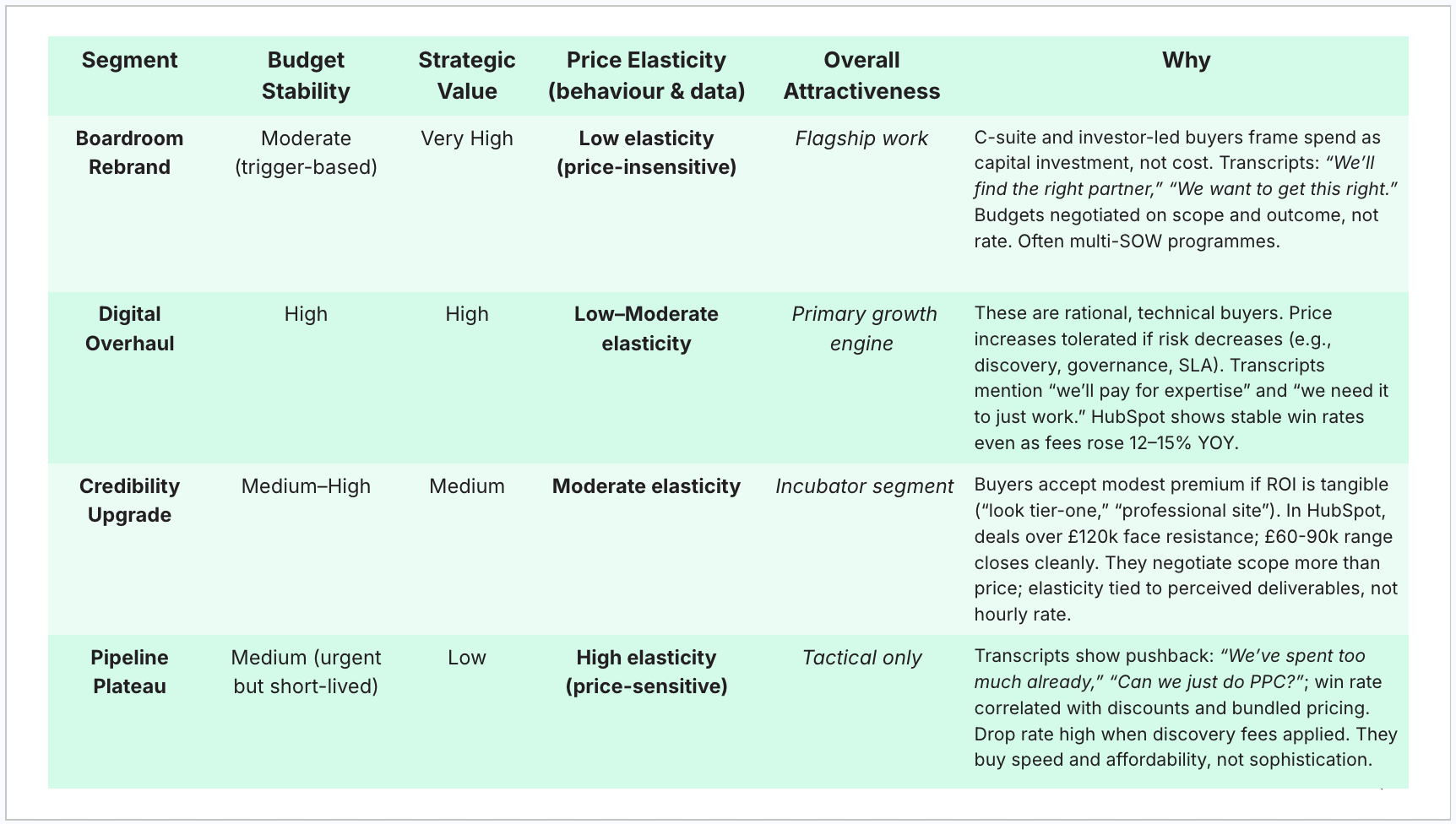
- Category entry points (CEPs). Reframed not as keywords but as buying triggers: the specific moments, motivations or needs that prompt someone to enter a category. These are contextual, not demographic. “We failed a pen test and the audit is in six weeks” tells you far more than a job title and age bracket ever could. Mark suggested mining sales call transcripts and CRM data to surface these triggers, then grouping them to inspire genuinely relevant messaging.
See how Hallam did this to identify our own segmentation and targeting.
Source: Hallam.Agency
He acknowledged the B2B-specific hurdles that make this harder than in B2C. For example, buying groups can span five to sixteen people across four functions, and 74% of B2B buying teams show “unhealthy conflict” during the decision process. However, the underlying playbook (start with strategy, speak to real customers, get emotional, then build familiarity through consistency) doesn’t change. He backed this with a real-life example: Hallam’s work with Workbooks which delivered a 143% increase in pipeline value through a genuinely distinctive creative campaign.

Source: Hallam.Agency
UX & CRO at Hallam: Driving paid media success
Katherine Sherry, Hallam’s Head of Experience, argued that websites are no longer static, one-off builds and rather they’re living systems that need to be adaptive, connected, strategic and constantly evolving.
Citing Forrester’s 2026 predictions, she made the point that success increasingly depends on balancing AI tooling with human governance and expertise, not replacing one with the other. Websites now sit within a much wider digital ecosystem that includes CRM, analytics, paid media and even the data that trains a brand’s own AI models – rather than functioning as standalone marketing assets.
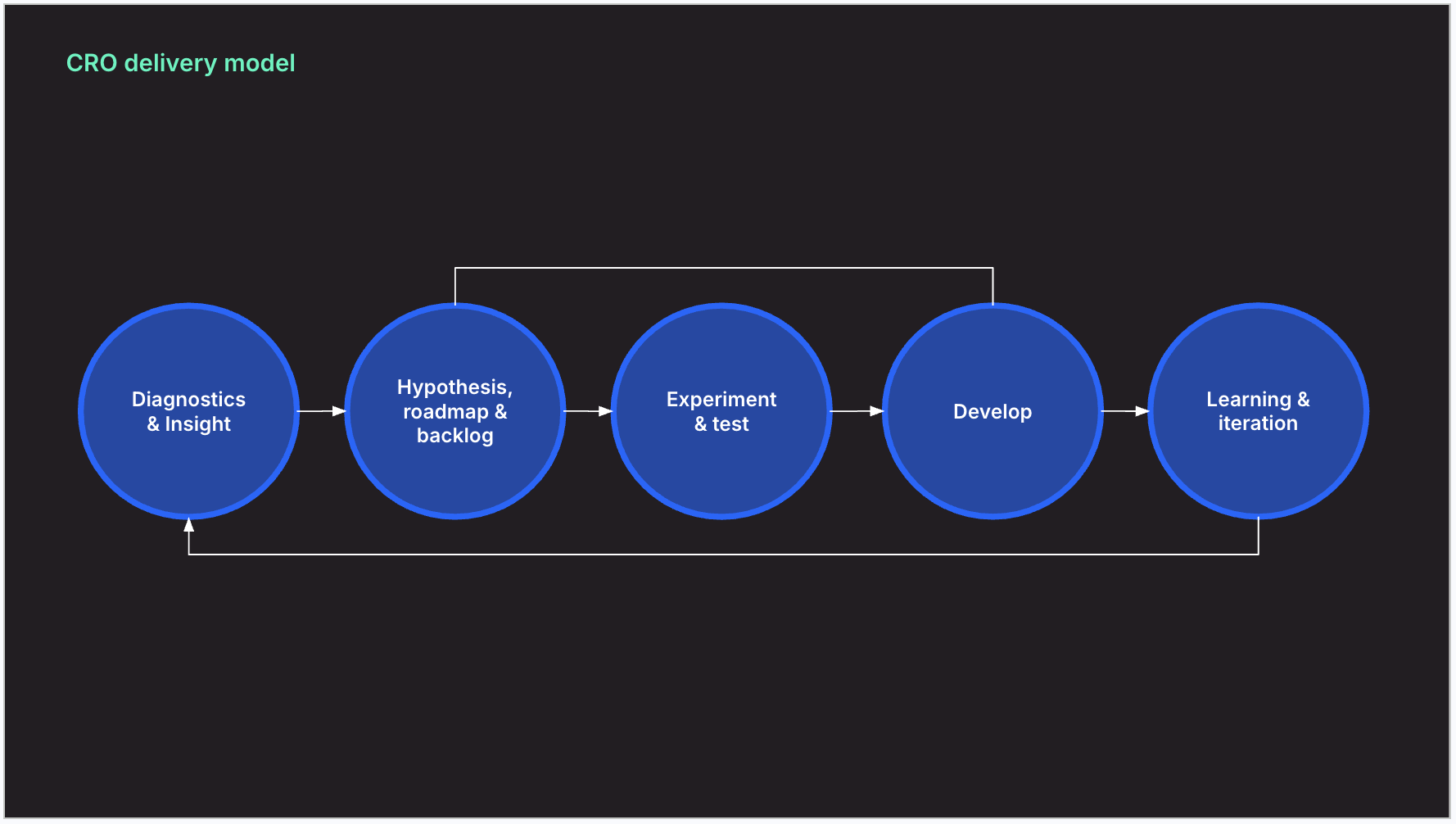
The session mapped just how much complexity now sits behind a single page: SEO structure, CMS and integrations, site performance and security, visual and video assets, UX patterns like navigation and trust signals, and interactive tools from ROI calculators to booking systems. Hallam’s approach to managing that complexity is a circular CRO delivery model which follows diagnostics and insight, hypothesis and roadmap, experiment and test, develop, then learn and iterate – continuously. An iterative approach designed to run in cycles rather than as a single redesign project.
Source: Hallam.Agency
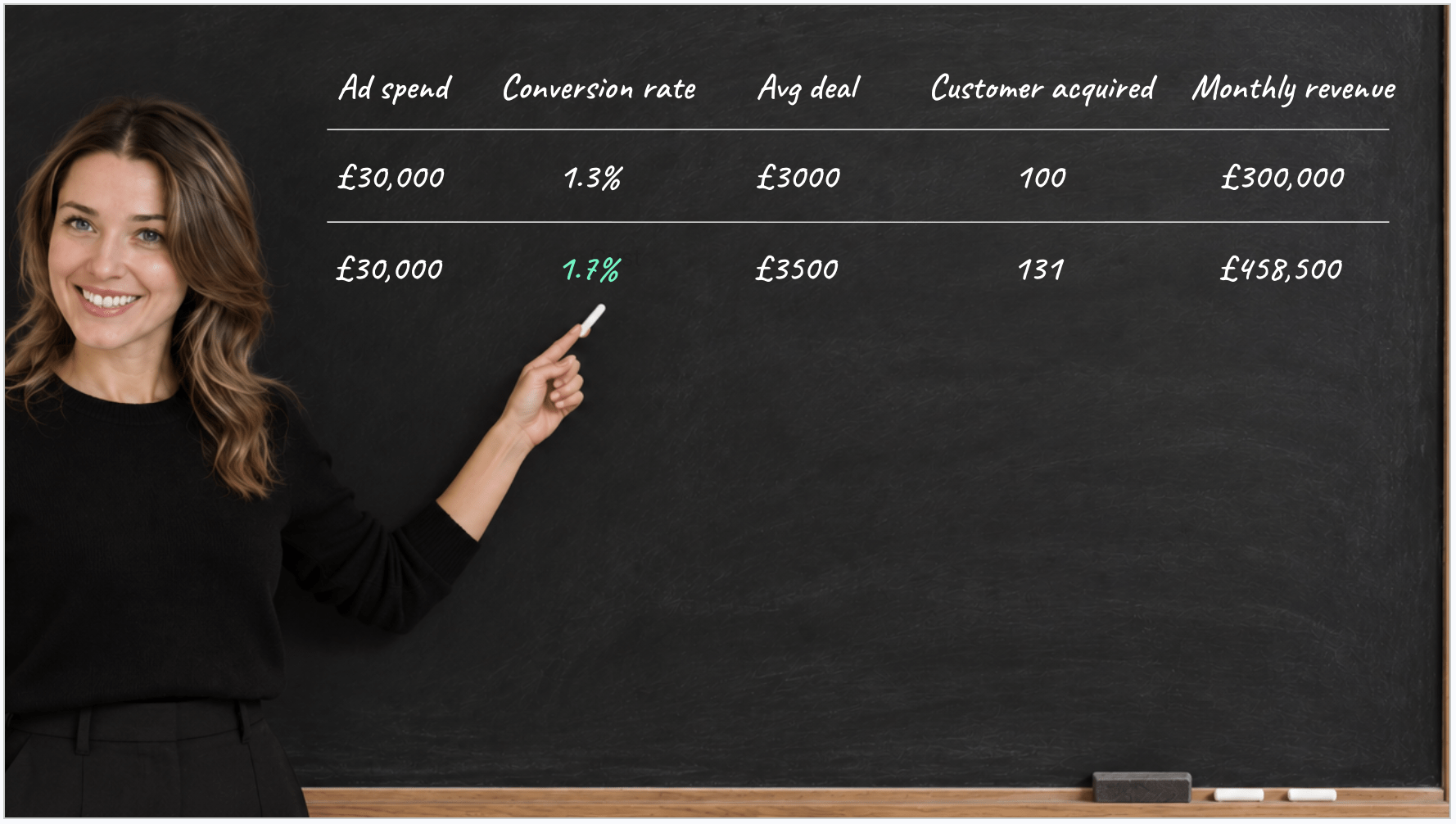
For paid traffic specifically, Katherine set out how landing page purpose should shift by funnel stage: educational content and service pages for the explore stage, case studies and ROI calculators for validate, and tightly tailored landing pages for convert. She illustrated (through the humorous AI-generated slide below) the compounding value of even modest conversion rate improvements with a simple example: lifting conversion rate from 1.3% to 1.7% on the same ad spend and similar average deal size took monthly revenue from £300,000 to roughly £458,500. A solid reminder that CRO gains can rival, or even outperform, incremental increases in media spend.
Source: Hallam.Agency
PR and its importance for AI Citations
Sarah Fleming, Digital PR Lead, made the case for Digital PR as one of the most underrated levers for AI visibility. Google search interest in “Digital PR” is up 173% year-on-year, and for good reason: brand web mentions show the strongest correlation with AI Overview visibility of any factor studied. Plus brands that AI models actively “search for” before answering are reportedly 33 times more likely to appear in final answers. As SEO consultant Rand Fishkin has put it, the goal now is to influence the model before it ever performs the search.
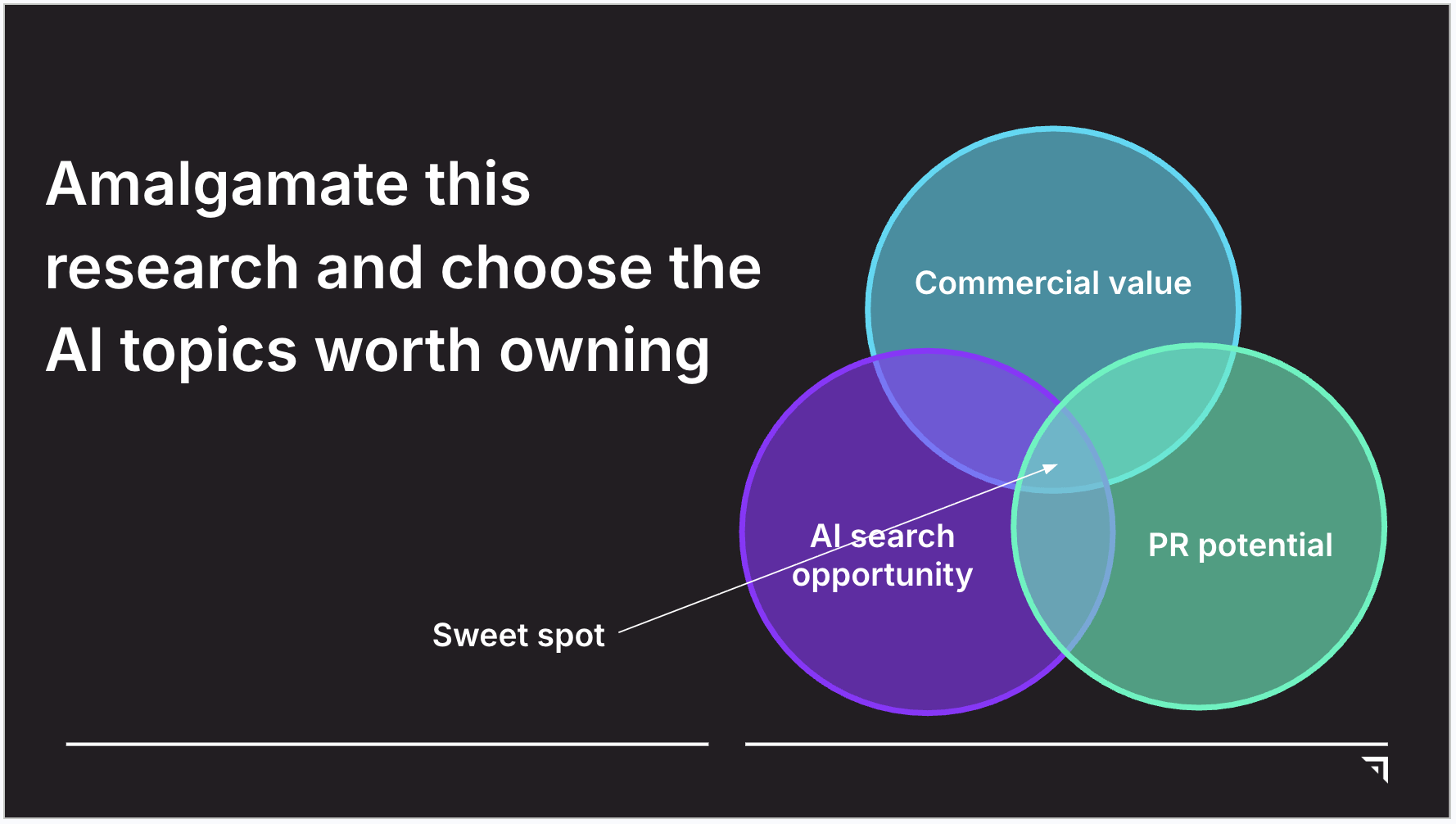
Sarah’s framework for building a brand that AI already knows to cite starts with genuine audience research (mining sales calls, customer conversations, Reddit and social for the recurring questions people actually ask), then mapping that against a competitor benchmarking exercise. One suggestion was to filter Ahrefs link gap analyses for language like “said” to surface competitors’ reactive, spokesperson-led coverage specifically. From there, brands should prioritise topics where commercial value, AI search opportunity and PR potential overlap, and then do the harder work of finding a genuinely newsworthy angle rather than trying to force a target keyword into a story journalists have no reason to run.
Source: Hallam.Agency
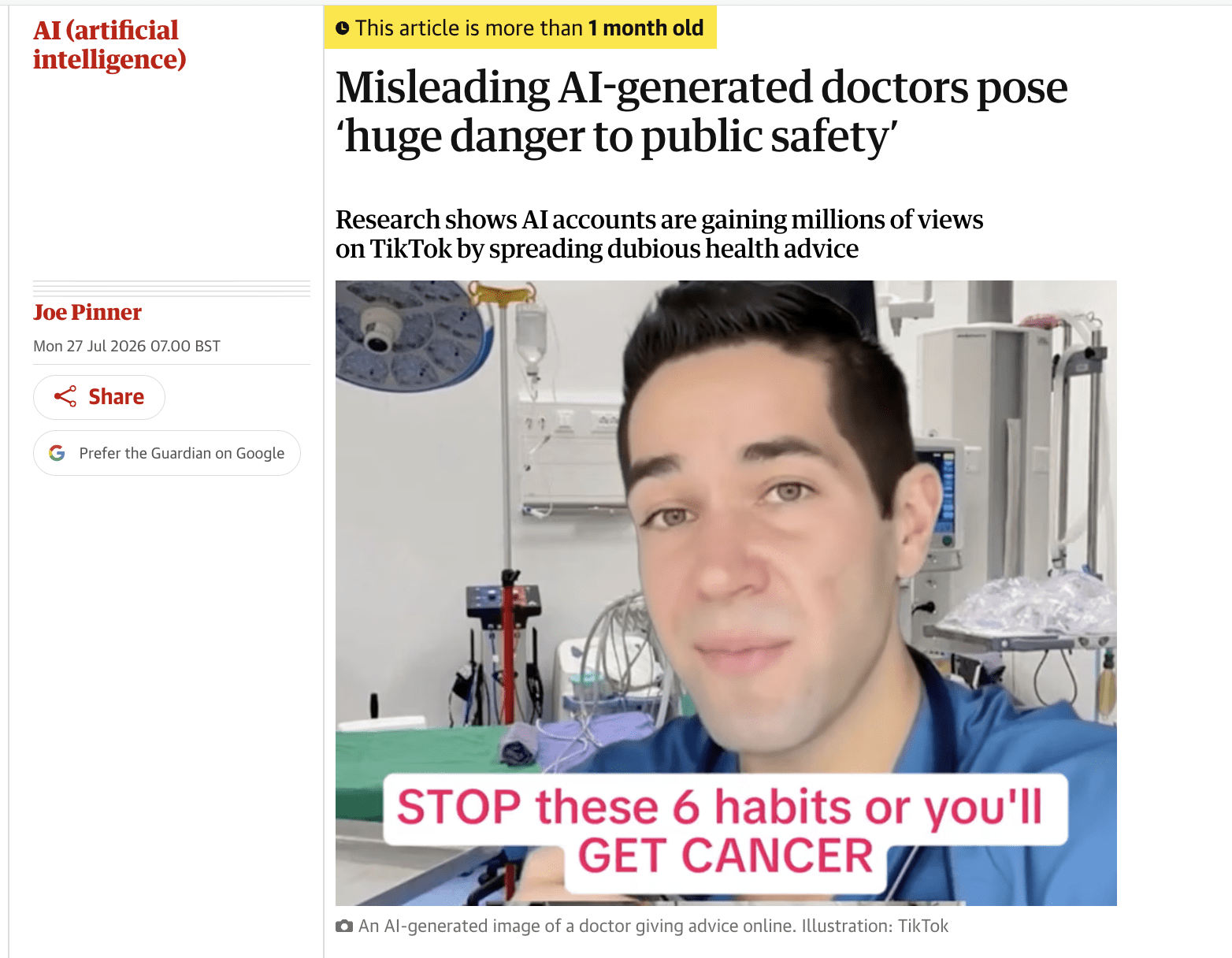
We’ve recently done this for Hallam, with our study into AI-generated content on TikTok across 5 sectors we work in. This data study became so newsworthy, that we’ve seen over 45 pieces of coverage for it globally, including a story from The Guardian.
Source: The Guardian
On reactive and spokesperson PR, her message to the room was blunt: journalists are increasingly wary of “fake experts” wheeled out by agencies with no real credibility, which creates a genuine opportunity for brands willing to invest in real ones. She set out four practical checks for preparing an internal expert for media success.
- Make sure their credentials actually stand up
- Make them visibly real (photos, video, a genuine presence)
- Give them a hub of published work that demonstrates ongoing authority
- Invest in real media training so they’re confident on camera and on calls
For pitching, her guidance was to always lead with the problem a product solves rather than the product itself, ensure commentary speaks directly to audience pain points, bring a genuinely unique angle rather than echoing competitors, and time commentary to topics journalists are already covering.
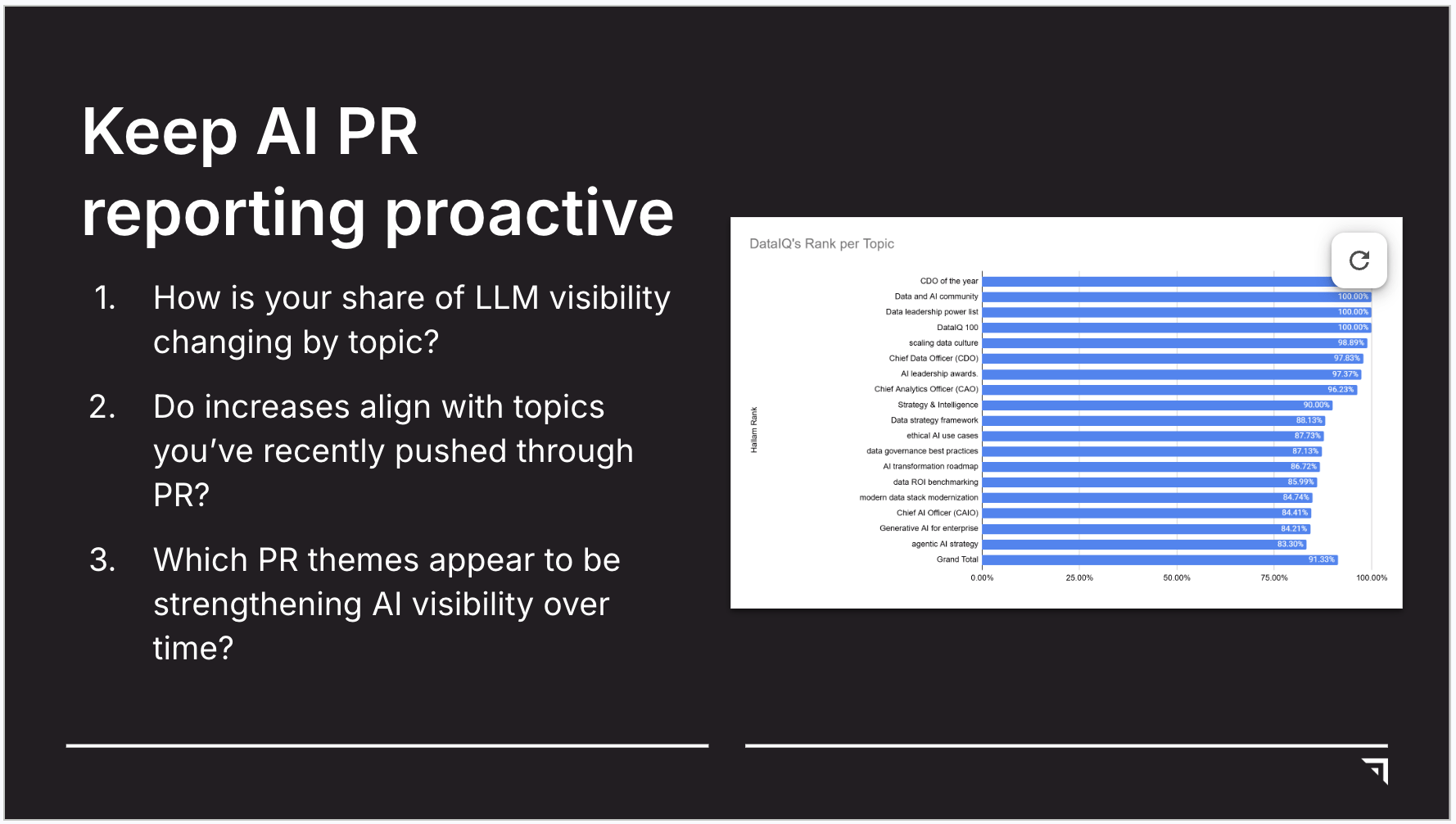
On measurement, Sarah recommended pairing traditional share-of-voice tools with newer AI visibility tools (Ahrefs, Profound) to consistently map PR coverage against target terms and track whether “Share of LLM” visibility is shifting in the topics a brand is actively pushing through PR.
Source: Hallam.Agency
What we learned from Google
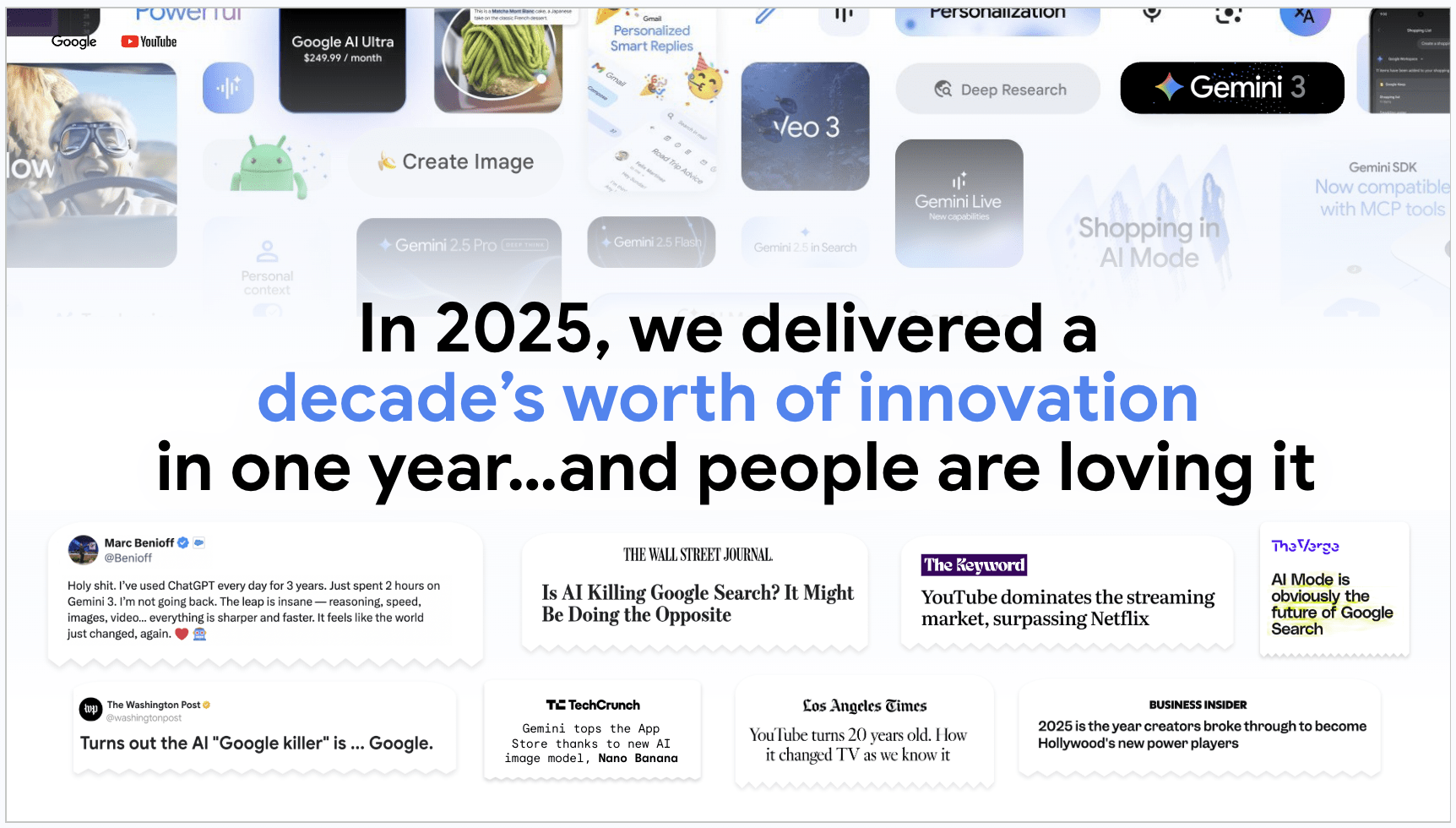
Google’s Clinton Koola opened his session with the scale of the shift now underway: Google now sees over five trillion searches a year, queries have grown longer and more complex, and last quarter search volumes hit an all-time high. AI Overviews has surpassed 2.5 billion monthly users, and the newer, more conversational AI Mode has already passed 1 billion monthly users, with Google framing 2025 as having delivered roughly a decade’s worth of AI innovation in a single year.
Source: Google
His core message for advertisers echoed the day’s wider theme: the best ads in an AI search experience need to function as genuine answers, not interruptions, and platforms like AI Max and Performance Max are being built around that shift, reportedly improving conversion outcomes for advertisers who adopt them fully.
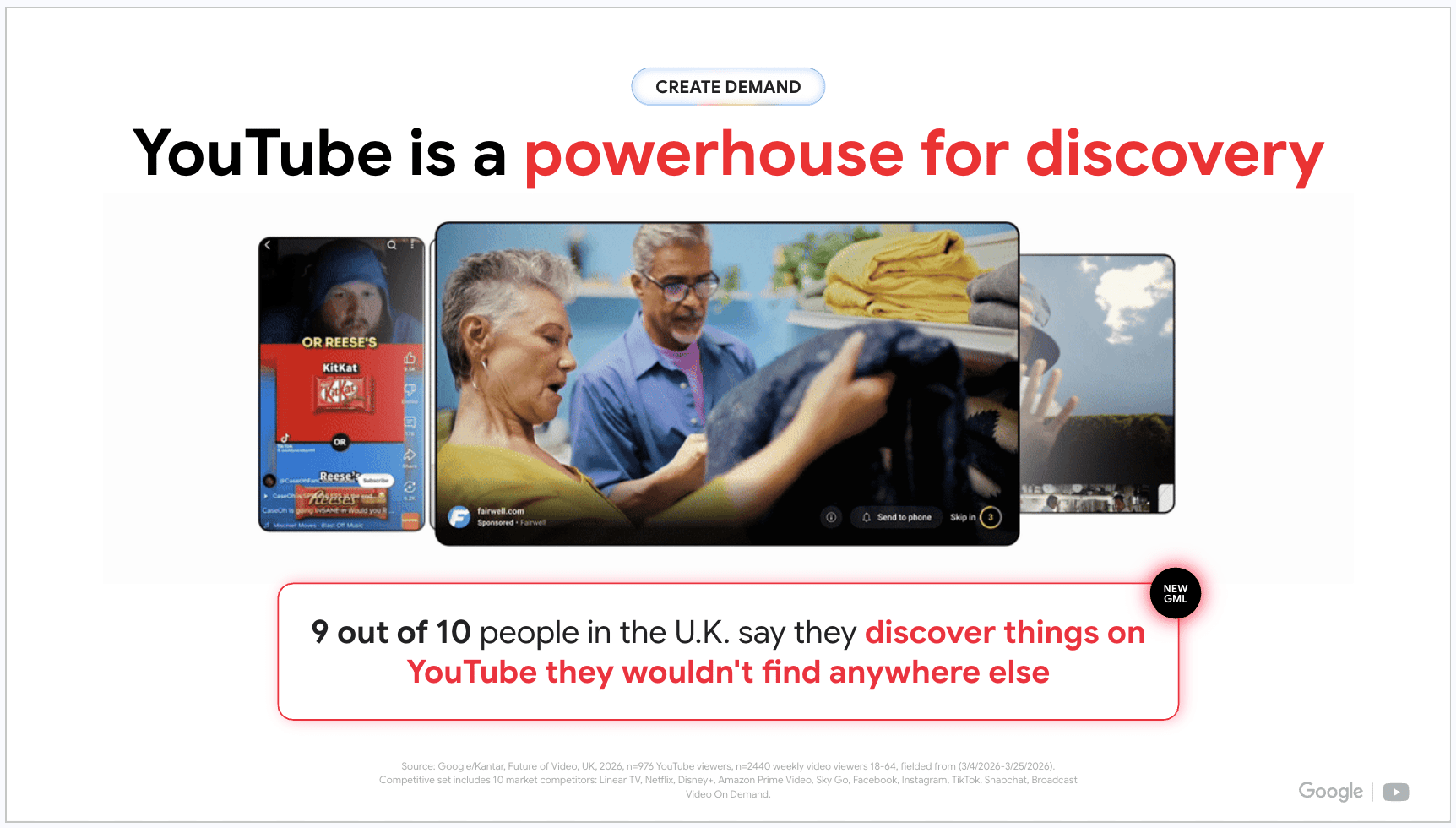
Nessa O’Hara’s session focused on YouTube’s dual role as both a brand-building and performance channel, noting that attention on YouTube behaves differently to other social platforms, and that YouTube continues to be a major discovery engine for UK audiences. The majority of a shopper’s path to a buying decision now touches Google or YouTube at some point. The clearest strategic takeaway from both Google sessions was that brands need a marketing mix that spans searching, streaming, scrolling and shopping behaviours together, rather than optimising for any one in isolation.
Source: Google
The common thread
What struck us most, pulling all the sessions together, is how consistent the underlying message was despite covering our wide breadth of expertise.
AI hasn’t created a new discipline to master but it’s raised the cost of not doing the fundamentals well. Distinctive positioning, genuine expertise, reference-grade content and consistent presence in places you don’t fully control were always good marketing practice. They’ve now become the literal inputs that train what AI models say about a brand.
If you’re a B2B brand looking to stand out in your sector and be chosen before the search begins, then get in touch.