

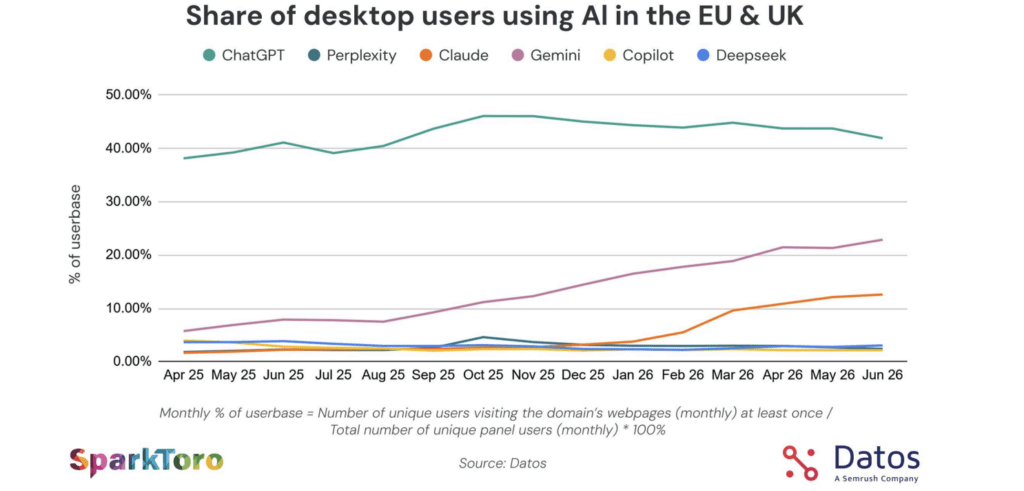
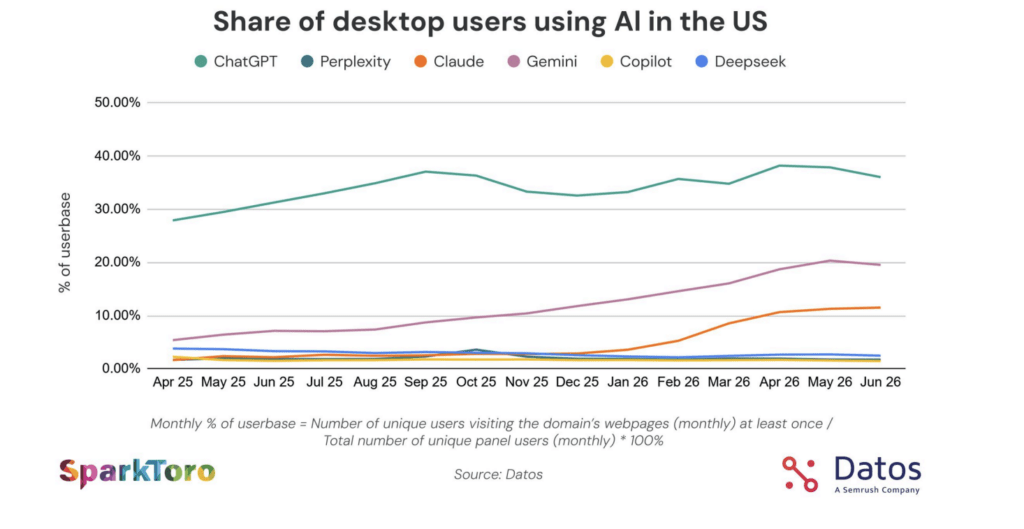
Search behaviour is undergoing its most radical shift in two decades. According to a joint Datos & Sparktoro Q2 report for 2026, AI Search continues to accelerate across US, UK and Europe, it’s compounding fast and businesses need to adjust fast.
One of the biggest differences between optimising for traditional Search and AI Search (AI Overviews, AI Mode, Gemini, ChatGPT, Perplexity & other LLMs) is that the focus is moving away from only improving your own website to considering your overall brand and marketing strategy. Whilst your website optimisation is the cost of entry, your brand consistency, messaging and visibility across the web become the new currency you have to deal with if you want to be found in AI Search.
In this article, I will go through what you need to consider for AI Search optimisation to ensure you brand is mentioned in LLM responses. Let’s dive in!
Technical elements to consider for AI Search optimisation
These are the most important technical elements that need to be considered for AI optimisation.
- JavaScript – if it was important for Google, think of it as crucial for LLM visibility. Most AI crawlers do not execute JavaScript efficiently or they can skip it entirely to save resources. This means that if critical business information like pricing, services or booking details are dependent on JavaScript to render and display – AI platforms won’t be able to read it and service it. Ensure your content (text, images, and links) is not dependent on JavaScript.
It is worth mentioning that markdown files have been marketed as a solution to this but this feels more like a tactic as opposed to a strategy and not a long-term solution. David McSweeney also brought up an excellent point that markdown files can lead to content cloaking. - Site architecture – just as with traditional SEO, a logical website hierarchy and content clustering are critical for AI search optimisation. A clean, structured architecture makes it significantly easier for LLMs to crawl, retrieve data, and accurately map how different pages and topics relate to your brand.
- Structured data – whilst a recent Ahrefs study disproved the direct benefits of schema markup for AI search visibility, it remains highly valuable for traditional search engine optimisation, which is increasingly integrated as a retrieval mechanism in Retrieval-Augmented Generation (RAG).
- Core Web Vitals – page speed is still a factor so continue working with your technical and UX specialists to ensure your pages load efficiently and provide seamless experience.
- Server logs – At BrightonSEO 2026, PromptWatch founder Gijs de Groot delivered an insightful presentation demonstrating the critical importance of accessing and auditing server logs. These logs provide a wealth of data, revealing which AI platforms and crawlers are accessing your site, which pages they target, and their overall crawl rate. Analysing these metrics helps identify which high-priority pages require fresh content and highlights opportunities to optimise key user journeys. What’s more, log audits can uncover interesting behaviours such as ChatGPT bypassing “noindex” tags and the speed at which your newly published content is indexed is picked up.
When you audit your server logs, you will encounter different crawlers accessing your site. It’s important to know their differences and purpose to be aware of what content is used for training purposes and what content has been retrieved.
- GPTBot: OpenAI’s bulk web crawler used to train foundational models.
- OAI-SearchBot: OpenAI’s web search crawler, acting similarly to a traditional search engine bot.
- ChatGPT-User: An on-demand retrieval bot. It only triggers when a user explicitly asks ChatGPT to read or fetch a specific URL.
- PerplexityBot: The automated bulk crawler that continuously scans the internet to build Perplexity’s AI index.
- Perplexity-User: An on-demand, user-driven fetching agent rather than a background crawler.
- ClaudeBot: Anthropic’s primary bulk crawler used to train and update Claude’s foundational models.
- Claude-SearchBot: Anthropic’s search indexing crawler, navigating the web to power Claude’s AI-search features.
- Claude-User: A real-time web-fetching agent that acts like a live browser when a user prompts Claude to visit a specific URL.
How to optimise content for AI Search
By now, you would have encountered a lot of ‘tactics’ when it comes to content optimisation for AI Search. Chunking is likely one of them. Spoiler alert – there is no need to chunk your content if you have already structured it well.
There is no one specific way to write content for AI Search optimisation but what I implore you to do is consider your overall content strategy – not just across your website but your marketing materials, brand messaging, social media strategy, employee advocacy programme, Digital PR, community management and thought leadership content.
- Structure your content well with relevant headings, paragraphs, and bullet points. This is not content chunking (which has been debunked), it’s about organising your content in a logical manner and grouping content under the right headings. As SEOs, we are very much used to this.
- Provide original research and data. AI platforms value unique content like original research or whitepapers. Google refers to this as non-commodity content:
“Create non-commodity content that’s helpful, reliable, and people-first: Focus on developing unique, expert-led content that provides value beyond common knowledge.”
Remember the days when everyone will write the same blog because that was the long tail keyword with the highest search volume? We used to end up in the sea of sameness on the first page of Google. AI Search takes care of that by summarising all of the content and providing only the unique points of view. - Prioritise keeping your top-performing, high-traffic assets current. If a core group of pages consistently drives the majority of your organic and multi-channel traffic, implement a routine review process to ensure their content, internal links, and supporting data remain accurate and timely.
- Define your category and maintain brand consistency. I cannot stress this enough; know who you are and communicate this well. Establishing a clear category identity and communicating it consistently across all touchpoints is critical. Your website content, social media strategy, and broader marketing campaigns must present a unified value proposition that clearly differentiates your business from competitors. Ambiguity or misalignment between channels creates immediate brand dissonance.
- Establish brand authority and strong entity. There are multiple studies showing the correlation between brand presence in AI Search and web mentions and anchors.
This speaks to my previous point on why brand identity and consistency become so important. To ensure AI platforms recommend your business, you must focus on three core pillars:- Brand message consistency: Your brand messaging must be unified across all platforms. If your website, social media, and marketing materials communicate different value propositions, you create semantic dissonance. Consistent messaging is required for LLMs to confidently categorise your brand.
- Optimise your brand online: Ensure your business details are perfectly aligned across highly trusted databases like your Google Business Profile, LinkedIn, Crunchbase, and Wikidata.
- Prioritise Digital PR: AI engines need to know which brands dominate specific categories (e.g., “best AI note-taker” or “premium coffee machines”). Because LLMs exhibit a systematic bias toward third-party validation, they are far more likely to recommend you if an authoritative external site verifies your expertise.
AI Search broke the funnel
Talking about AI Search optimisation without considering how we’ll measure performance feels incomplete, and measurement is a crucial part of any marketing strategy.
We know that even position one in Google no longer guarantees traffic, that citations and mentions in AI platforms behave differently to a traditional ranking, and that customers can now research your brand, self-qualify and even contact you without ever visiting your website. Cue trendy topic: zero-click search, and everyone losing their mind over traffic that was a vanity metric to begin with anyway.
It’s true that traffic has declined across the board – even branded terms are suffering and are no longer getting the CTR they used to. Every industry has felt this, and the keyword group hit hardest is informational.
What’s harder to admit is that attribution is breaking down with it. A prospect might see the answer to their question summarised in AI Overviews, then go directly to your website a few days later and convert – showing up in your CRM as SQL with no clear source, when the AI mention did the actual persuading. The funnel hasn’t disappeared. It’s just been rebuilt with several of its stages happening somewhere you can no longer see.
So as content shifts from a primary KPI to a nice-to-have, demand hasn’t gone anywhere -it just needs different metrics to prove it’s working. Instead of relying on traffic alone, focus on tracking:
- Share of Search
- Branded query impressions in GSC
- Direct traffic
- MQLs/SQLs from Direct and AI traffic
- Conversion rates from AI traffic
- Prompt tracking for key topics
- Percentage of AI traffic in comparison to overall traffic
None of these metrics work in isolation, and none of them replace good judgement, but together they give you a far more honest picture of performance than organic sessions alone ever did. Track them consistently, and you’ll actually be able to prove AI Search is working for your brand, rather than just hoping it is.
Final thoughts
AI Search isn’t a bolt-on to your existing SEO strategy – it’s a fundamental shift in who you’re optimising for and how you prove it’s working. Get the technical foundations right so AI platforms can crawl, read and cite your content. Build content and a brand presence that’s genuinely differentiated, consistent and verified by third parties, because in a world where LLMs decide who gets recommended, your website is the cost of entry, not the whole game. And retire the assumption that a single click-through tells you whether any of it worked.
Let’s talk to help you get all three elements right – technical, content and measurement.