

Most B2B CRO advice was written for ecommerce, and it shows. The typical recommendations – shorter forms, fewer clicks, a trust badge above the fold are built around a buyer who decides in minutes and checks out alone. They fall apart entirely when your conversion might be a buying committee, your deal cycle could stretch to three months and your ideal customer may have spent weeks researching before they ever make contact.
Conversion rate optimisation for B2B demands a fundamentally different approach. Maximising form submissions is the wrong target. What matters is the quality of conversations that turn into pipeline. A single well-qualified lead is worth more than a hundred unqualified leads who never intended to buy.
This guide covers what B2B website conversion actually requires – reading intent signals correctly, removing the friction points that cost you deals, and making sure the right leads reach your sales team at exactly the right moment.
Why B2B CRO is a different discipline
In B2C, conversion is usually a single moment, whether that’s someone buying, subscribing or signing up. In B2B, conversion is a sequence. A prospect might visit your pricing page, read a case study, attend a webinar and then, weeks later, submit a demo request. Each of those actions is a micro-conversion, and optimising any one of them in isolation can send you in completely the wrong direction.
According to Gartner’s B2B Buying Journey research, the average buying group involves six to ten decision-makers, each conducting independent research before the group aligns. So your website isn’t just one person’s journey. It’s potentially the backdrop for an entire committee’s evaluation process.
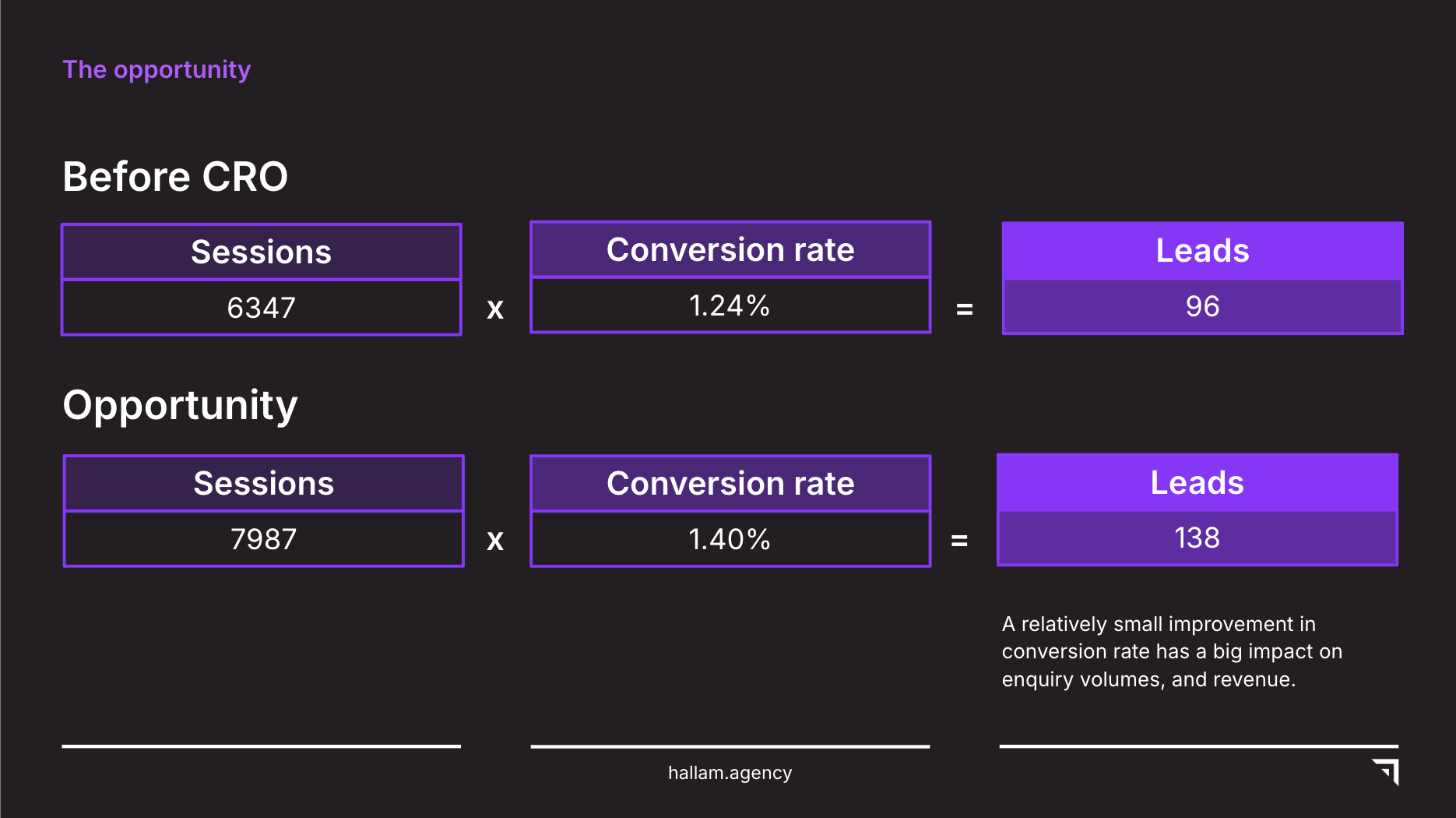
The practical implication: optimise for quality and progression, not volume. A shorter form that generates more unqualified leads is a cost transfer from marketing to sales, and it’ll show up in wasted pipeline and frustrated reps.
Reading high-intent signals correctly
Not all traffic is equal. And not all behaviour signals the same thing. High-intent visitors are already past awareness. They know their problem, they’ve been comparing solutions and they’re deciding. A well-optimised B2B website identifies those visitors and gives them exactly what they need to choose you.
Behavioural signals to watch
- Multiple page visits in a single session, particularly pricing combined with case studies or team pages
- Repeat visits within 7–14 days of an initial browse
- Deep scroll depth on solution or product pages (above 70%)
- Engagement with bottom-of-funnel content such as ROI calculators, comparison guides or detailed product documentation
- Direct navigation or branded search as the entry point — they already know who you are
Firmographic signals
Behavioural data tells you what someone did, whereas firmographic data tells you whether they’re worth pursuing. Tools such as Clearbit, Koala or 6Sense can identify company-level visitors by IP range, surfacing whether traffic from your ideal customer profile is landing and leaving without converting.
If your target accounts are visiting but not getting in touch, that’s a CRO problem, not a traffic problem. Something on the page isn’t giving them the confidence or the reason to act.
Key takeaway: high-intent means ready to be convinced. Your conversion rate optimisation strategy should reduce the distance between that intent and a real conversation with your team.
The five friction points killing your B2B conversion rate
B2B conversion problems are almost always one of five things. Getting clear on which applies to your funnel tells you exactly where to focus.
1. Message mismatch
The ad, the LinkedIn post or the search result promised one thing, but the landing page delivered something different. This is the fastest way to lose a high-intent visitor. They arrived with a specific expectation and your page didn’t meet it.
The straightforward fix is to tailor landing page headlines to the specific channel, campaign or keyword that drove the click. Message match is the foundation of everything that follows. When we audit underperforming paid campaigns at Hallam, mismatched messaging between ad and landing page is one of the most common offenders. And one of the quickest wins once addressed.
2. Asking for too much, too soon
Jumping straight to a demo request before you’ve established value is like proposing on a first date. Many B2B sites make the hardest ask their only ask. You should build a nurture pathway alongside it (content upgrades, free tools, email sequences) that moves prospects toward commitment at their own pace.
Not every visitor is ready to talk to sales. A well-timed content offer to a mid-funnel visitor is still a conversion, so treat it as one.
3. An unclear value proposition
Can a visitor articulate what you do, who it’s for and why it’s better in ten seconds or less? If not, you’re leaking conversion at every stage. The value proposition is the specific, credible claim that makes your ideal customer think ‘this is exactly what I’ve been looking for’.
Consider the difference between ‘AI-powered project management software’ and ‘Cut your project delivery time by 30% without the status meetings’. One describes a product while the other describes an outcome. The former asks the visitor to connect features to the benefits themselves, and most won’t bother.
4. A trust deficit
B2B buyers are spending company money; so a wrong decision has professional consequences. Without strong social proof, recognisable customer names and specific outcome-driven testimonials, even genuinely interested visitors will hesitate. Trust signals are load-bearing, not decorative.
The mistake most teams make is relegating proof to a dedicated ‘our customers’ page. Show the most relevant evidence at the exact moment the visitor is most likely to hesitate: next to the CTA, adjacent to pricing, immediately after a bold claim.
5. Calls to action that don’t match intent
A single CTA (usually ‘book a demo’) ignores where most of your visitors actually sit in the buying journey. Top-of-funnel visitors need educational content, mid-funnel visitors want comparison tools and proof, bottom-of-funnel visitors need an easy, low-friction path to a real conversation.
Matching CTAs to intent level is the difference between a lead that progresses and one that bounces.
Landing page strategy for B2B website conversion
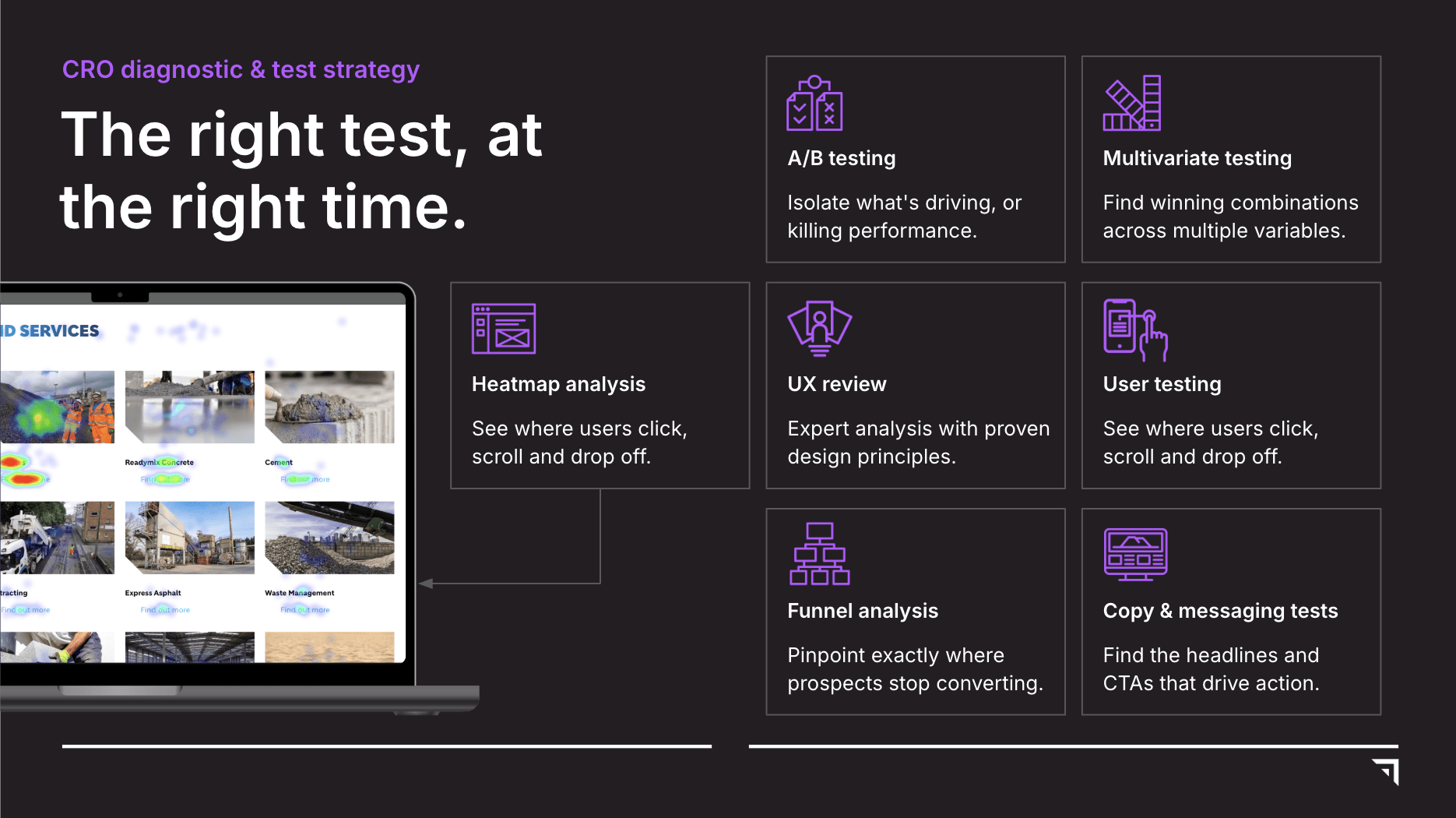
A B2B landing page needs to do serious persuasive work with a sceptical, time-poor reader who will scan before they read and leave the moment they’re confused or unconvinced.
Structure your pages around the questions a buyer is unconsciously asking, in order:
- What is this? Lead with a specific, outcome-led headline. Name the problem, the solution and the result in one sentence.
- Is it for me? Qualify the visitor immediately. Name your target customer, their company type and the problem you solve.
- Does it actually work? Lead evidence early. A client quote with a specific metric beats any amount of feature copy.
- How does it work? Explain your approach clearly. Buyers want to understand the mechanism, not just the promise.
- What do I do next? Make the ask clear and calibrated to intent level. Never make “talk to sales” the only option.
The fastest CRO win on most B2B pages is rewriting the headline. Most headlines describe the product, while the best headlines describe the outcome for the buyer. It requires no design resource, no developer and no A/B test to justify, just the willingness to be specific about the value you actually deliver.
Forms are where B2B website conversion is won or lost
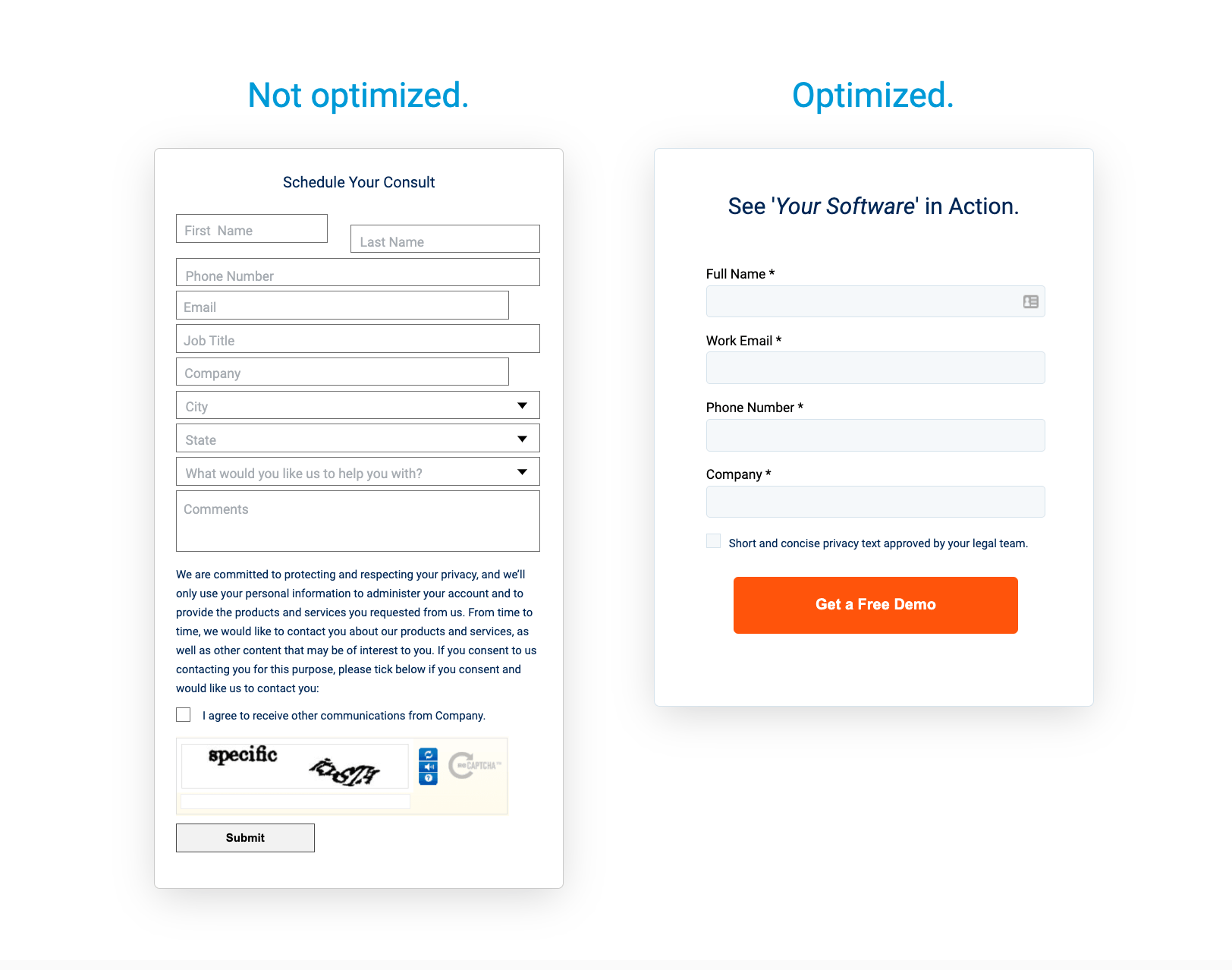
The form is where intent meets commitment, and where most B2B conversion rates collapse. There’s a genuine tension between the two most common approaches. Shorter forms produce more submissions but worse leads. Longer forms filter for seriousness but lose more visitors. The right answer depends entirely on your sales model.
If your sales team handles volume and has strong qualification skills, a shorter form makes sense. If qualification needs to happen before the first call, ask the qualifying questions in the form itself. And own that trade-off consciously, rather than defaulting to minimum fields out of habit.
A few principles that consistently improve form performance:
- Replace open text boxes with dropdowns where the answer set is finite (company size, role, use case)
- Remove fields that exist for internal reporting rather than customer experience
- Add inline validation so visitors don’t discover errors only on submission
- Below the submit button, set clear expectations: what happens next, how quickly they’ll hear back, and who will contact them
- For longer forms, consider a two-step structure: capture name and email first, then ask qualifying questions. Once someone has completed step one, completion rates for step two rise significantly
Qualified conversations convert. Design your forms around that, not around submission volume.
Building trust that actually converts
B2B trust is earned in layers. As a visitor scrolls, they’re working through a sequence of questions, whether consciously or not:
- Have companies like mine used this? Logo walls, named case studies and sector-specific proof all answer this.
- Do real people vouch for it? Named testimonials with job title, company and a specific outcome carry far more weight than anonymous quotes. For instance, ‘It’s transformed our process’ tells a buyer nothing. But ‘We reduced onboarding time by 40% in the first quarter’ tells them everything.
- Is this company credible? Press mentions, awards, analyst recognition and years in business all contribute.
- What if it goes wrong? Guarantees, SLA commitments, cancellation policies and security certifications address the risk side of the decision.
- Will I be stuck? Migration support, onboarding processes and dedicated success contacts remove the fear of a costly transition.
Proof that’s buried in a footer or hidden on a standalone page won’t convert anyone. Place it where the doubt lives.
Lead scoring and the handoff to sales
A lead that converts on your website is only half the job. B2B CRO extends to what happens next, because the speed and quality of the handoff from marketing to sales is often where high-intent leads are lost.
Build a lead scoring model
Assign points for firmographic fit (company size, industry, geography) and behavioural intent (pages visited, content downloaded, email engagement). Set a threshold score for sales-qualified leads and route them immediately to a rep. Everything below that threshold goes into a nurture sequence, not a sales queue.
Speed matters more than most teams appreciate. According to Harvard Business Review, companies that respond to inbound leads within an hour are nearly seven times more likely to qualify that lead than those who wait even 60 minutes longer. A prospect researching actively is often speaking to multiple vendors at once. The first credible, personalised response wins disproportionately.
Connect your web analytics to your CRM
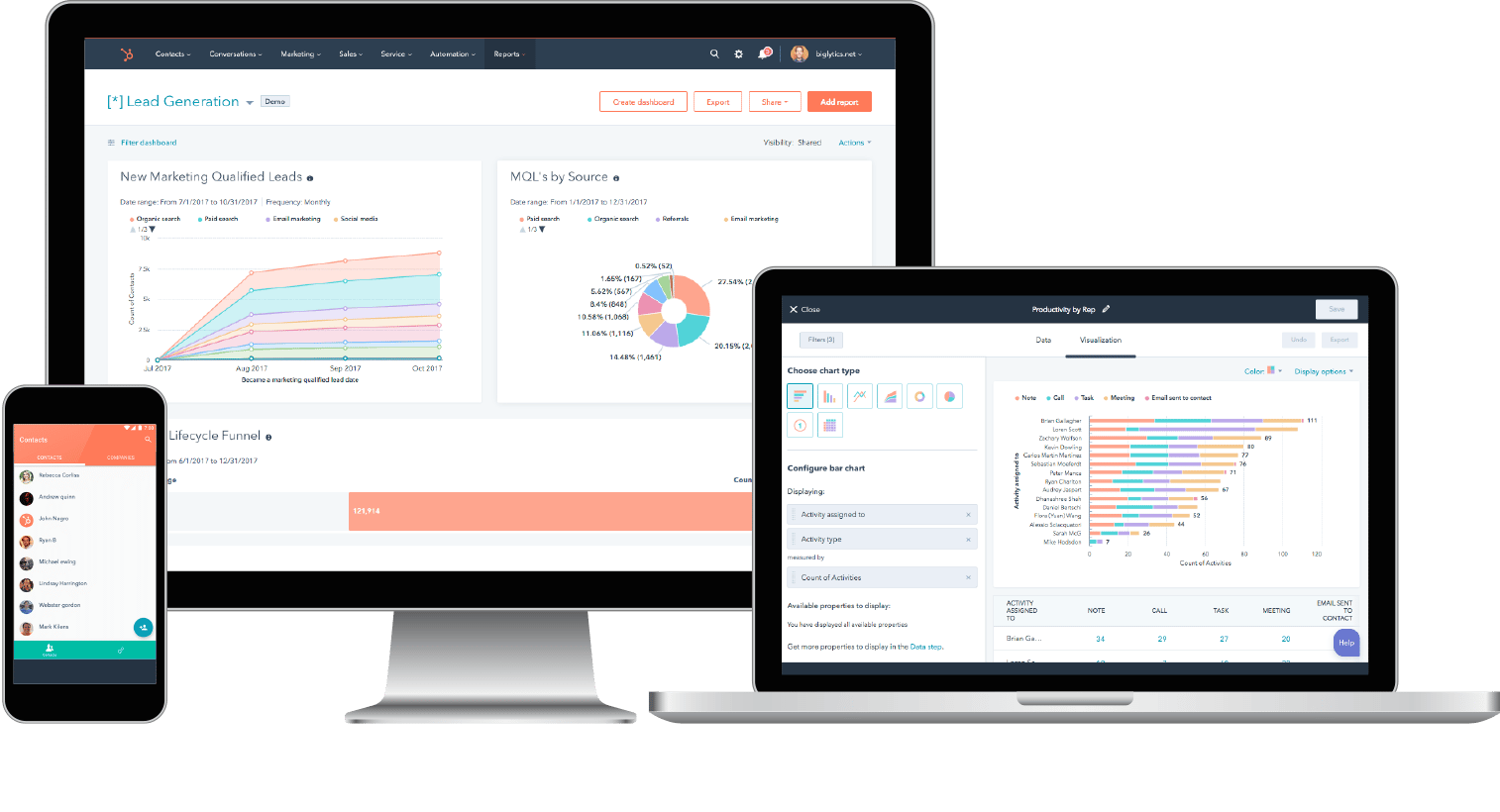
Without this linkage, you’re optimising blindly. You’ll know what visitors do on the website, but not which actions predict revenue. Connecting these two data sources lets you answer the questions that actually matter. Which pages appear most often in the journeys of closed-won deals? Which content assets influence the pipeline? Where do the leads that close actually come from?
Measuring what matters in B2B CRO
Standard CRO metrics such as page conversion rate, bounce rate and time on page are just a starting point. In B2B, the metrics that matter most are further down the funnel.
- Lead-to-SQL rate: Of all form submissions, what proportion are genuinely sales-qualified? A rising lead-to-SQL rate means your CRO work is attracting better-fit visitors, not just more of them.
- SQL-to-opportunity rate: Of SQLs passed to sales, what proportion progress to an active opportunity? This surfaces handoff friction and qualification gaps.
- Influenced pipeline by content: Which pages, offers and content types appear most often in the journeys of closed-won deals? These are the assets worth investing in further.
- Time to first meaningful engagement: How long between a visitor’s first session and their first qualifying conversation? Shortening this is a direct CRO objective.
Track both leading indicators (traffic, engagement, form submissions) and lagging ones (MQLs, SQLs, pipeline, revenue). And because B2B buyer journeys are long and involve multiple touchpoints, use multi-touch attribution rather than giving all the credit to the last click.
Start where the drop-off is
B2B CRO rewards patience and precision. The wins are rarely dramatic – a refined headline here, a restructured form there, a better-placed case study. But the compounding effect of incremental improvements across a long buying journey is substantial.
Start where your data shows the most drop-off. If high-intent visitors are landing but not converting, look at trust and messaging. If they’re converting but not qualifying, look at form design and targeting. If they’re qualifying but not closing, look at the handoff.
Fix the right thing in the right order, and the results compound quickly.
Want to understand where your biggest conversion opportunities are? Hallam’s CRO audits identify exactly where high-intent traffic is being lost and what to do about it. Get in touch.