Most B2B marketing right now is a lead-generation problem masquerading as a strategy.
Every agency pitch I go into ends the same way. Someone senior, usually the person accountable for revenue, says a version of the same line: “The leads are one thing, but proving they are worth it is the hard part.” I heard it yesterday on a global pitch: I hear it constantly, and I’ll hear it again on the next one.
The problem is not the leads. It’s that a huge chunk of B2B is running the same tired playbook: spin up a campaign, capture form fills, chuck them over the wall to sales, and argue about quality. Marketing is asked to prove value inside a system built to count leads, not to build businesses. And when the numbers don’t move fast enough, marketing is the first thing questioned.
That’s the system most teams are stuck in. It’s why we built Better B2B.
The MQL machine
Here is the hot take most agencies will not say out loud: the lead gen obsession in B2B is killing marketing teams.
We see it in nearly every client we onboard. A marketer, often solo or in a team of two, works for a sales-led business where the CEO, the board, and every decision maker came up through sales. Marketing exists to feed them a steady diet of MQLs. The KPI is lead volume. Lead quality becomes a fight. Brand gets cut because it cannot be attributed to a closed deal in a 30-day window. Eventually, the marketer burns out and leaves, with their replacement inheriting the same broken setup.
I have sat in those boardrooms. I have watched FDs question a brand budget while nodding along to a sales team asking for more headcount. And the data backs it up. A third of UK B2B marketers had their budgets cut this year, according to Marketing Week’s 2025 research. Over half say senior leadership fails to understand marketing beyond lead generation, and for more than a quarter, lead volume is the only metric of success.
The biggest misunderstanding in B2B marketing
At any given moment, 95%of your potential buyers are not ready to buy. Only 5%are. This is the finding the LinkedIn B2B Institute calls the 95-5 rule, drawn from research with the Ehrenberg-Bass Institute. Companies buy computers once every four years. They change their banking services every 5 years. Most of the time, most buyers are out of the market. They will be in-market eventually, just not today.
Now look at how most B2B marketing budgets are spent. Paid search. Retargeting. Gated content. Demo forms. Almost all of it is designed to catch the 5% who are ready to buy right now. Meanwhile, the 95%who will buy eventually get almost no attention.
This is the biggest misunderstanding in B2B marketing. Most teams are chasing a tiny fraction of their future market and ignoring the people who will actually make the decisions that matter six, twelve, and eighteen months from now. It is like optimising the checkout of a shop that 95%of your future customers have not yet walked into.
When buyers eventually do move in-market, they do not run a careful evaluation from scratch. They go with the brands they already remember. If you are not in their head before the search begins, you have already lost. This is the idea behind Hallam’s own positioning: we help B2B brands be chosen before the search begins. Because that is where the decision is actually made.
None of this means lead gen is worthless. It means it is the last 5% of the job, not the whole job. And yet it is where most marketing teams are being forced to spend most of their budget, on the easy-to-measure, bottom-of-the-funnel tactics.
The solo marketer is carrying too much.
The human cost of all this falls on the solo marketer or the two-person team. They are expected to run brand, demand, website, content, events and CRM while fielding questions from a sales director who thinks marketing is “broken” because last month’s webinar only had 40 sign-ups.
We have worked with dozens of these. They are some of the smartest, most commercially minded marketers I know, and many of them are exhausted. Marketing Week’s latest career survey found that 58% of UK marketers feel overwhelmed, and half are emotionally exhausted.
B2B marketing can be a lonely job. You are often the only person in the room thinking about the market the way you do. The only one who sees why the sales team’s “quick website tweak” will tank organic traffic. The only one trying to explain why brand matters when the FD only wants to see the pipeline. Being right on your own, repeatedly, is exhausting.
Community is where the decisions are made.
When we say community-led growth, we do not mean the agency fluff version. We mean the recognition that the most valuable place a B2B marketer can be in 2026 is in the rooms where buyers and their peers actually talk.
Slack groups, WhatsApp chats, small events. That is where the shortlist gets built.
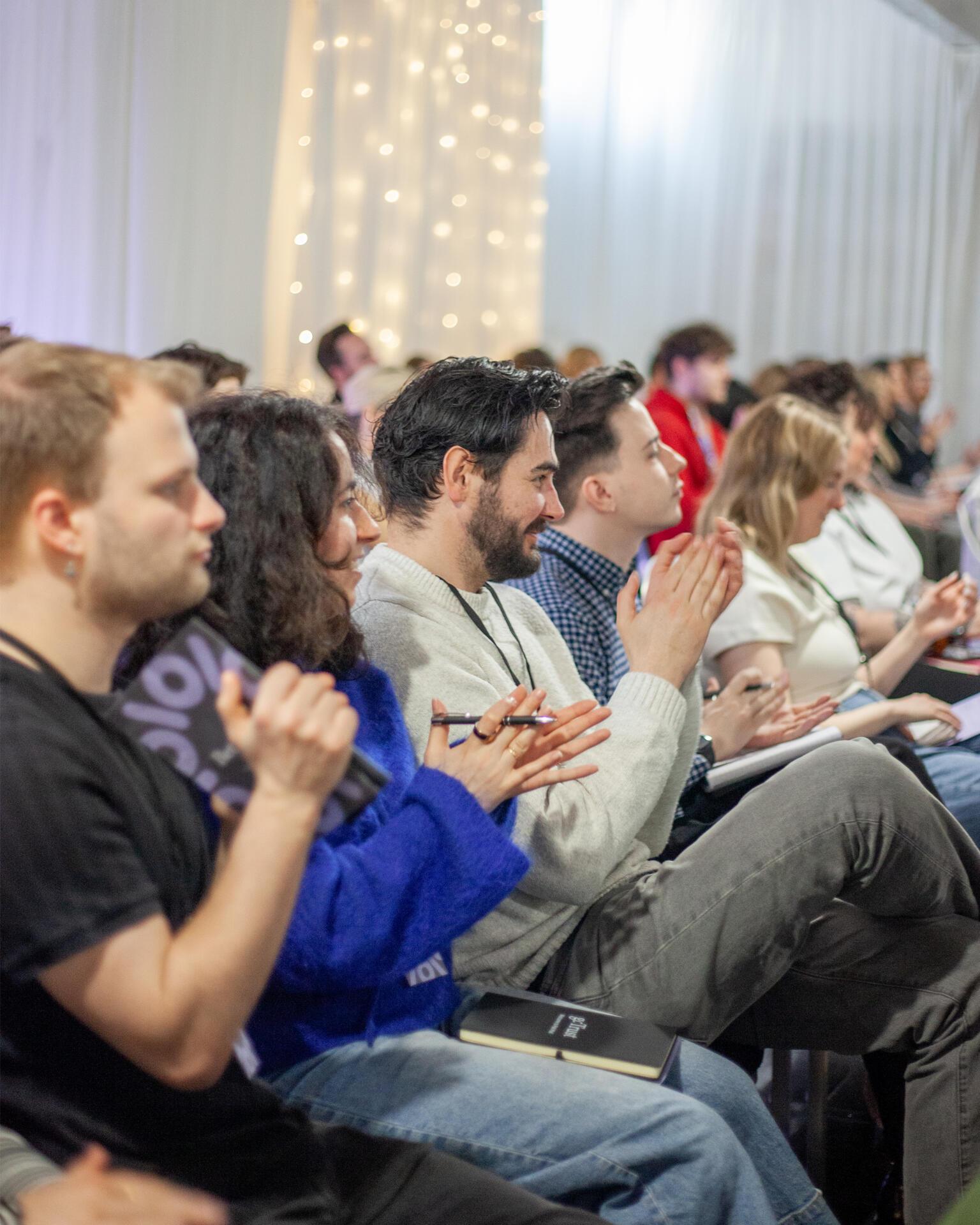
The numbers are moving. CMX’s 2025 Community Industry Report found that 85% of organisations said community is core to their mission. Forrester’s 2025 events research showed the fastest-growing event type is small, in-person gatherings. Not 2,000-person trade shows. Fifty people in a room, having a proper conversation.
Most B2B marketers know this intuitively. They know their best leads come from referrals. They know a good conversation at an event is worth more than paid social. They just cannot get their board to fund it, because it does not fit neatly into a monthly MQL report.
Why we launched Better B2B
Better B2B did not start as a plan to build a community. It started as a reaction to something we kept seeing in client after client: smart marketers stuck in businesses that did not understand what marketing was actually for, doing the job alone, with no obvious place to go for help that was not a sales pitch from another vendor.
Jake Third, our CEO, had the idea and the name. Hiring Amber Carnegie as Community Marketing Manager meant we could actually build the thing. A lot of us at Hallam have rolled up our sleeves to get it off the ground. But the thing itself belongs to the people in it.
The name matters too. We called it Better B2B because Hallam is a B Corp, and we genuinely believe in doing things better. Better for clients, better for the people who work with us, better for the industry. The logo is a circle made of 1s and 0s, designed to make the same point: behind the data are people. Marketing runs on numbers, but it does not stop there. It is a craft done by humans, for humans, in a world that would rather reduce it to a dashboard. The circle is what happens when those people come together.
It is a free community for B2B marketers who want to do better work in harder conditions. No paywall, no gated whitepapers, no hidden agenda. It exists because the best conversations we have ever had about B2B marketing have not been in conference rooms or on webinars. They have been in pub corners after events, on WhatsApp threads between people who get it, and in the unplanned half hour at the end of a meeting when everyone has stopped performing and started being honest.
We ran our first in-person event, Better B2B North, in Manchester last week. A second, Better B2B South, is coming in September. We also published our own 2026 B2B Marketing Decision-Maker Survey to sit alongside the rest of the research: 44%of B2B decision-makers plan to increase brand investment next year, 73% say sales cycles are lengthening, only 5% have more budget. The system is under pressure. The people inside it need somewhere to talk, think and compare notes without being sold to.
If you are trying to do good work in a system that keeps asking the wrong questions, come and join us.