
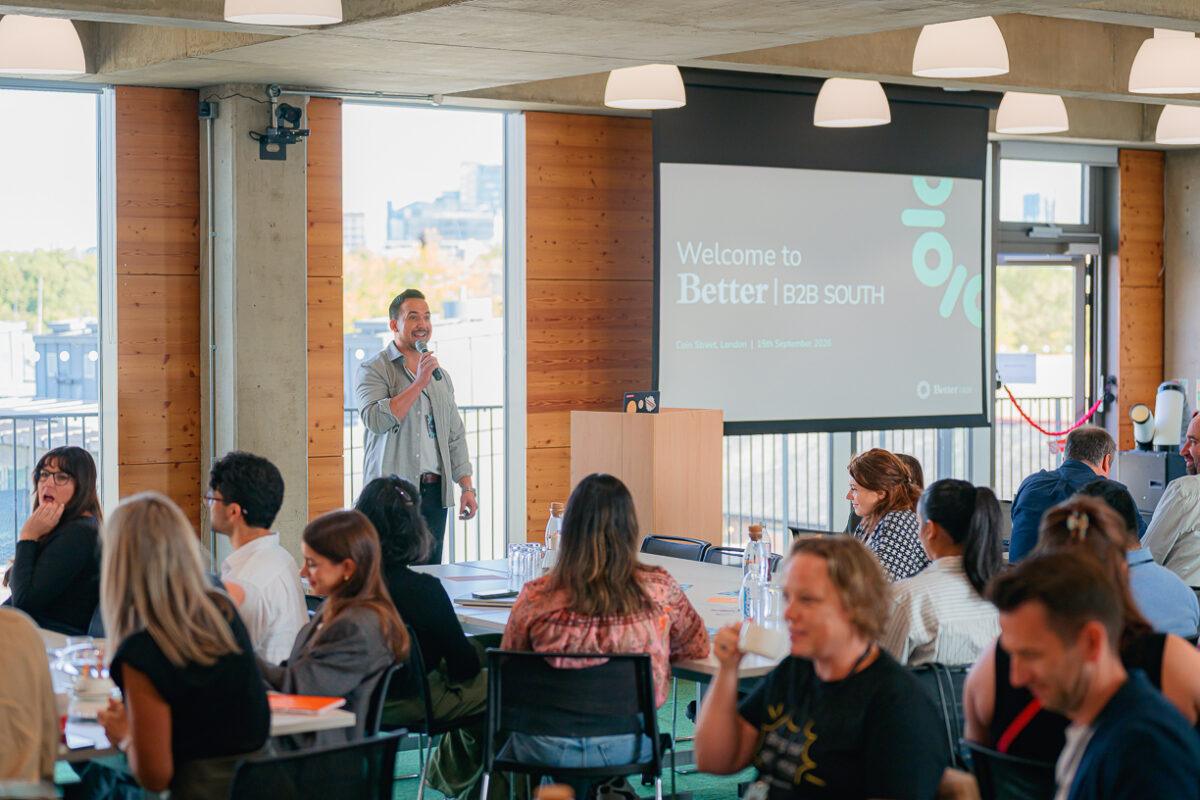
When over 100 B2B marketers gathered at Coin Street Conference Centre in London for Better B2B South on September 15th, you might have expected dramatic, sweeping statements around SEO, MQLs and AI rewriting the marketing playbook entirely. That isn’t what happened.
Across a full day of keynotes, panels and conversations about AI, search, creativity, measurement and the changing buyer journey, a much more practical message came through: The playbook isn’t broken. It’s changing.
That was one of the clearest themes to emerge from Better B2B South. At Hallam, these are conversations we’re having with clients every day. Better B2B gives us another opportunity to step back from individual campaigns and ask a bigger question:
What actually needs to change about the way we do B2B marketing?
Better B2B is the community Hallam launched in 2025 for ambitious B2B marketers. And across the talks and two panel discussions, three themes came through particularly clearly, each with implications for how B2B teams should approach their strategy next.
1. Search is changing: visibility is bigger than rankings
Search hasn’t disappeared, but it is expanding. B2B brands now need to show up in far more places than a standard Google search engine results page.
Search and brand can no longer work in isolation
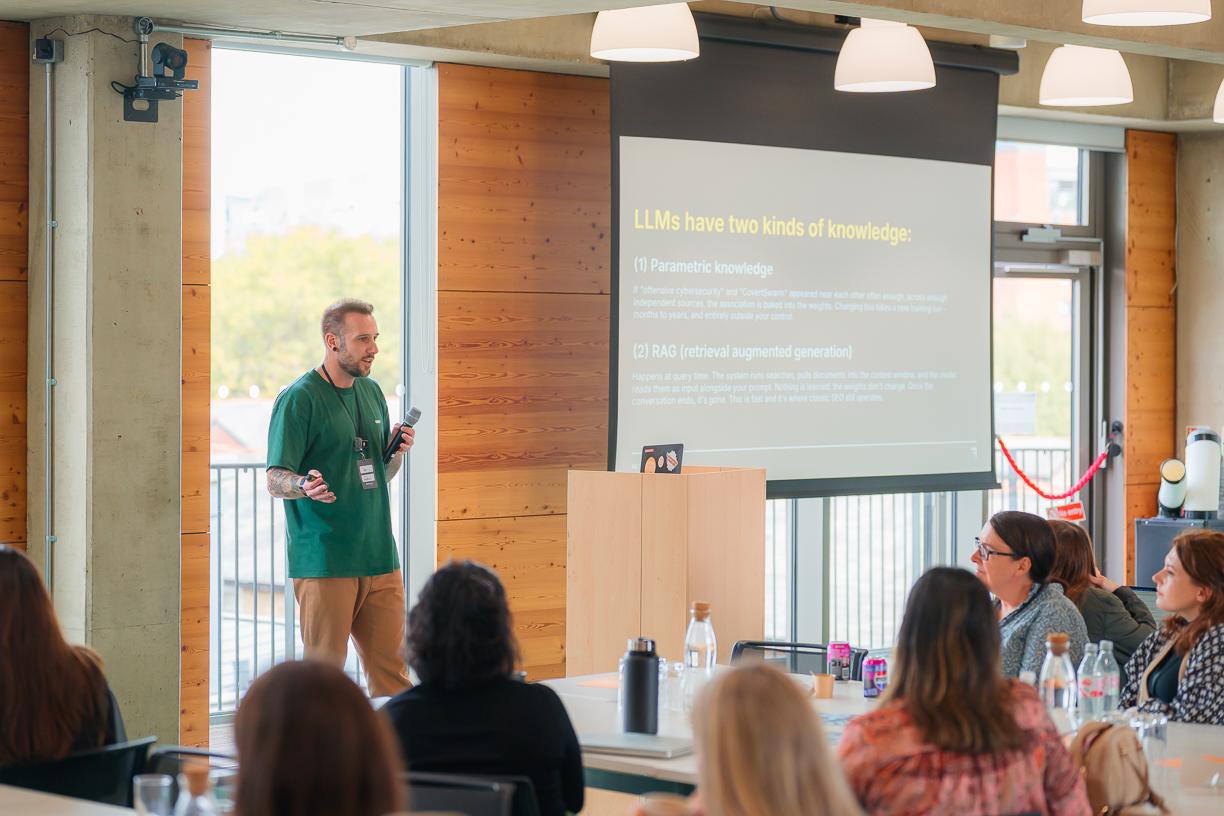
Ben Wood, Hallam’s Performance Director, opened this thread with ‘The Great Recoupling: When Search and Brand Collide’. His argument was straightforward: search and brand cannot operate in silos anymore. Standalone keyword rankings don’t prove whether a brand is genuinely visible to buyers.
Consider how a modern B2B buyer builds a shortlist. They ask an AI tool for options or consult a peer in a private Slack group. They scan reviews, monitor communities, or remember a name they’ve repeatedly seen on LinkedIn. By the time they type anything into a search engine, the shortlist is usually already decided.
You want your brand to be chosen before the search begins. High visibility doesn’t always require a direct click. It happens when you’re cited in an AI summary, recommended by a peer, or referenced in a trade review.
Technical SEO still matters, but it’s part of a wider picture

In ‘Beyond SEO: Winning Visibility in Modern Search’, panel members Radina Ivanova, Rejoice Ojiaku, Flo Guerrouani, and Billie Geena McNeilly were clear: technical SEO and structured content remain essential foundations.
However, traditional tactics need adjusting. Direct recommendations and online communities carry far more weight than typical SEO strategies account for and that’s a gap worth closing.
Personal brands drive corporate visibility
This reality made Shoaib Ahmed’s session on LinkedIn personal branding especially relevant. In B2B, individual employees and personal accounts are a massive part of how buyers encounter and remember companies. Shoaib backed the commercial case with concrete figures and real-world examples, carrying his practical advice through to the closing Ask Better B2B AMA.
Stop asking “Is SEO dead?” Start asking “What does visibility mean today?” For most B2B brands, standard ranking reports only capture a fraction of real market presence.
2. Measurement needs to reflect actual commercial impact
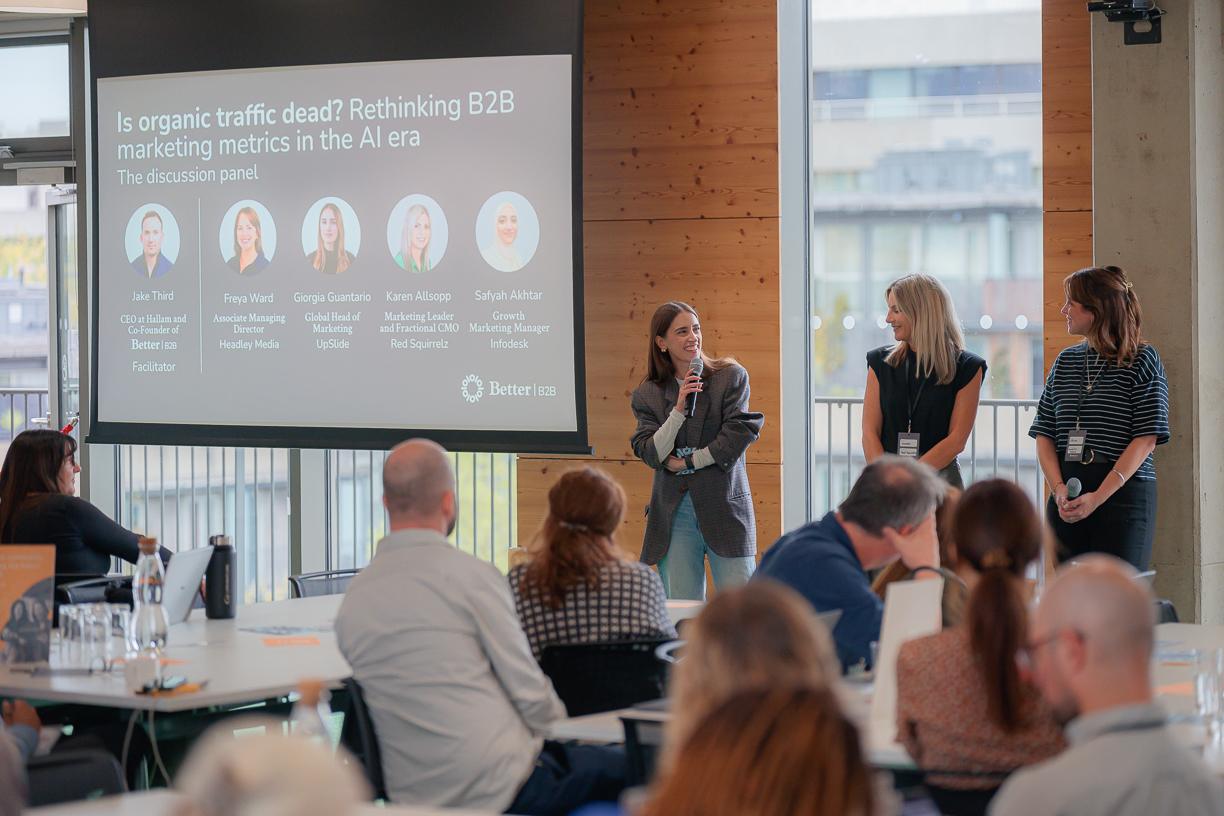
The opening panel tackled a deliberate provocation: ‘Is Organic Traffic Dead? Rethinking B2B Marketing Metrics in the AI Era’. Speakers Jake Third, Freya Ward, Giorgia Guantario and Karen Allsopp didn’t dismiss traffic entirely. They questioned what we are measuring, and why.
Traffic shows arrivals, not buying intent
Web traffic tells you people landed on a page. It won’t tell you if they are the right account, whether you influenced their thinking, or if the visit will ever turn into revenue.
Disqualified MQLs are valuable data points
MQLs received similar scrutiny. Why are sales teams rejecting so many? What happens after handover? Do these leads indicate genuine buying intent?
One sharp point stood out: a disqualified MQL isn’t automatically a marketing failure, it’s feedback. If sales consistently rejects leads for identical reasons, the data is telling you something. Your audience targeting might be off, campaign messaging could be misaligned, or the team is optimising for lead volume over deal quality.
Align definitions directly with Finance

Giorgia highlighted the shift toward tracking qualified pipeline and generated revenue, requiring tight alignment with sales operations. She also brought up a point about Finance that gets ignored far too often.
Marketing must stand behind its numbers. If marketing reports one revenue figure and Finance records another, credibility disappears instantly. Fix this by agreeing on definitions upfront and maintaining absolute clarity on data sources.
Every growth model requires a tailored metric framework
No panelist offered a neat, single metric to replace the MQL. That missing one-size-fits-all answer was the entire point. The right reporting model depends entirely on your growth strategy, business structure, and commercial goals.
Measurement works best as a hierarchy built around commercial priorities:
- Business outcomes
- Commercial impact
- Marketing contribution
- Leading indicators
Traffic, rankings, and form fills still belong in that bottom layer as leading indicators. They just shouldn’t occupy the whole dashboard.
3. Technology changes. Human behavior doesn’t.
AI changes search behaviour and marketing execution. It hasn’t altered the fundamental need to understand buyers or create memorable work. If anything, distinctiveness matters more now.
Distinctiveness is a commercial lever
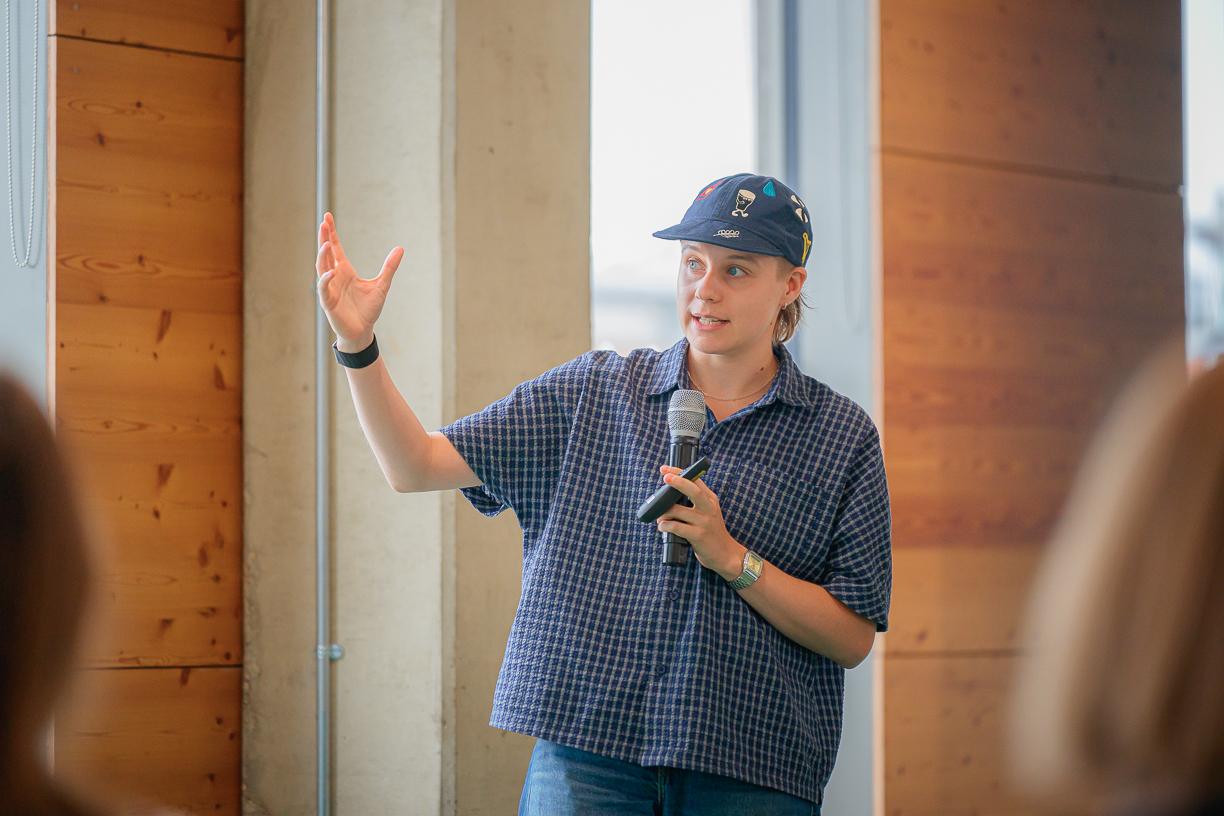
Beth Marchant, Strategy Director at System1, outlined this in ‘Unlocking the Creative Dividend’. B2B marketers need to build emotive, memorable brands rather than pouring every pound into short-term performance tactics. Distinctiveness isn’t a design luxury, it’s a commercial lever.
When AI makes average content quick and cheap to produce at scale, “competent” stops being a differentiator. Distinctive work is what actually gets remembered.
Replace static personas with real buyer insights

Hayley Phipps, B2B Marketing Manager at Samsung Europe, challenged a common industry default. In ‘RIP to Static Personas (They Were Boring Anyway)’, she advocated replacing fictional, assumption-heavy personas with continuous buyer research. That research comes from practical, real-world sources: customer reviews, sales calls, community threads, and direct interviews.
This changes how teams should view AI. AI cannot fix weak audience research. Feed it outdated assumptions and it simply scales those mistakes faster. Quality output requires quality buyer inputs.
Insights mean nothing without brave execution
Brian Macreadie, Head of Marketing at Addleshaw Goddard, asked the necessary follow-up in ‘Let’s Do It: How to Win Support for Brave B2B Campaigns’. He walked through the firm’s partnership with the RHS Chelsea Flower Show, an unconventional move for a corporate law firm, to show how marketers can win internal buy-in for creative, standout work.
Good data and audience research aren’t enough on their own. You still need the courage to execute something unique with those insights.

What this means for your B2B strategy
Look at these three themes together and a clear pattern forms. The fundamentals of good marketing haven’t become obsolete. But the environments around them have changed, which means the way we measure, execute and apply those fundamentals needs to change too.
That means moving beyond the metrics and processes we’ve traditionally used as proxies for marketing effectiveness.
From traffic to visibility.
It’s no longer enough to know how many people reached your website. We need to understand whether our brand is showing up in the places our target buyers are actually looking, and whether we’re becoming more visible and relevant along the way.
From MQL volume to what happens next.
Generating a lead is only the beginning. The more useful question is what happens after handover: which leads progress, which are rejected, why they’re rejected, and what that tells us about our targeting and messaging.
From AI efficiency to audience understanding.
AI can help us produce more, and faster. But that doesn’t automatically make the work better. The advantage comes from understanding the person on the other side of it well enough to know what they need, what they care about and what will actually be useful.
From safe benchmarks to memorability.
A campaign can tick every performance box and still disappear without a trace. As feeds become more crowded and AI makes content production easier, being remembered becomes increasingly valuable.
The opportunity isn’t to throw out the B2B marketing playbook.
It’s to make it bigger.
Keep the conversation going
Better B2B South was never intended to be a conference where the conversation stopped when the final speaker left the stage.
Some of the best discussions happened between sessions, over coffee and in the closing Ask Better B2B AMA. When marketers could challenge ideas, share what they’re seeing in their own businesses and learn from each other.
That’s really the point of Better B2B.
The B2B landscape is changing quickly, and there isn’t a single playbook that has all the answers. The most useful thing we can do is keep asking better questions, sharing what we’re learning and figuring out what works together.
And, importantly, do a bit of good while we’re at it. Thanks to everyone who joined us, we raised £400 for Mind in the City, Hackney and Waltham Forest, supporting mental health across local communities in East London.
Because the conversation about the future of B2B marketing shouldn’t end when the event does.
Join the Better B2B community and keep the conversation going.