

This may be a slightly uncomfortable truth for those of us who’ve built careers in a discipline where technical optimisation is king, but the mechanism that ultimately decides whether an AI recommends you isn’t the same. It’s mental availability, made computational. And that changes what we should actually be doing on a day to day basis.
The internet is now cluttered with AI slop
Over the last twelve months I’ve witnessed a proliferation in agentic AI usage across marketing teams. Teams are building agents to run full SEO audits, building integrations to act on what it found and publish through their CMS.
Much can now be handled without human intervention: technical SEO audits, content audits, competitor keyword analysis, content strategy development, and writing and publishing content via API. I certainly wouldn’t recommend handing over control fully to an agent, but technically it is now possible to do so.
As a result, we’re seeing the volume of content published on the internet exploding. Ahrefs analysed 900,000 newly created web pages and found 74.2% contained AI-generated content, though only 2.5% were pure AI with no human involvement, and 71.7% were a human-AI mix. AI-generated articles made up 49.9% of everything published online in Q1 2026.
Technical optimisation is no longer a differentiator
As a result of the improved technology we now have at our disposal, a model can crawl your site, diagnose the issues, write the fixes and ship them. The result is that clean technical execution is becoming less of an advantage. It’s the bare minimum requirement for indexing and retrieval.
As a result, AI systems are now leaning much harder on elements brands don’t own and can’t easily manipulate – which I’ll go on to explain in more detail shortly.
AI models have a training problem
A quick bit of context on how we reached this point – the mechanics behind LLMs and their desire for new, original information.
AI models trained on their own output degrade over time. The industry term for this is model collapse, and the practical implication is that these systems have a structural, permanent appetite for genuinely new, human-generated information.
So the AI companies face exactly the question that internet users face – what’s worth trusting? And which signals can they lean on to assess which brands and individuals to trust amongst a sea of AI generated content?
Watermarking AI outputs
On 11 August, Anthropic published a support page confirming that Claude now embeds an invisible watermark in the text it generates.
Anthropic has signed the EU AI Act’s Code of Practice on Transparency of AI-Generated Content, which came into force on 2 August and requires providers to mark AI-generated or edited content in a machine-readable way. And although the driver is European regulation, Anthropic is applying it worldwide.
In terms of how it works, the model generates text by repeatedly choosing which word comes next. The watermark alters the source of randomness, so that across enough text the pattern of selections is statistically distinctive. You can’t see it as a human, it doesn’t change the meaning or readability, and it’s only detectable by someone holding the key that encodes it.
Because the pattern lives in the word choices themselves, it travels when you copy and paste, and it can persist through light editing. Heavy rewriting, paraphrasing, translating or running the output through a different model will degrade or destroy it.
Google has been watermarking across formats for years. OpenAI has had text watermarking capability for some time and has chosen not to ship it. Suno and Spotify are marking AI music. Substack, where you’re reading this, has integrated Pangram’s detection. LinkedIn has been testing a “seems like AI slop” button recently too.
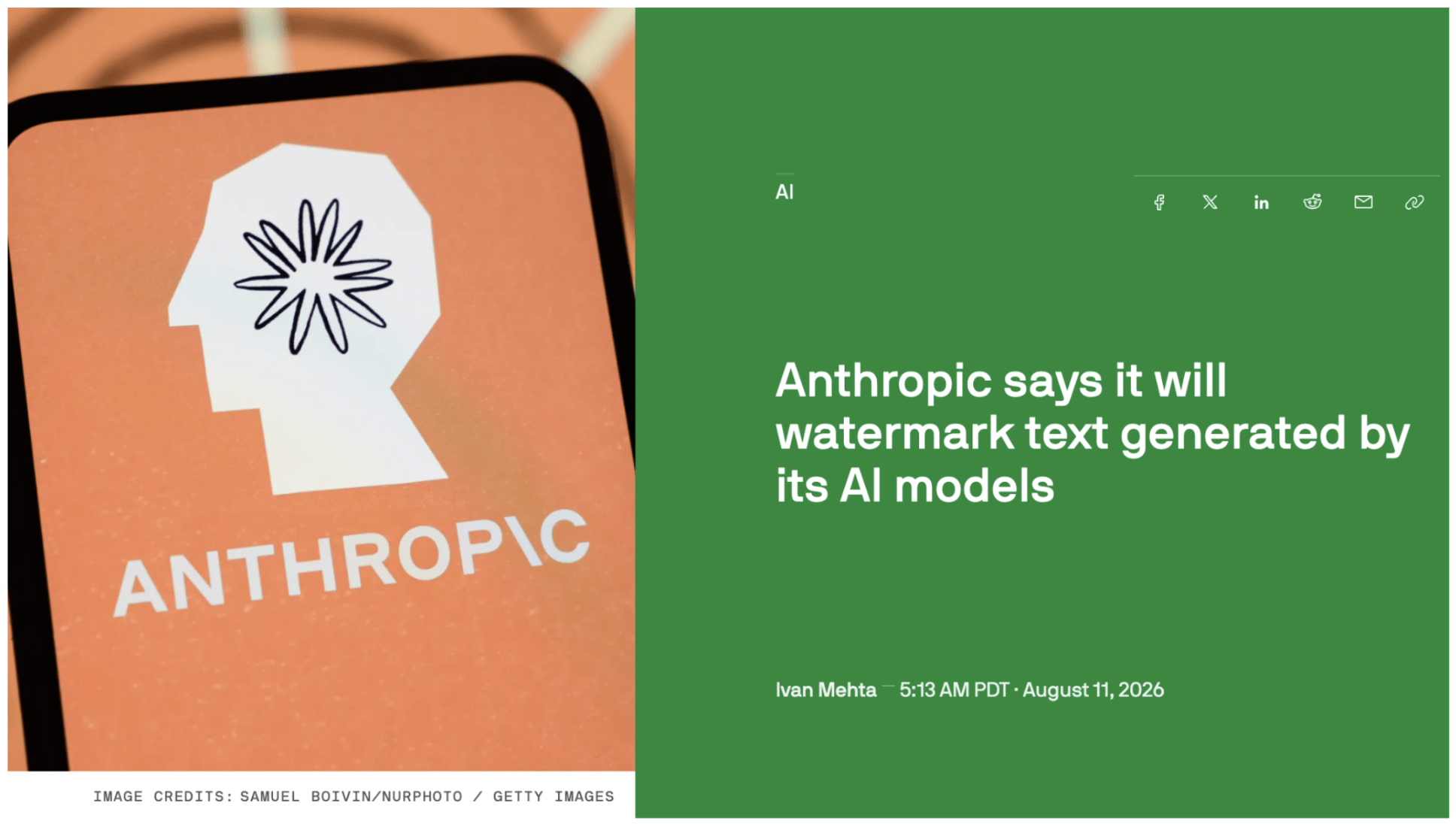
[Source: TechCrunch]
While watermarking answers did a machine write this? It doesn’t answer whether it is worth trusting. No file, tag, schema or watermark can answer it. The only thing that can is other people in places you don’t own.
This is where authority comes in.
The emphasis on authority started in 2012
Google has been trying to attach identity and expertise to content for over a decade. This began with the rollout of Authorship in 2012 (remember seeing author bios in the SERPs?), then a public push towards E-E-A-T, then the Helpful Content Update, in which Moz found winners and losers had near-identical domain authority but a meaningful gap in brand authority – essentially signaling Google were de-valuing classic optimisation tactics (links), in favour of classic brand authority signals (like brand search volume).
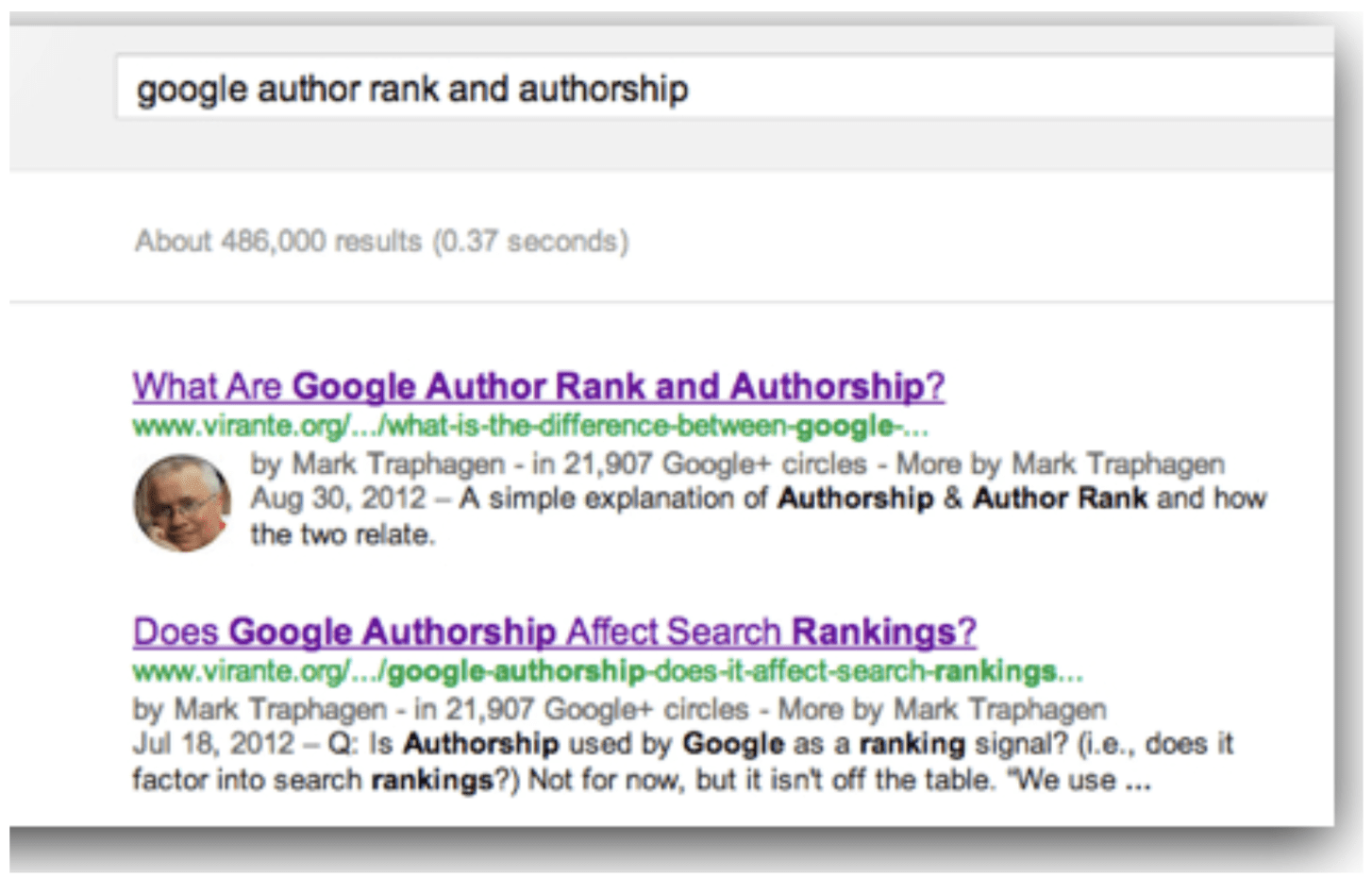
[Google Authorship example]
With the knowledge that AI can now produce plausible content faster and cheaper than anyone ever could, and AI tools can in theory handle most of the technical optimisation that used to separate good sites from bad. The volume of competent-looking content is effectively infinite, and the signals that used to distinguish quality are the exact signals that are now trivial to manufacture.
As a result, LLMs (and search engines alike) are leveraging the signals that are much more difficult to influence – what independent, credible humans say about you, in the places you don’t own.
Remember Google telling people to eat rocks and glue cheese to pizza? That was an AI Overview surfacing unfiltered Reddit comments. Funny at the time? Yes. But a sign that these systems are outsourcing a level of moderation to humans. When AI systems need judgement about what’s trustworthy, they reach for credible human consensus.
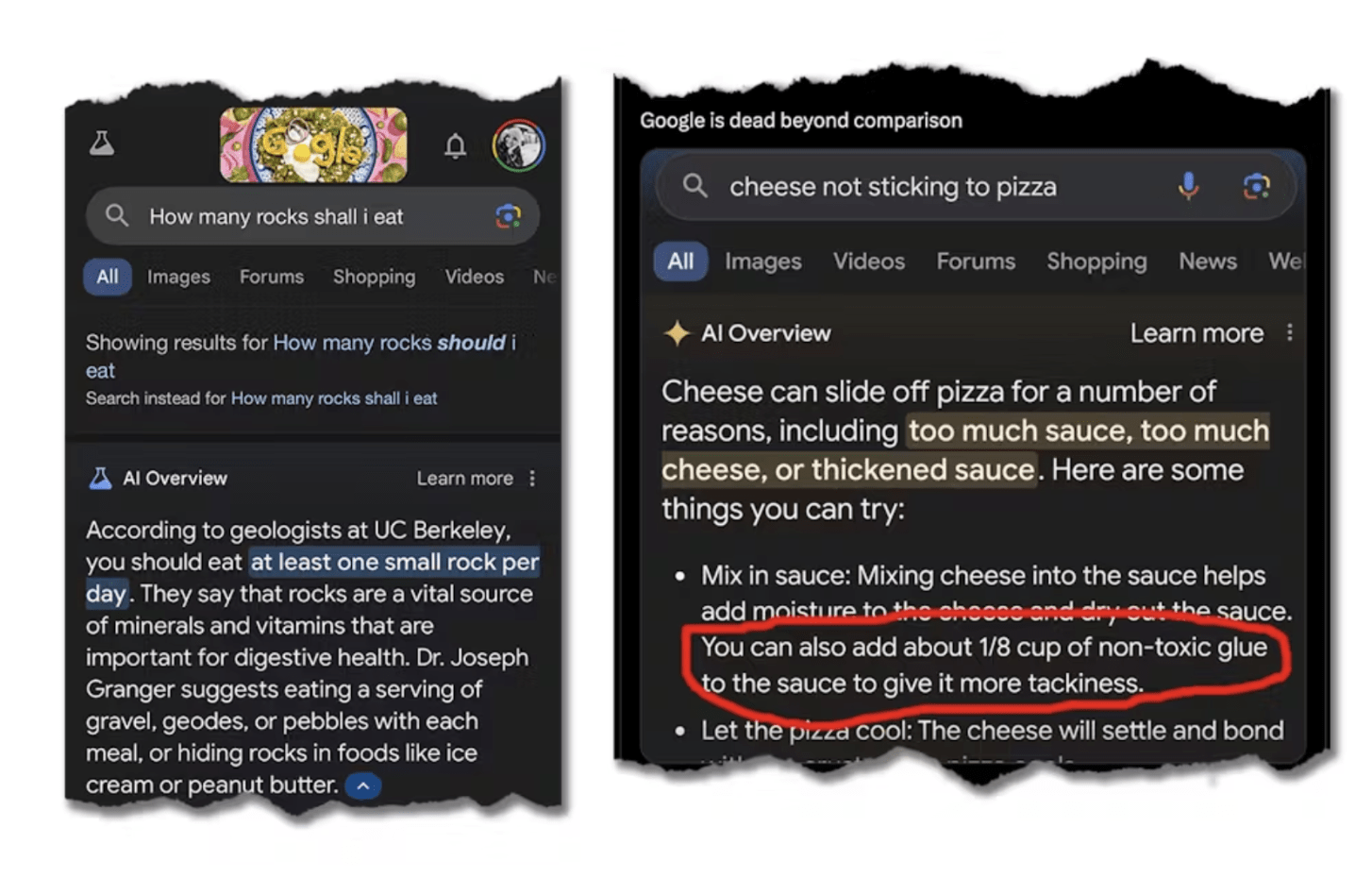
[Google’s early attempt at AI Overviews]
How LLMs assess authoritativeness
Large language models have two kinds of knowledge
- Parametric knowledge is what’s baked into the model’s weights during training. If “offensive cybersecurity” and “CovertSwarm” appear near each other often enough, across enough independent sources, that association is in there. Changing it requires a new training run – which takes months to years, mostly outside your control.
- Retrieval (RAG) happens at query time. The system runs searches, pulls documents into the context window, and reads them alongside your prompt. Nothing is learned. The weights don’t change, and when the conversation ends, it’s gone.
In a recent article, Suganthan Mohanadasan spent time investigating the raw network traffic underneath ChatGPT’s answers, and found that the model writes brand names into its own first search query before it fetches a single page. In 21 of 27 conversations, that first query contained brands the user had never mentioned. Ask for the best AI note-taking app and the query it wrote for itself already contains Granola, Notion AI, Otter, Fireflies.
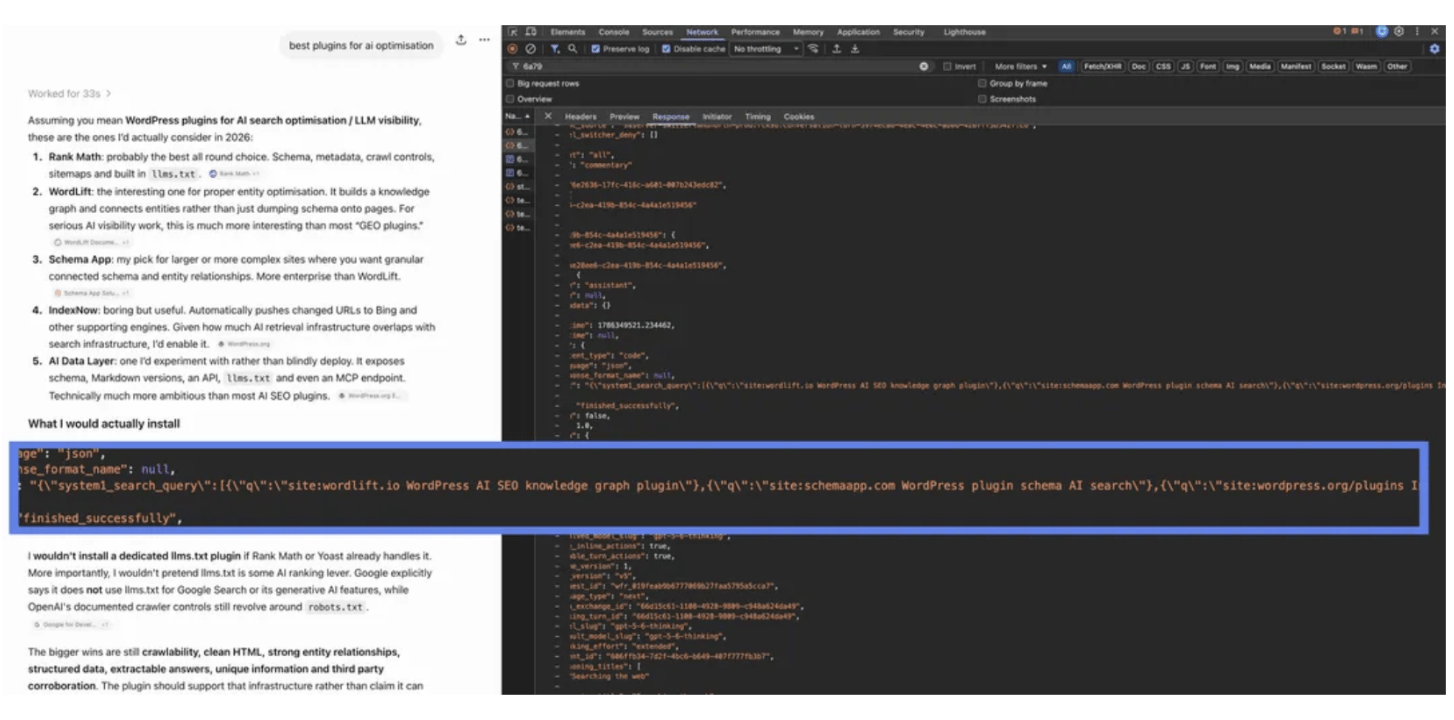
[Source: Suganthan Mohanadasan]
Brands named in the model’s own query reached the final answer 68.9% of the time. Brands that were only fetched during the search made it 2.1% of the time. Of 3,554 retrieved pages, only 3% earned a place in an answer. Roughly 33 times the difference between being known and being retrieved.
Search engines and LLMs operate differently
| Search engines | LLMs | |
|---|---|---|
| Processing | Deterministic | Stochastic |
| Knowledge structure | Page-centric | Concept-centric |
| Source attribution | Transparent | Opaque |
| Query model | Keyword | Conversational |
| Trust mechanism | Backlinks | Association frequency |
Deterministic vs stochastic. Search gives the same output for the same input, which is why an entire industry could be built on rank tracking. Models are probabilistic. Ask for the best provider in your category five times and you’ll get five overlapping but different lists. Anyone selling you a one-off AI visibility audit is selling you a snapshot of a coin toss.
Page-centric vs concept-centric. Search indexes documents, ranks documents, sends people to documents. The unit of value is a URL. Models don’t hold your page – they hold the relationships between ideas. Which is why a brand with a thin website and a large industry presence can out-perform a brand with a beautiful site and no reputation.
Transparent vs opaque. You can see who ranks, who links, and reverse-engineer why. Nobody outside the labs can see the weights. We’re all working from observed behaviour and correlation studies, and we should be honest with our stakeholders about that. Anyone who tells you they know the algorithm is guessing with more confidence than the evidence supports.
Keyword vs conversational. People used to compress an intent into two or three words they thought the machine would understand. Now they search using full, conversational sentences.
Backlinks vs association frequency. Search decided trust through links, which was gameable, which is why so much of our industry existed. Models decide trust through how often, and in how many independent places, your name appears next to the thing you want to be known for. You can’t build that quickly with a link campaign. It accumulates.
Which factors correlate with strong LLM visibility?
Every factor that correlates strongly with AI visibility is an off-site brand signal. This data has been pulled from multiple sources, including Ahrefs, SEMrush, Profound, Zyppy, and is summarised in the fantastic resource from Machine Relations, who have done a great job correlating various studies around how organizations earn and hold citations from AI answer engines.
In terms of headlines – of 75,000 brands in one study, YouTube mentions had around 0.737 correlation with AI visibility, branded web mentions had around 0.66 – 0.71, branded anchor text 0.527, branded search volume 0.392. While backlinks – the signal our entire industry was built on – only 0.218 correlation.
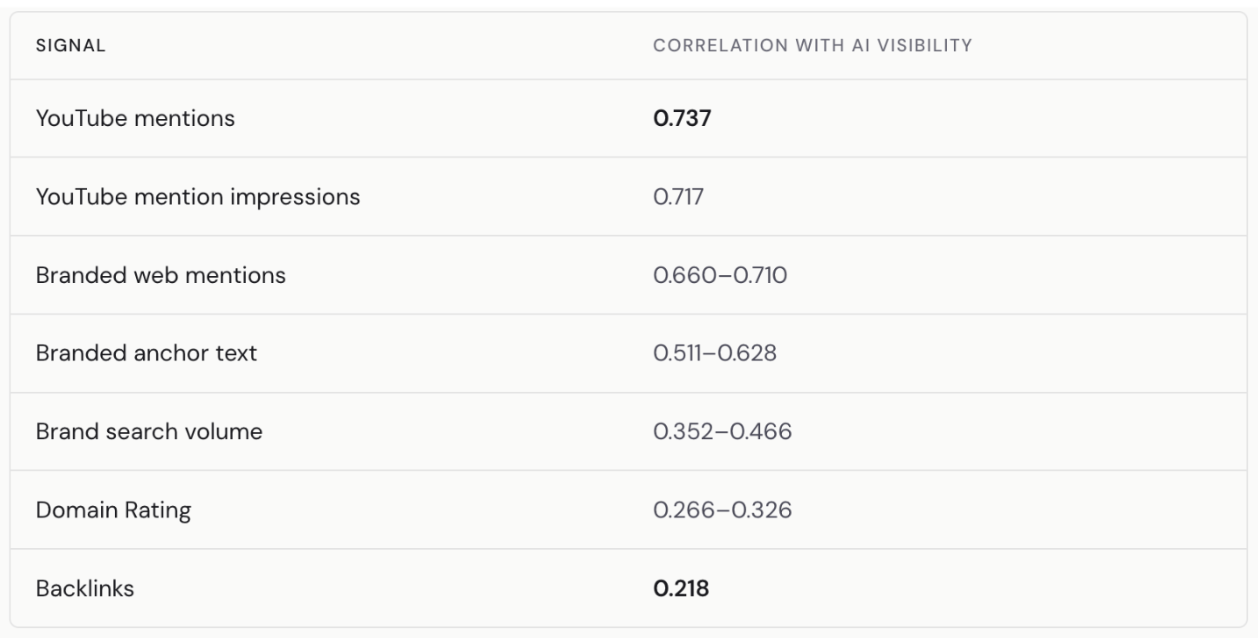
[Source: Machine Relations]
We know that correlation isn’t causation. Well-known brands accumulate mentions and AI visibility, and brand strength is a plausible common cause of both. These are not specific levers you can pull, but the direction is consistent enough across independent datasets to see the pattern in how brands can start to build visibility in AI.
What doesn’t help grow visibility in LLMs
- LLMs.txt. Ahrefs analysed 137,210 domains and found 97% of published llms.txt files received zero requests in a month. Of the small share that did get traffic, the single largest category of requester was SEO audit tools checking whether the file existed. (Ahrefs, June 2026)
- AI-specific technical work generally. In May, Google published its first official guidance on this and was unusually direct. The guide explicitly says you don’t need llms.txt, AI-specific markup, or content chopped into machine-sized chunks – and warns against seeking inauthentic brand mentions. (Google Search Central, May 2026)
- Rankings alone. This is the one that surprises people the most. Ahrefs found only 38% of cited pages also ranked in the top 10 for the same query – down from 76% in their mid-2025 analysis. The rest split almost evenly between positions 11–100 and outside the top 100 entirely. (Ahrefs, February 2026). With the query fan-out mechanism deployed by LLMs, these models judge you on whether you help answer a cluster of related questions, not whether you hold one position.
A practical framework
Given what we’ve discussed so far, if the old era of search was about out-optimising your competition, this one is about out-thinking your competition.
In the era of search engines, you could out-execute a better brand with links, better technical work and more content. However, in LLMs, association frequency can’t be optimised as easily.
The next era of search requires a much broader approach, one that spans every element of your marketing strategy, focused on building a reputable brand that is seen as a leading authority in your category by both humans and robots alike.
To achieve this, we use a model at Hallam called Total Authority™ to ensure our clients are approaching AI search from a truly holistic perspective, which will drive much more impact over time. This spans three areas:
- Category authority – defining the narrative for your brand. What is the thing you want to be the answer to?
- Content authority – being the canonical reference in your space. The explanations people and platforms actually rely on.
- Distributed authority – earning credible external validation. Proof in the places you don’t own.
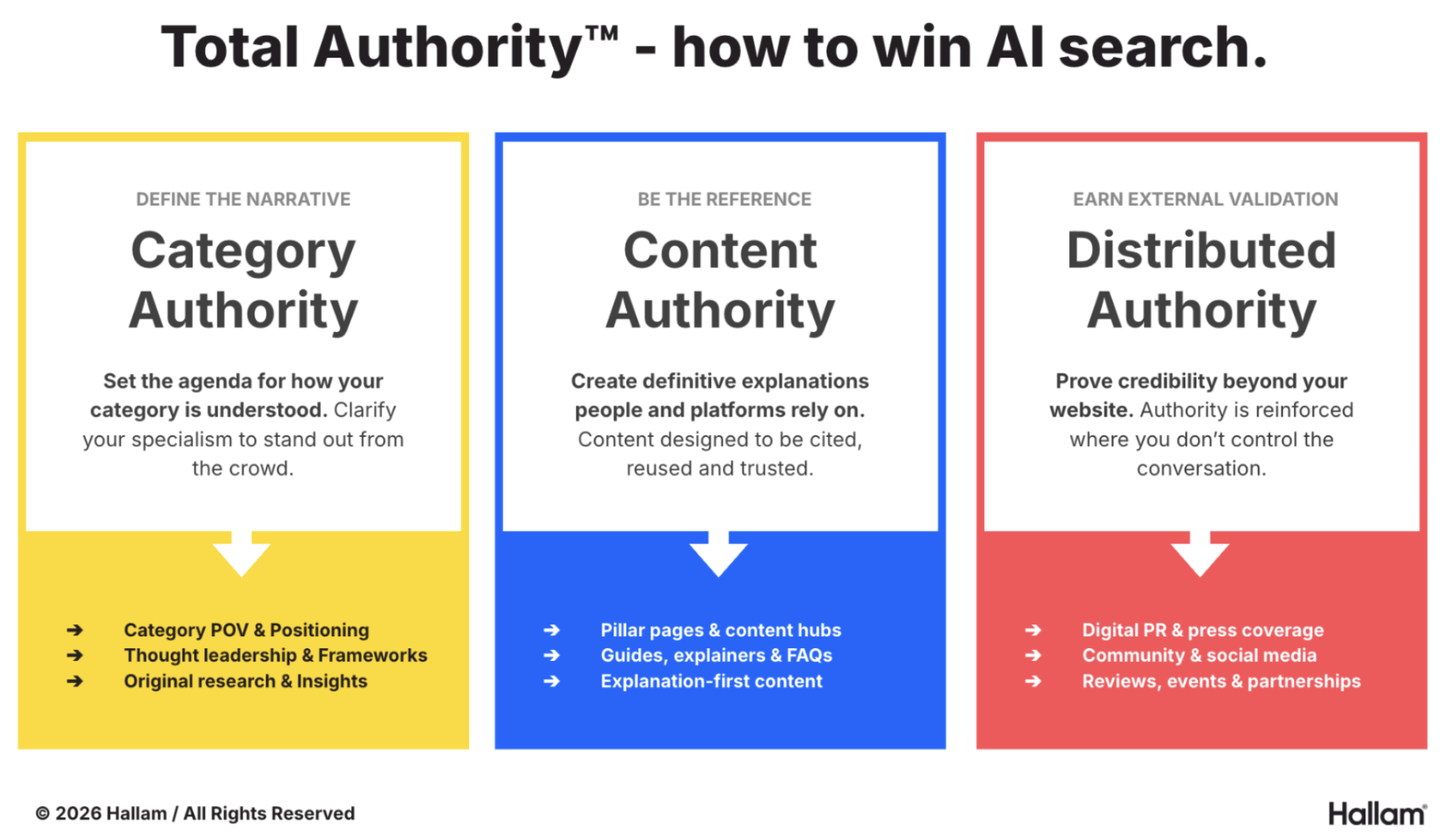
[Source: Hallam.Agency]
1. Category authority – going deep not broad
Models favour distinctive concepts. They favour niching. A model can only bind you to something specific. As an example, “marketing agency” is a bucket with ten thousand names in it, how then do you give yourself more of a chance?
In one piece of research, Kevin Indig found that in categories distant from a brand’s core expertise, 50% of appearances are citations and only 25% are mentions. In close, topically relevant categories, 74% are cited, 44% are named. In theory, you can be a source on almost any topic, but the model only recommends you in your core areas of perceived expertise.
Furthermore, SimilarWeb recently found that when prompts are focused (which we know they often are), only brands with a strong established connection to that exact category stay visible. A brand that looks secondary (smaller) at category level can still be very competitive if it owns a clear, well-defined niche.
This makes blue ocean strategy more important than it’s been in years for search. Blue ocean is the concept nobody has claimed, and for smaller brands trying to accumulate co-occurrence against players with a decade’s head start in a broad category, it’s close to the only viable route to success in LLMs.
One related concept worth mentioning here is information gain – a concept unearthed from a Google patent that’s been around for years and (while not like for like) the theory applies just as much to AI answers as to classic ranking. If you’re restating what already exists, you add nothing to the corpus and there’s no reason to cite you. Have an original point of view, go deep rather than broad, and provide value above what’s already there – this is the core theory behind building genuine category authority.
To achieve this at Hallam, we ensure we build brand strategy into the heart of our AI search process. A brand workshop happens with every client, not just the ones asking for a rebrand. The output isn’t a content calendar, it’s alignment over where and how the brand competes, which cascades into content and distribution strategies – with the ultimate aim of building long-term entity co-occurrence across the internet.
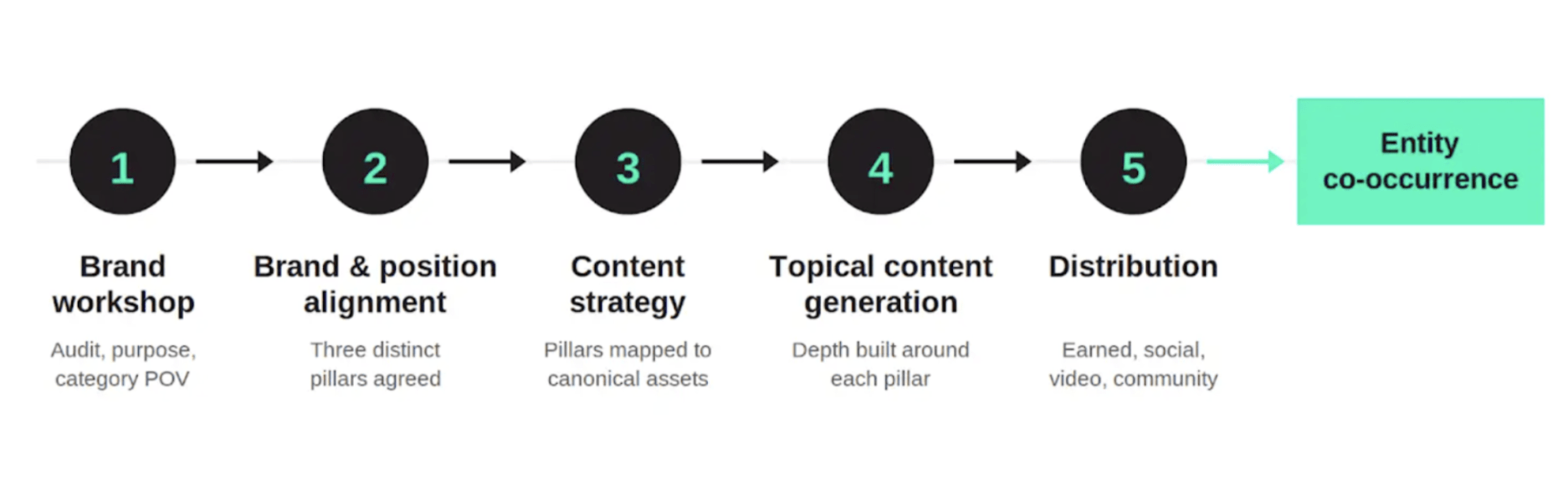
[Source: Hallam.Agency]
CovertSwarm is the cleanest client example I can provide on this. Operating in the general cyber security space, they saw a gap in a niche called “Offensive cybersecurity”.
Then they built a point of view sharp enough to argue with. “You deserve to be hacked” isn’t a tagline, it’s a position. You can disagree with it. That’s the point. And it cascades into advertising, content, site architecture. Every surface reinforces the same entity association.
2. Content authority – building canonical assets
If category authority sets the belief system, content authority operationalises it. The aim isn’t to cover the most ground. It’s to own the definitive explanation of the thing you’ve just said you stand for.
Canonical assets are pillar pages, content hubs, structured explainers, maintained FAQs, clearly authored guides, and the one most B2B teams skip – primary research. These should be reference-grade explanations, not blog posts.
Ahrefs themselves are the obvious example of this done properly. They sell software by being the source everyone cites, including the models.
For B2B specifically, this means executive explainers, regulatory walkthroughs, industry trend updates, conference keynotes. And it shouldn’t be limited to text.
Multimodal content is essential. YouTube mentions are the single highest-correlating factor in the Ahrefs data, higher than branded web mentions. Models aren’t watching your videos, they’re reading them. Transcripts, chapters, timestamps, descriptions and metadata are clean, structured, machine-readable text, and most teams are still under-leveraging video.
If you’re wanting to better understand which questions are being asked in your niche, a useful place to start is what a model actually asks on your behalf. Dejan’s query fan-out tool will show you the sub-queries a model generates from a single prompt. Treat the output with care, though, as the large majority of sub-queries carry no search volume. Instead, cluster them into persistent themes: cost, credentials, comparisons, integrations, availability. Those clusters will help form your content briefs!
3. Distributed authority
Distributed authority is proving credibility beyond your own website, and it’s where most of the evidence models actually use is stored.
Consider this the machine learning verification layer, and it happens almost entirely in places you don’t control: digital PR coverage and the citations that come with it, award shortlists, speaking slots, reviews, LinkedIn discourse, community forums.
Worth noting here that alongside PR, review management is becoming even more important. Seer Interactive analysed over 800,000 AI responses across ChatGPT, Gemini, Perplexity and Google AI Mode for Trustpilot. Brands with no claimed review profile had 1% median citation rate. Brands with a claimed profile and a median of 13 reviews had 54% citation rate. Brands with active profiles, around 80 reviews, responded to regularly had a 75% citation rate. In B2B, review sites came out as the second most-cited source category overall by LLMs.
In terms of the review platforms that deserve attention – SE Ranking analysed 30,000 commercial keywords and found five platforms accounted for 88% of all review-platform citations: Gartner Peer Insights (26%), G2 (23%), Capterra (18%), Software Advice (13%) and TrustRadius (8%).
G2’s July Buyer Behavior Report found review sites have edged back ahead of AI chatbots as the top influence on shortlists, So your review presence is doing two jobs: a citation source a model uses at discovery, and a trust signal a human uses at evaluation. .
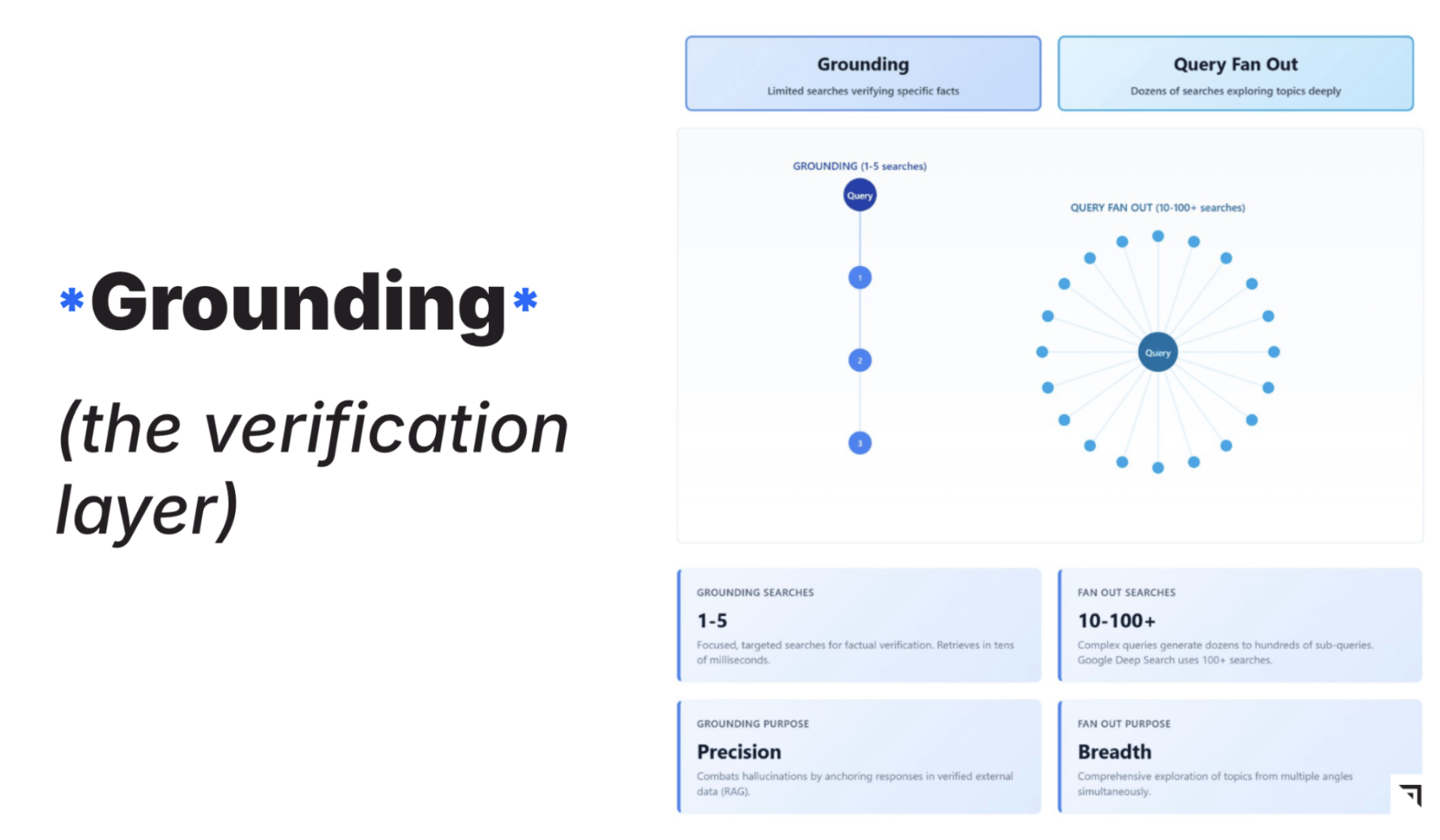
[Source: Hallam.Agency]
What this means for measurement
GA4 have recently added a native AI Assistant channel, classifying sessions from recognised chatbots, while Google have also rolled out generative AI performance reporting in Search Console.
However, it can only count clicks carrying a referrer, while a large share of AI-originated traffic arrives with none at all and lands in Direct. Importantly, it misses one of the key measures of success in LLMs – being mentioned, regardless of the click.
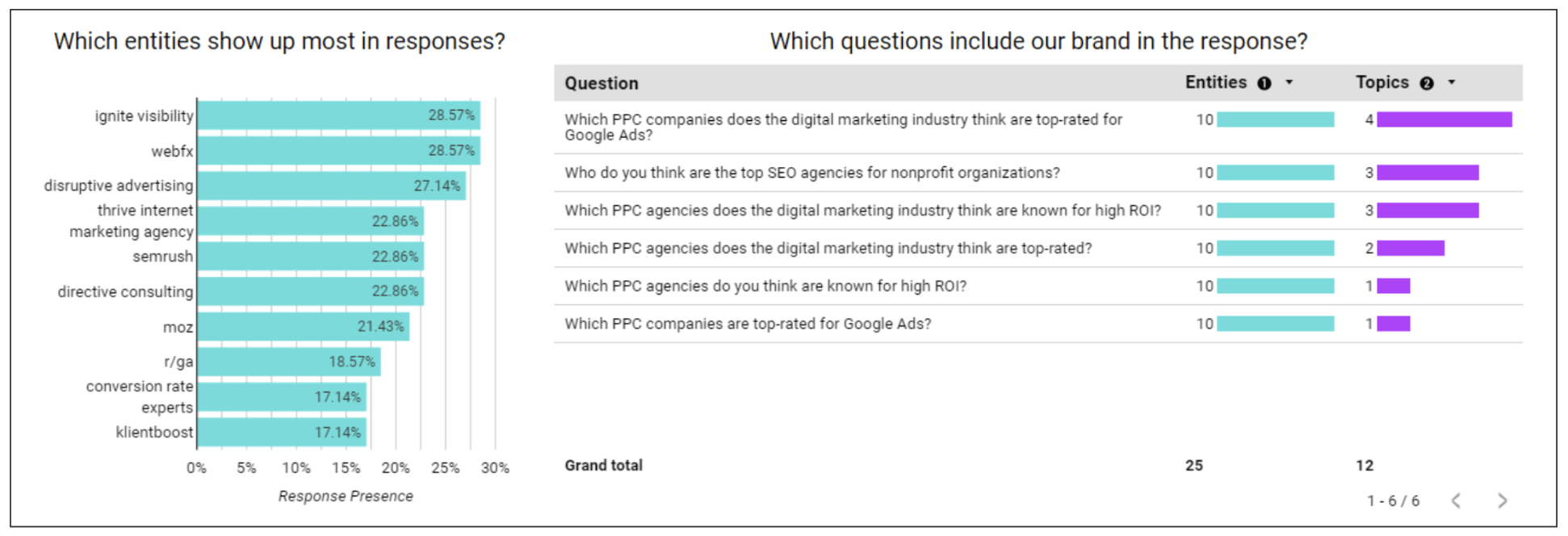
As a result, we have built an index to measure some of the most important leading indicators of AI search success:
- Fame – measuring branded search volume, share of search, and brand sentiment.
- Discoverability – measuring Share of model, total search visibility, and citation authority.
Remember, to assess share of model, you’ll need a fixed set of prompts, run repeatedly, reported as a distribution with variance.
[Source: Seer Interactive]
To recap
There’s no quick fix to LLM visibility. Association frequency accumulates over a long period, there’s no file, schema or audit that shortcuts it.
AI systems are assessing what you’re actually known for, what you’ve published that’s worth referencing, and what credible people say about you in places you don’t control.
My advice to brands is to go deep rather than broad. Be the source that gets cited rather than the site that gets crawled. And spend as much energy earning proof off your website as you do building things on it.
The most durable competitive advantage in AI search is also the least technical one available – authority.