
If you’ve seen the headline “Gen Z is replacing Google with TikTok” doing the rounds, it’s worth treating with a healthy dose of scepticism. The real data tells a more useful story: only 4% of Gen Z actually prefer TikTok to Google for search, down from 8% just two years ago. So no, TikTok hasn’t replaced search, but it has added a new layer to it.
That nuance matters more for B2B brands than almost anyone else, because the temptation is either to dismiss TikTok entirely (“our buyers aren’t dancing on TikTok”) or to chase it as if it’s the next LinkedIn… But neither is right. TikTok SEO is real, it’s growing, and for B2B brands willing to do it properly, it’s one of the most under-used discovery channels available. It’s just not the channel where your buyers are actively comparing vendors.
This guide covers what TikTok SEO actually is, how the platform’s discovery systems work, where the genuine opportunity sits for B2B brands, and where your effort is better spent elsewhere.
Why TikTok SEO matters for B2B brands
The single biggest shift in how TikTok distributes content is the one most marketers haven’t caught up with: according to Emplifi’s 2026 Social Media Benchmarks Report, by the end of 2025, more than 70% of brand video traffic on TikTok originated from the For You feed rather than existing followers, up from the mid-50% range in early 2024. In plain terms, TikTok is actively pushing brand content to people who’ve never heard of you, based purely on how that content performs.
For a B2B brand starting from zero followers, that’s a genuinely rare opportunity. Most platforms reward audiences you’ve already built. TikTok rewards content that resonates, regardless of who’s watching it first.
The numbers back this up at the search level too. Brands optimising specifically for TikTok SEO report 3.1x more organic impressions than those relying solely on the For You algorithm, and TikTok search queries have grown 174% year-over-year. Yet only 8% of B2B marketers currently invest in TikTok at all. That combination, real and growing search volume, low competition from other B2B brands, is exactly the gap worth exploiting before it closes.
We’ve written before about how TikTok is changing content consumption more broadly, and the same principle applies here: the brands paying attention early are the ones building the authority that’s far harder to catch up on later.
How TikTok search actually works
To optimise for TikTok SEO, it helps to understand that TikTok runs two separate discovery systems, and they reward different things.
For You Page vs. Search
The For You Page (FYP) is TikTok’s algorithmically curated feed, built around predicted interest and engagement velocity, things like watch time, shares and replays in the first few hours after posting. TikTok Search is a different beast entirely. It works much closer to a traditional search engine: someone types a query into the search bar because they’re looking for something specific, and TikTok’s algorithm matches that intent to relevant videos based on keyword signals.
A video can perform brilliantly on the FYP and rank nowhere in search, or vice versa. Treating the two as the same thing is one of the most common mistakes brands make.
What TikTok actually reads as keyword signals
TikTok’s search algorithm pulls keyword relevance from more places than most brands realise:
- On-screen text (captions burned into the video itself)
- Spoken word (TikTok transcribes audio and indexes it)
- Captions and hashtags in the post description
- Completion rate, which TikTok increasingly treats as the single most important ranking signal, since it’s the strongest proxy for whether a video actually satisfied the search intent behind a query
That last point is definitely worth sitting with: Completion rate is widely reported as the single most important TikTok SEO ranking signal in 2026. A keyword-stuffed caption with a video nobody finishes won’t rank, whereas a clearly spoken explanation that holds attention to the end will.
The pinned comment tactic
Here’s one of the more under-used tactics, and one that’s genuinely easy to implement: after publishing, you (as the creator) can post a comment on your own video and pin it to the top. TikTok’s search includes pinned creator comments in its keyword analysis, which means that pinned comment becomes additional indexable content. It’s also a useful place for a follow prompt or a question that encourages engagement, without cluttering the video itself.
If you want a deeper look at how TikTok fits into a broader earned-visibility strategy, our piece on using TikTok to elevate your digital PR strategy is a good next read.
TikTok SEO tactics for B2B specifically
General TikTok SEO advice tends to assume a consumer audience and a product people can show off. B2B content needs a slightly different approach.
Do your keyword research properly
TikTok’s Creator Search Insights tool shows you what users are actively searching for, rather than just guessing at FYP-friendly topics. For B2B brands, this is the starting point: build content around the specific questions your audience is searching, industry terminology, common pain points, “how does X work” queries, rather than chasing trends that have nothing to do with your category.
Native beats repurposed, every time
Videos created inside TikTok’s own tools consistently outperform externally produced content by a wide margin. The platform can detect the difference: aspect ratio (9:16 native versus a cropped 4:5 or 1:1), use of TikTok-native sounds and features, and overall production style all factor into how TikTok ranks and distributes a video. If your team is recycling polished brand video from other channels, expect both lower reach and lower search ranking.
Optimise for Google too, not just TikTok
Because TikTok videos increasingly surface inside Google’s own video carousels and search results, a single well-optimised video can earn visibility in two search engines from one piece of content. Structure your keywords, captions and on-screen text to be legible to both TikTok’s search and Google’s crawlers, and you get the dual-platform benefit without doubling the production effort.
This kind of multi-platform thinking matters even more as discovery itself becomes more fragmented. We’ve explored this in more depth in our piece on the social media marketing funnel, which looks at where different platforms genuinely earn their place at each stage of the buyer journey.
Where TikTok SEO has limits for B2B, and where LinkedIn still wins
This is the part most TikTok SEO guides skip, and it’s the part that matters most if you’re a B2B marketer deciding where to put your time.
A 2026 survey of B2B-focused marketers asked which platform actually delivers the most “search-like” discovery for their business. TikTok came last among the major contenders:
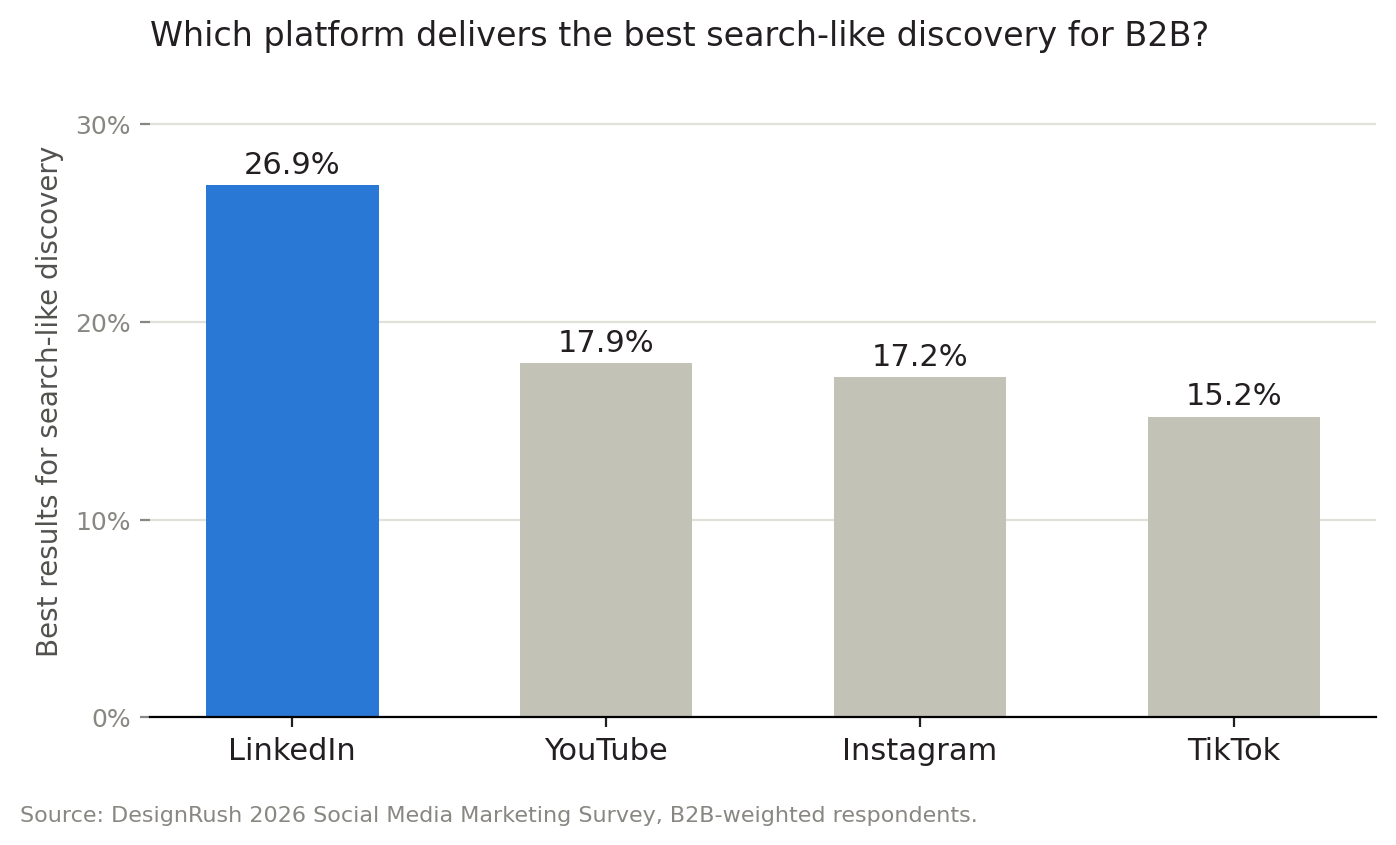
LinkedIn led at 26.9%, ahead of YouTube (17.9%), Instagram (17.2%) and TikTok at 15.2%. The gap isn’t marginal, and it lines up with how B2B buyers actually behave: they use TikTok for content that benefits from social proof and a more human format, but they still turn to LinkedIn, YouTube and Google when they’re actively evaluating a vendor or researching a business problem with a right or wrong answer.
In other words, if your business depends on capturing buyers who already know what they’re looking for, “best accountant for our industry,” “compare ERP platforms,” “vendor case studies”, TikTok SEO has limited direct impact on that bottom-of-funnel traffic. Where it genuinely earns its place is further up the funnel: brand awareness, simplifying complex concepts, building familiarity with your category before a buyer starts actively comparing options.
This is also why TikTok SEO works best as one layer of a much broader search and visibility strategy, alongside the increasing importance of AI search visibility. We’ve covered this shift in detail in how we’ve achieved LLM visibility for B2B search and in share of LLM as a B2B metric, both worth reading alongside this piece.
A practical way to think about it
The honest position is this: TikTok SEO is a genuine, growing, low-competition discovery channel for B2B brands, but it’s an upper-funnel tool, not a replacement for the search channels where your buyers are actually closer to a purchase decision. Treat it as a way to build category awareness and simplify your expertise for an audience that increasingly expects video, not as a lead-generation engine on its own.
The brands getting this right aren’t choosing between TikTok and LinkedIn, or between TikTok SEO and traditional SEO. They’re building a search presence across all of them, with each channel doing the job it’s actually good at. If you’re working out where TikTok fits into that wider picture alongside your paid, organic and CRO strategy, our guide to aligning SEO, paid and CRO for B2B brands is a useful starting point.
Key takeaways
- TikTok search and the For You feed are two different systems that reward different signals, optimise for both separately.
- Completion rate is the most important TikTok SEO ranking signal, not keyword density.
- Pinned comments are indexed by TikTok search and are one of the easiest under-used optimisation wins available.
- Native TikTok content consistently outperforms repurposed video in both reach and search ranking.
- TikTok SEO is an upper-funnel channel for B2B, useful for awareness and category education, not a substitute for LinkedIn, YouTube or Google where bottom-funnel vendor research still happens.
If you’re not sure where TikTok fits into your B2B search strategy, or want help working out the right channel mix for your buyers, get in touch with our team.