
Most B2B marketing budgets are built for the 5% of buyers who are ready to buy now.
That sounds sensible. They are the people searching, comparing, filling in forms and speaking to sales. They are visible on the dashboard. They make the numbers feel real.
But they are also the smallest, most expensive, most fought-over part of the market. The bigger prize is the 95% who are not buying yet but will be one day. And in most B2B businesses, those future buyers are barely represented in the budget at all.
I ran a global pitch recently and watched this play out. We had been talking about the 95-5 rule and the case for brand investment. Then, their head of content asked the question I get on every B2B pitch in some form: “I get the 5%, 95% stuff. I’m on board. But our brief was specific. We need help with paid search. How do you square that when we don’t have the budget to throw at a big brand?”
Their marketing director cut in, candid in a way you don’t always get on a pitch. “We’ve got a business that thinks the brand is ubiquitous and well known and that we’ll be top of the list. Speaking for myself and the team, we know that’s not the case. But the FD sees the customer numbers and the big logos, and assumes the brand is already doing the job. They don’t see us as a strategic partner, which we believe we are. We’re not, in reality.”
That is the entire problem. Most B2B businesses think they are already on the “day one” list. Most aren’t. It is the same issue we highlighted when launching Better B2B: marketers stuck inside systems that count the wrong things and reward the wrong outcomes.
The 95-5 rule, properly explained.
In 2021, Professor John Dawes at the Ehrenberg-Bass Institute noted something that should have rewired B2B marketing overnight. It didn’t, but it should have.
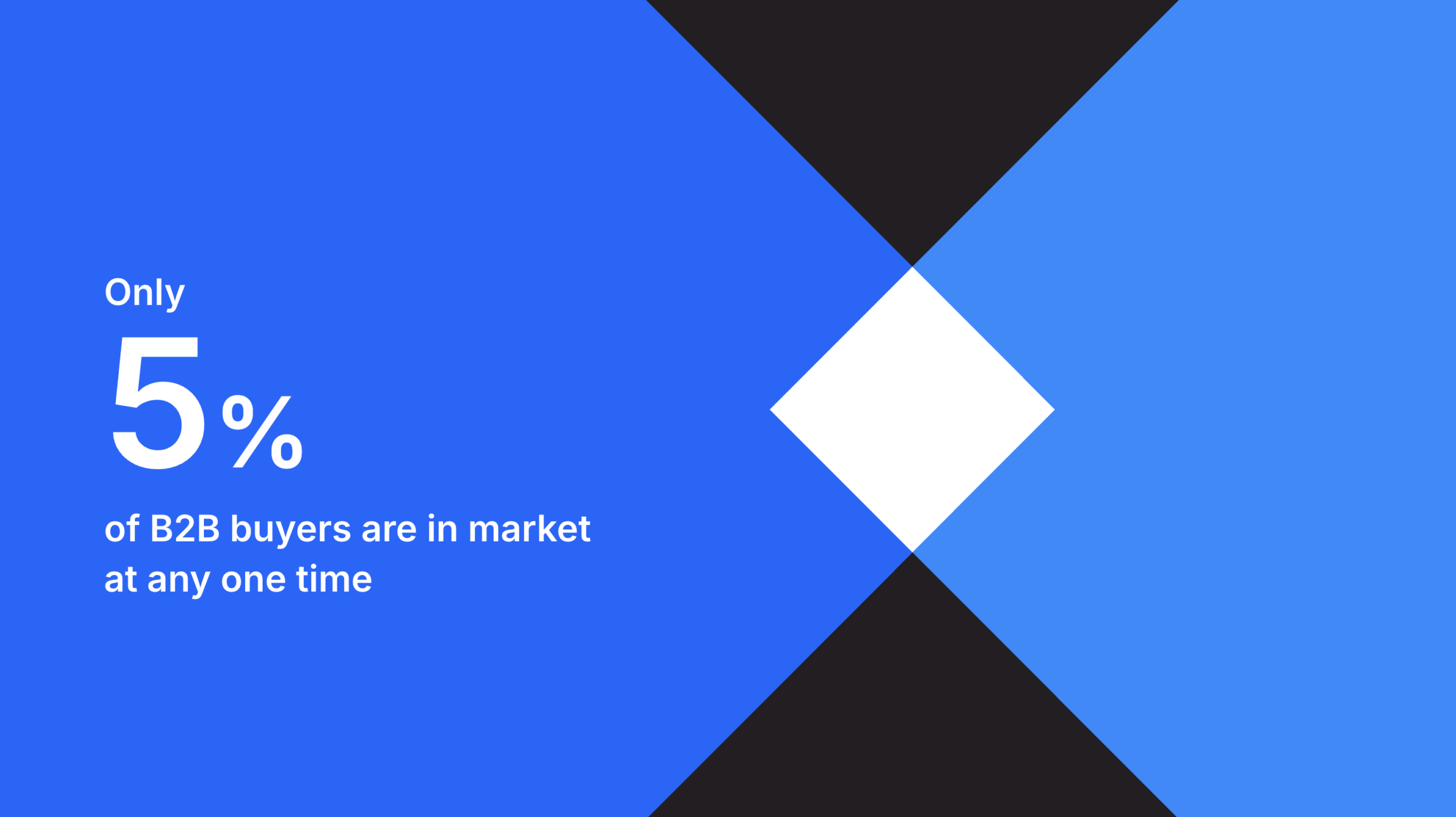
Companies do not buy things constantly. They buy in cycles. Banking services every five years or so. Computers every four. CRM platforms every five to seven years. Run the maths, and at any quarter, only around 5% of your potential customers are actually in-market for what you sell. The other 95% are happy with what they have, locked into a contract, or not even thinking about it yet.
Dawes called it the 95-5 rule. It is a heuristic, not a precise law. The exact split varies by category. But the implication is what matters: most of the people you want as customers are not buying anything from anyone right now. Marketing’s job is to make sure that when they do, your name is the one they remember.
The Bain and Google evidence
If Dawes shows you the maths, Bain and Google show you what it looks like in practice. In 2022, the two ran a study of 1,208 US B2B buyers across software, cloud hosting, hardware, telecoms, logistics, marketing, and industrial equipment. The headline finding should be on the wall of every marketing department in the world.
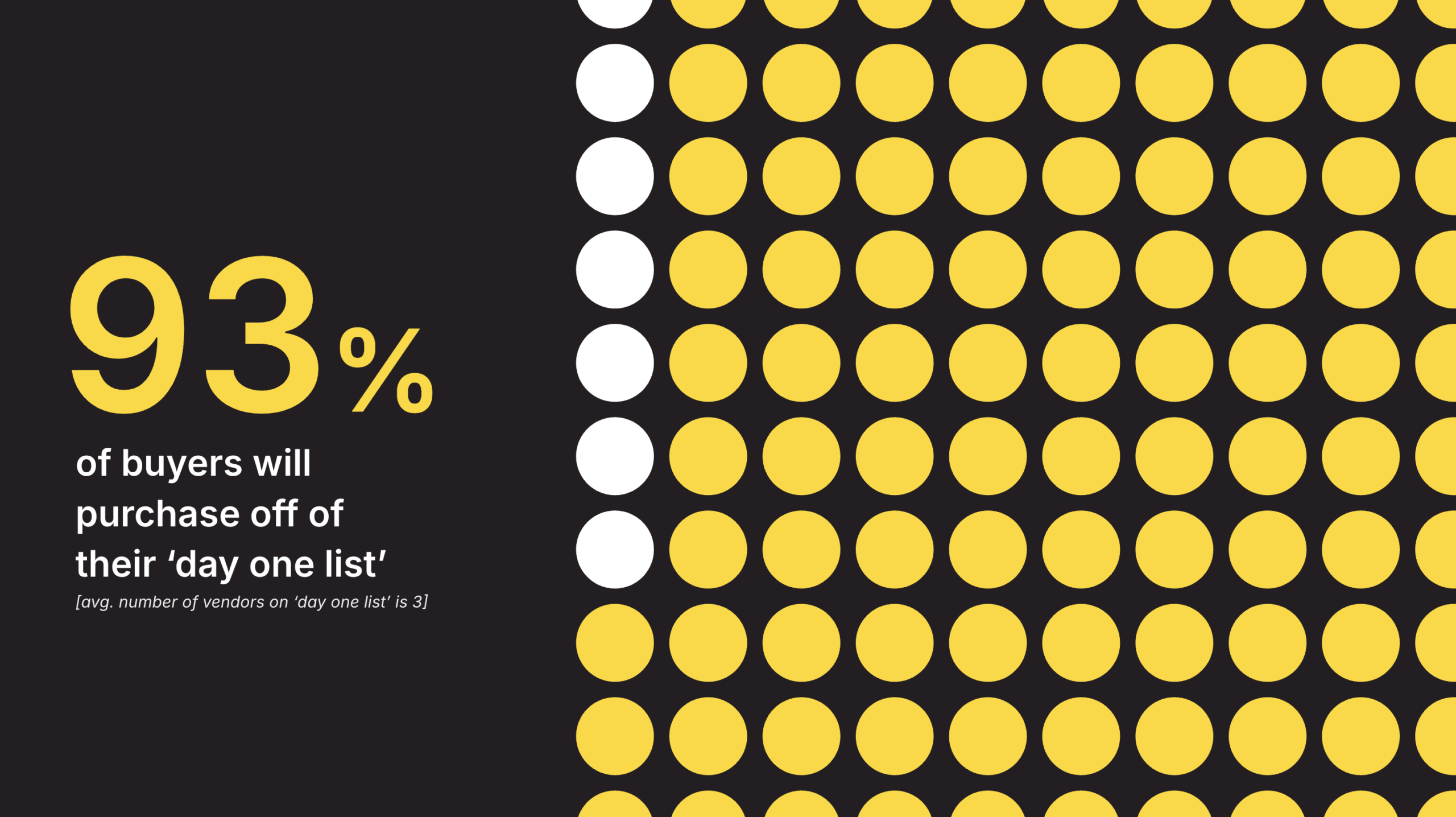
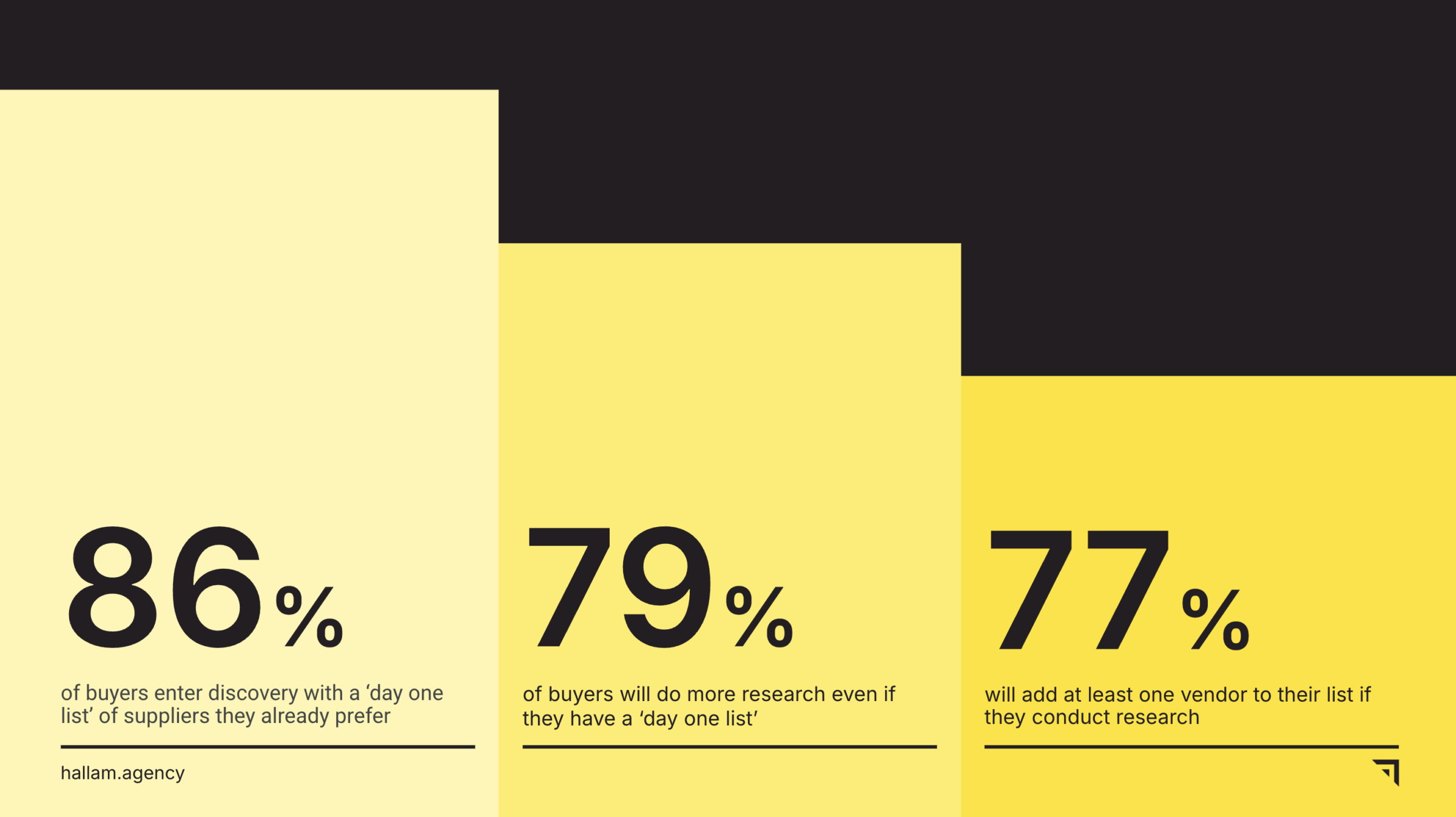
86% of B2B buyers have a Day One List of vendors they already know they want to consider, before they start any formal research. 93% of them go on to buy from that list.
By the time the buyer hits your website, books your demo or fills in your form, the decision has mostly been made. They are not evaluating whether you are right. They are confirming what they already believed. The form fill is a formality.
Where the money actually goes
Now look at where most B2B marketing budgets get spent.
LinkedIn’s B2B Marketing Benchmark consistently shows lead generation as the single biggest line item, taking around 36% of total spend. Brand and awareness sits at 30%. Demand generation at 20%. So more money goes on chasing the 5% who are ready right now than on building memory in the 95% who will be ready eventually.
On the ground, it’s often more skewed. The LinkedIn data is the global average. In the mid-market British businesses we work with, the split is regularly 70-30 in favour of demand capture. Sometimes 80-20. I have seen marketing plans where the only brand line item was a logo refresh.
This is not because B2B marketers do not understand the argument. Most know the 95-5 rule. They have read Binet and Field. They can quote you the line about brand and activation. The problem is that they are working for boards that cannot see the brand on a dashboard. Marketing Week’s reporting in 2025 found that many B2B marketers say brand building isn’t prioritised because its ROI is not well understood internally. That tracks with every conversation we have.
What to cut, what to add, what to keep
If you take the 95-5 rule seriously, your budget needs to change. With Binet and Field’s B2B research with the LinkedIn B2B Institute, defining the operational optimal split at 46% brand and 54% activation.
Most B2B teams are nowhere near 46-54. They are 20-80, sometimes 10-90. So the question is what you trim and what you grow.
Start with the waste. Retargeting pools where every site visitor gets treated as a hot lead. Paid search defending demand you would have won anyway. SDR sequences are hitting accounts that have shown no signal. Gated whitepapers feeding a nurture journey nobody actually runs. Conference sponsorships are based on headline attendance rather than whether the right buyers will be there. None of this is brand building. None of it is good demand capture, either. It is just spending that survives because nobody has been brave enough to switch it off.
What gets added is the harder stuff, because it is harder to measure. Brand-led content built around the situations buyers find themselves in when they go in-market, not the products you happen to sell. Founder and leader voices on LinkedIn instead of branded company posts that nobody engages with. Podcasts, both your own and other people’s. Small in-person events where forty good people in a room are worth more than four hundred badges on lanyards. Customer marketing and advocacy is almost always the most under-funded part of a B2B budget, despite being the highest-quality demand creation you can run.
What stays is sensible demand capture for the 5% who are in-market today. High-intent SEO. Sales enablement. Lead routing and scoring. The 95-5 rule does not say lead generation is bad. It says lead generation captures demand. It does not create enough of it on its own. The rest of the budget should be building the conditions in which leads happen at all.
Start with one per cent.
Back to that pitch. After the head of content asked his question and the marketing director gave his honest answer, our head of paid media stepped in with the practical version of the same argument: “We don’t need to put any percentage of the budget into brand building necessarily. We could start with 1% of the budget. Doing something is better than doing nothing.”
That is the move most B2B marketers can actually make this quarter. Not a wholesale reallocation. Not a board-level argument about long-term brand investment. Just one per cent. A founder doing video on LinkedIn. A podcast appearance once a month. A small event for thirty customers. The numbers are tiny enough that nobody on the FD’s team will fight you on it. The compounding effect over twelve months will give you the data to fight for ten per cent next year.
So the real problem is not whether brand works. Most marketers already know it does. The real problem is that brand has to compete for a budget inside a system built to reward short-term proof. That means the case has to be made in commercial risk terms, not marketing theory.
How to make it board-safe
The board does not need a lecture on mental availability. It needs a risk case. The brand argument should not sound like a belief system. It should sound like commercial risk management.
Six things are worth tracking and showing. Three are about the cost of doing nothing. There are three leading indicators of progress.
Three numbers tell the cost-of-inaction story. How much has your customer acquisition cost risen over the last twelve to twenty-four months? How much paid search CPC has climbed in your category? How many deals are you losing to competitors that the buyer already knew about before they spoke to you? Each one on its own is uncomfortable. Together they show the same trend: the pool of in-market buyers is shrinking, getting more expensive, and easier for better-known competitors to win.
On the leading-indicator side: share of search against your direct competitors, easy to pull and a strong proxy for mental availability. Direct traffic and branded search growth from your target accounts, which shows whether the people who matter actually know you exist. And win rate where the buyer knew you before they enquired versus where they did not, which is the cleanest commercial proof that brand investment shortens cycles and improves close rates.
None of this requires a brand survey or a board-level mindset shift. It requires a spreadsheet, two hours of analyst time and a willingness to put the numbers in front of people. Once a CFO sees the cost-of-inaction trend lines, the conversation changes.
This is what we mean when we say we help B2B brands be chosen before the search begins. It is not a slogan. It is the only viable strategy when 95% of your future market is not searching for you yet. The data backs it up: in our 2026 B2B Marketing Benchmark Report, 73% of B2B firms told us their sales cycles are lengthening, and only 5% reported having more budget. The system is under pressure. The maths is not.
The marketing job happens before the buying process starts. Get that wrong, and no amount of paid search will save you. Get the FD on side, and you can start fixing it next quarter.