

B2B paid media has a measurement problem.
Too often, success is reduced to platform metrics like clicks, impressions and lead volume. While these numbers can indicate campaign activity, they rarely tell the full story. For B2B brands with long sales cycles, multiple stakeholders and complex buying journeys, proving paid media ROI requires a more strategic approach.
The challenge is not a lack of data. It is knowing which data actually matters.
Without a clear PPC measurement framework, teams can end up optimising for the wrong outcomes. Marketing reports look healthy, but sales teams question lead quality. Budget decisions are made on incomplete attribution. Paid media becomes difficult to defend when scrutiny increases.
A strong B2B paid media measurement framework changes that. It connects campaign activity to commercial impact, helping marketers understand what drives pipeline, revenue and long-term growth.
In this blog, we will explore:
- Why traditional PPC reporting often falls short in B2B
- The key components of an effective paid media measurement framework
- Which metrics matter at different stages of the funnel
- How to better align marketing and sales measurement
- Practical ways to improve paid media ROI reporting
- Why B2B paid media measurement is more complex

B2B buying journeys are rarely linear.
A prospect might discover your brand through LinkedIn, attend a webinar months later, return through branded search and only convert after multiple conversations with sales. By the time revenue is generated, the original paid media touchpoint can feel disconnected from the outcome.
This creates several measurement challenges:
- Long sales cycles delay revenue visibility
- Multiple touchpoints complicate attribution
- Buying committees make individual lead tracking less reliable
- Offline interactions influence conversion decisions
- CRM and platform data are often disconnected
As a result, marketers often default to reporting on metrics that are easy to access rather than metrics that reflect commercial value.
This is where many B2B paid media strategies struggle. If your reporting focuses only on cost per lead or click-through rate, you risk optimising for efficiency rather than effectiveness.
A campaign generating low-cost leads may appear successful while producing little pipeline impact. Meanwhile, a higher-cost campaign targeting senior decision-makers could drive significantly more revenue over time.
Measurement needs to reflect business reality, not just platform performance.
The problem with vanity metrics
Vanity metrics are not inherently useless. Clicks, impressions and engagement rates can provide useful directional, day-to-day insight. The issue arises when they become the primary definition of success.
For example:
- High click-through rates do not guarantee qualified traffic
- Low cost per lead does not guarantee pipeline contribution
- High impression volume does not indicate commercial impact
In B2B paid media, volume alone rarely tells the full story.
A measurement framework should help answer deeper questions:
- Are we attracting the right audiences?
- Which campaigns influence pipeline creation?
- What is the sales conversion rate by channel?
- Which touchpoints contribute to revenue generation?
- Where are leads dropping out of the funnel?
These are the insights that help teams improve paid media ROI over time.
What a strong PPC measurement framework looks like
An effective PPC measurement framework connects media activity to business outcomes.
Rather than focusing on isolated platform metrics, it creates visibility across the full customer journey.
While every organisation will have different priorities, most strong frameworks include five core areas.
1. Clear business objectives
Measurement should start with commercial goals, not reporting templates.
Before defining KPIs, align on what success actually looks like. This could include:
- Pipeline generation
- Revenue growth
- Market expansion
- Customer acquisition
- Product adoption
- Account engagement
Once objectives are defined, metrics become easier to prioritise.
For example, if the goal is pipeline growth, measuring marketing qualified leads alone is unlikely to provide enough insight. You also need visibility into sales acceptance, opportunity creation and revenue contribution.
2. Full-funnel measurement
Not every campaign is designed to drive immediate conversions.
Awareness activity plays a different role from demand capture campaigns, and measurement should reflect that.
A full-funnel approach helps teams understand how channels contribute at different stages:
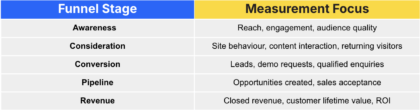
This prevents upper-funnel activity from being undervalued simply because it does not generate immediate lead volume.
3. CRM and platform integration
One of the biggest barriers to effective B2B paid media measurement is disconnected data.
If your CRM, marketing automation platform and ad platforms are not properly integrated, it becomes difficult to track lead progression beyond initial conversion.
Strong integration enables marketers to:
- Track lead quality by source
- Measure opportunity creation rates
- Understand revenue contribution
- Improve audience targeting
- Optimise towards downstream outcomes
Platforms like Google Ads and LinkedIn become significantly more powerful when offline conversion data is fed back into the system.
Rather than optimising for form fills, campaigns can optimise towards qualified pipeline outcomes.
Attribution: useful, but never perfect
Attribution is one of the most debated areas of paid media measurement.
Many businesses still rely heavily on last-click attribution because it is simple and easy to report on. The problem is that B2B journeys are rarely driven by a single interaction.
A prospect may engage with multiple campaigns across several months before converting. Assigning all value to the final touchpoint creates an incomplete picture.
Different attribution models can provide different perspectives:
- First-click attribution highlights initial discovery
- Last-click attribution focuses on conversion completion
- Linear attribution distributes credit evenly
- Data-driven attribution uses machine learning to estimate contribution
No attribution model is flawless.
The goal is not to find a perfect answer. It is to build a more balanced understanding of channel influence.
In practice, this often means combining attribution data with broader business context, CRM insights and qualitative sales feedback.
Measuring lead quality, not just lead quantity
One of the most important shifts in B2B paid media measurement is moving from lead generation to lead quality measurement.
Generating high lead volume can look impressive in reports. But if those leads never progress through the pipeline, performance is being overstated.
A more useful framework measures conversion efficiency at every stage:
- Lead to marketing qualified lead
- Marketing qualified lead to sales accepted lead
- Sales accepted lead to opportunity
- Opportunity to closed revenue
This helps identify where campaigns are genuinely contributing value.
For example, two channels may generate similar lead volume, but one consistently produces higher-value opportunities with shorter sales cycles. Without downstream measurement, this insight can easily be missed.
How to improve paid media ROI reporting
Improving paid media ROI reporting often starts with simplifying what matters most.
Many dashboards become overloaded with metrics that create noise rather than clarity. Stakeholders end up with large reports but limited actionable insight.
Effective reporting should focus on:
- Business outcomes over platform activity
- Trends rather than isolated snapshots
- Context alongside raw numbers
- Actionable insights and recommendations
A strong report should help answer three questions:
- What happened?
- Why did it happen?
- What should we do next?
That final point is often overlooked. Reporting should not just describe performance. It should inform decision-making.

Common mistakes in B2B paid media measurement
Even mature organisations can fall into common measurement traps.
Measuring channels in isolation
Channels rarely work independently.
Paid social may create awareness that later converts through branded search. If each channel is assessed separately, contribution can be undervalued.
Over-relying on platform reporting
Ad platforms naturally focus on their own performance data.
Cross-channel analysis and CRM validation are essential for gaining a more accurate view of ROI.
Ignoring sales feedback
Quantitative data matters, but qualitative feedback matters too.
Sales teams can often identify lead quality issues long before they appear in reporting trends.
Chasing short-term efficiency
Optimising purely for immediate conversion efficiency can limit long-term growth.
Some of the most commercially valuable audiences may be more expensive to acquire initially but significantly more profitable over time.
The future of B2B paid media measurement
Measurement is becoming more complex, not less.
Privacy changes, reduced cookie visibility and fragmented customer journeys are making traditional attribution increasingly difficult. At the same time, leadership teams are demanding greater accountability from marketing investment.
This means B2B marketers need more resilient measurement strategies.
The future is likely to involve:
- Greater use of first-party data
- Increased CRM integration
- More blended attribution approaches
- Stronger collaboration between marketing and sales
- Greater emphasis on incrementality and business impact
The brands that succeed will be those that treat measurement as a strategic capability rather than a reporting exercise.
Final thoughts
A strong PPC measurement framework does more than justify spend.
It helps businesses make better decisions, improve campaign effectiveness and understand what genuinely drives growth.
For B2B brands, measuring paid media ROI requires a broader perspective than platform metrics alone. It means connecting marketing activity to pipeline, revenue and long-term commercial impact.
The goal is not to track everything. It is to measure what matters.
When measurement frameworks are built around business outcomes rather than vanity metrics, paid media becomes easier to optimise, defend and scale.
For marketers under pressure to prove value, that shift can make all the difference. Are you a B2B brand looking to measure your ROI? Let’s talk.