

Account-Based Marketing is one of the most powerful growth strategies in B2B and one of the most frequently botched. Too many teams rush in, pick a list of impressive-sounding companies, blast out some InMail and wonder why nothing lands.
The truth is that ABM done properly takes real preparation, budget, discipline and a coordinated multi-channel journey. Done right, it transforms your pipeline. Done wrong, it’s an expensive lesson in why you can’t shortcut strategy.
This guide outlines a practical, seven-step checklist for building an ABM programme that actually works.
Step 1: Choose your ABM model (and be honest about what you can afford)
There are three tiers of ABM and your choice determines your budget, team bandwidth and realistic milestones.
1-to-1: This is the gold standard, bespoke campaigns for individual accounts. You go deep on one business with custom content, personalised outreach and messaging built entirely around their specific business goals. Budget realistically at £5,000–£20,000+ per account when factoring in production, media and team hours. Only run 1-to-1 for accounts where the six-figure contract value justifies the investment.
1-to-Few: Group accounts by shared traits like industry, company size, or a common challenge, then create campaigns that feel personal without being entirely bespoke. For example, target 10–25 mid-market SaaS companies facing a specific compliance hurdle. Budget ranges from £1,500–£5,000 per cluster. The key discipline here is resisting the urge to expand the group. The tighter the definition, the sharper your messaging.
1-to-Many: This uses technology to serve targeted content to a broader list (typically 100–1,000 accounts) at scale. It’s less personalised but far more focused than general demand generation. Expect to spend £3,000-£8,000 per month in paid media alone. If using programmatic, ABM works best as a top-of-funnel layer that feeds your higher tiers as accounts show intent signals.
The honest truth: Most companies try to run 1-to-1 campaigns on a 1-to-many budget. That’s a guaranteed route to disappointment. Be clear-eyed about what each tier actually costs before you press go.
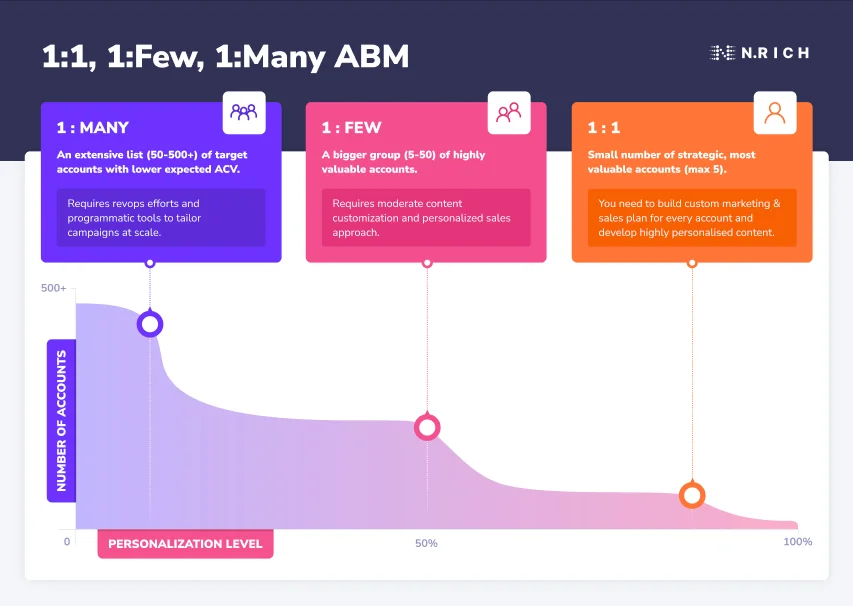
Image source: nrich.io
Step 2: Stop chasing Amazon and Coca-Cola (unless you’re ready to wait years)
The most common mistake in ABM is the “vanity list.” The sales team gets together, picks the most impressive logos they can think of and declares them targets. It feels exciting, but it is rarely effective.
Senior decision-makers at global enterprise organisations are absolutely bombarded with hundreds of InMails, cold emails and LinkedIn requests every single week. Their attention is fiercely protected. Breaking through requires enormous budgets, multiple stakeholder relationships and years of patience. Unless you have those resources, you are burning cash.
Instead, build your account list based on real signals of fit and readiness:
- Prioritise businesses that have already visited your website five or more times.
- Target companies that are active in communities relevant to your space.
- Look for accounts where your product solves a problem they are visibly struggling with right now.
According to prominent research on the 95-5 rule conducted by the Ehrenberg-Bass Institute, only around 5% of B2B buyers are actively in-market at any given moment. The remaining 95% are out-of-market and won’t buy for months or years. This makes targeting companies showing active, real-time intent signals absolutely vital.

Step 3: Stop ignoring the juniors
ABM strategy almost always defaults to targeting the C-suite and VP level. On paper, this makes sense because they hold the budget. In practice, ignoring everyone else is a major strategic error.
Senior executives are over-targeted and under-available. The CMO at a major corporation is not reading your cold message, but their Marketing Manager might. That manager is the person researching solutions, building internal business cases and recommending tools to leadership.
This behavior is well-documented. Data from Gartner reveals that B2B buying groups spend a mere 17% of their total purchase journey actually meeting with potential suppliers. To make matters more challenging, studies by 6sense indicate that buyers complete up to 61% of their evaluation entirely in the dark before ever engaging a vendor sales rep.
If you aren’t visible to the junior or mid-level staff during this self-directed research phase, you set yourself up to be excluded from the conversation. Map out multiple levels for each target account. Identify the people who influence upwards. Serve them content that helps them do their jobs better and gives them the ammunition to make the internal case for you.

Step 4: Go beyond LinkedIn, build a real multi-channel stack
If your ABM strategy is just LinkedIn ads plus some InMail, it isn’t a complete strategy. LinkedIn is a starting point, not the final destination.
Your channel stack should integrate LinkedIn alongside programmatic display platforms that allow you to serve ads via IP targeting and intent data. Use Sales Navigator for deep account intelligence (tracking job changes, company news and engagement signals). Look at display retargeting, industry-specific publications, podcast advertising in niche verticals and direct relationships with trade media.
And don’t forget the offline world! Thoughtful, physical touches sent to target accounts create a tangible presence that digital ads cannot replicate. Office deliveries timed around a key moment in the sales cycle (like a proposal or follow-up stage) can be remarkably powerful.
The goal is orchestration: ensuring your target account encounters your brand in relevant, credible contexts across their working day. Not noise, but a meaningful presence.
Step 5: Understand the pain points before you write a single word
ABM messaging that does not connect with a real, felt pain point will simply fail. Before any creative is produced or any sequence is written, you need a deep understanding of what your targets actually care about.
For 1-to-1 campaigns: Look for business-level intelligence. What are that company’s strategic priorities this year? What challenges did they mention in their last earnings call, job postings, or press coverage? The more you speak their internal language, the more it feels like you truly understand their world.
For 1-to-few campaigns: Focus on industry-level pressures. What regulatory changes, economic headwinds, or technology disruptions are keeping this sector up at night? Your messaging should position your product as the answer to those specific context-driven pressures.
This is where a brand platform becomes invaluable. Ground your personas in real customer data (intelligence drawn from sales call transcripts, customer interviews and CRM behaviour) rather than marketing assumptions.
Step 6: Map your messaging across buying stages
ABM is a long-term play. A target account moving from first awareness to a signed contract passes through non-linear stages. Your content and messaging must intelligently evolve alongside Gartner’s core B2B buying stages:
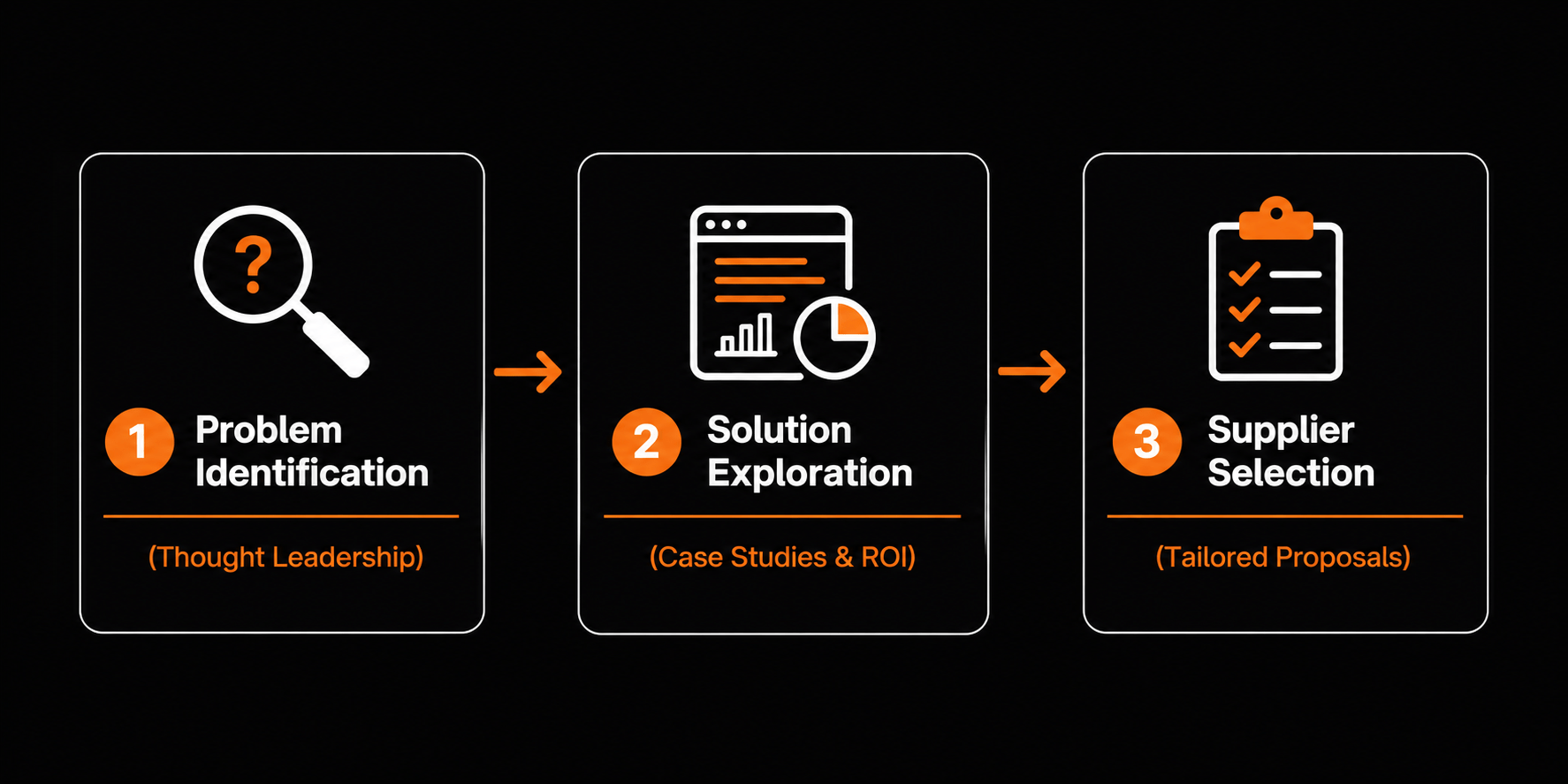
Problem Identification: Build familiarity and credibility. Use thought leadership content, industry insights and paid media that puts your brand in front of the right accounts. At this stage, soft metrics matter (impressions, engagement and website visits).
Solution Exploration: Focus on the specific problem your product solves. Introduce case studies from similar companies, comparison content and webinars. This is where personalisation starts to deliver its biggest returns.
Supplier Selection: Remove friction and reinforce confidence. Deliver tailored proposals, ROI calculators and executive-level conversations. A well-timed handwritten note or exclusive in-person event can tip a decision that digital channels alone cannot close.
Step 7: Measure, learn and resist the urge to rush
The single biggest reason ABM campaigns fail is that they are abandoned before they have had time to work. Running four weeks of ads and sending a handful of emails is not an ABM strategy.
Realistic ABM timelines run anywhere from three to twelve months depending on deal complexity. In the early stages, measure engagement at the account level:
- Are target accounts visiting your website more frequently?
- Are the right job titles opening your content?
- Are you seeing increased social engagement from key prospects?
Document everything. Track what worked at the problem identification stage, what content drove solution exploration and which channels got a response. This intelligence compounds over time, turning ABM from a one-off campaign into a core business capability.
The bottom line
ABM is not a shortcut to big logos. It is a disciplined, data-driven methodology that rewards preparation, patience and joined-up thinking. The campaigns that fail are built on vanity lists and executed on a single channel. The campaigns that succeed treat ABM as a strategic, multi-channel ecosystem.
If you want to build your ABM programme on solid foundations, starting with a brand platform rooted in real customer data, we can help. Let’s talk and move from guesswork to precision.