

AI-mediated discovery is eroding click-throughs before they reach you, compressing ad inventory above the fold, and pulling the top of the funnel out of search entirely.
The auctions you used to win cheaply are becoming the only auctions left to fight in, and every other B2B advertiser is piling in to compete, pushing CPC’s up across the board.
The numbers behind the squeeze
Since the first year of Google’s AI Max rollout, it’s been reported that CPCs are up between 10 and 15 percent year on year for most advertisers, with some accounts seeing increases as high as 25 percent.
Adthena data suggests the number of advertisers participating in search auctions has risen 35 percent year on year. More advertisers competing for less inventory = higher CPCs.
WordStream’s 2026 Google Ads benchmarks tell a similar story over a longer time frame. The average CPC across Google Ads now sits at $5.42, more than double what it was when the report first launched in 2016. CPCs increased for the vast majority of industries year on year, and Business Services in particular, which is where most B2B sits, now has an average CPC $5,87.
And it’s not just advertisers on Google that are feeling the squeeze, Stackmatix’s 2026 channel benchmarks put YoY CPC inflation at 14 to 18 percent on Google Search, 12 to 16 percent on Meta, and 18 to 22 percent on LinkedIn.
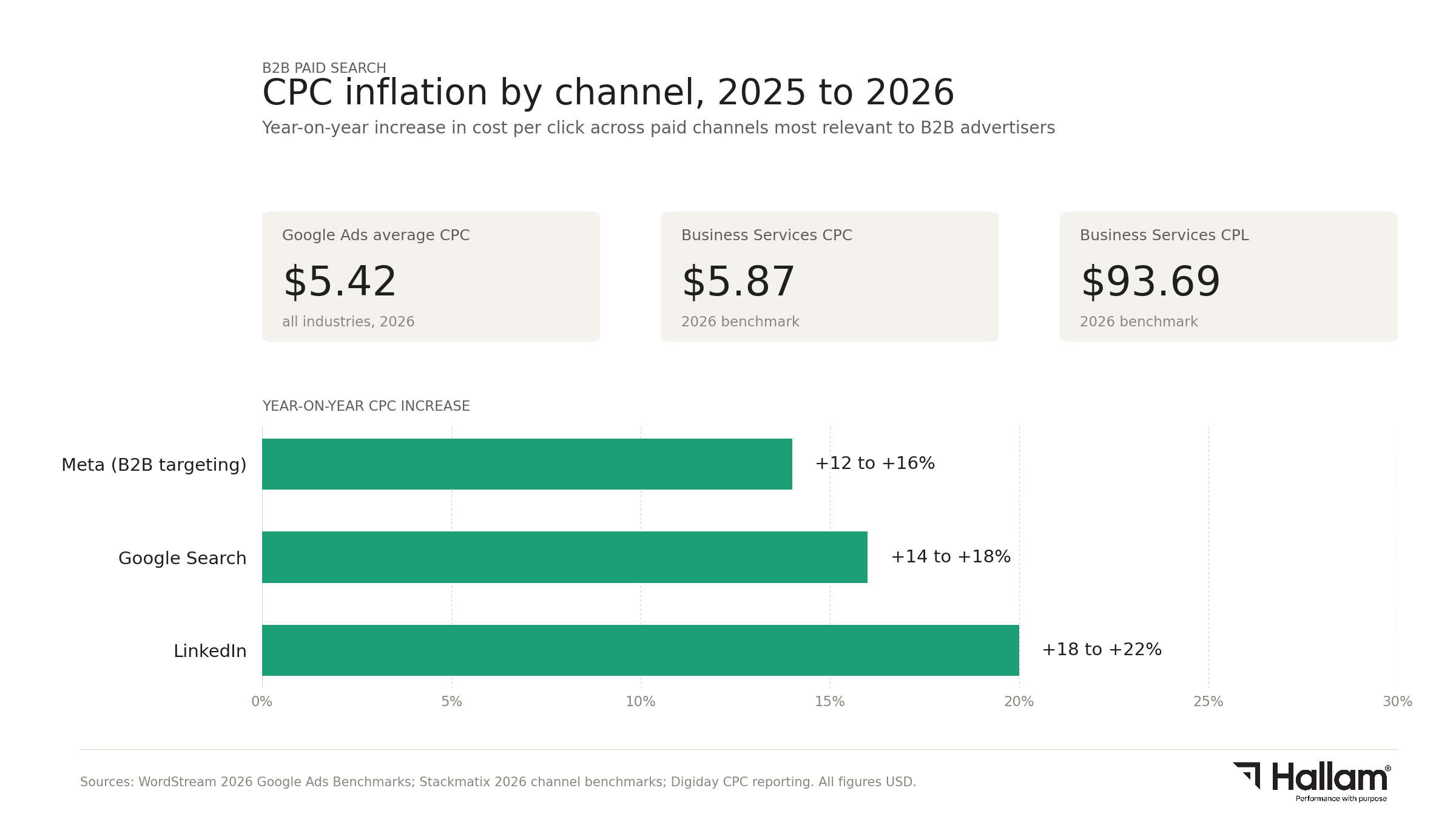
For a B2B brand running across all three, that is a compounding cost problem which means that if budgets remain flat YoY, you’re being asked to do more with a lot less.
The instinctive response to these increases is to look for a tactical fix. Tighten match types. Refresh creative. Audit negatives. All of which are valid and necessary to improve in-platform efficiency. But none of them address the underlying reason this is happening.
Why AI search + CPC inflation are interconnected
The temptation is to read CPC inflation as a paid problem and the rise of AI Overviews and LLMs as an organic problem. They are not separate. They are two visible symptoms of the same structural shift, and B2B brands are feeling it harder than most.
AI is compressing the SERP
Google’s AI Overviews, AI Mode, and the broader move toward generative answers inside the search interface push paid results further down the page. Fewer visible ad slots above the fold means more advertisers competing for the same inventory, and the auction prices respond accordingly.
Paid search is now being used to prop up performance for brands whose SEO traffic has fallen following the rollout of AI Overviews.
Organic clicks are leaking out of Google entirely
Digiday’s research on zero-click search found that 37 percent of brand and agency pros have already seen decreases in upper-funnel search traffic as a result of AI, and a Bain and Dynata survey estimated organic traffic decreases of 15 to 25 percent for brands whose users now rely on AI summaries.
For B2B brands specifically, 6sense’s research on B2B buyer behaviour now shows the vast majority of tech buyers using AI tools as much or more than search engines for vendor research, with significantly higher conversion rates from AI-referred traffic than from traditional organic.
B2B SaaS spend is growing faster than search volume
More well-funded brands are entering the auctions for the same finite set of high-intent commercial keywords. Even if AI search were not changing the SERP, you would still be paying more in 2026 than you did in 2024 because of competitive pressure alone.
Put those three forces together and CPC inflation looks less like a market correction and more like a permanent reconfiguration of where attention sits and what you have to pay to access it.
This is why I keep telling clients that we are watching paid search transition from a demand-capture channel into something closer to a demand-defence channel. The auctions you are paying premium prices for are increasingly the only auctions where your prospect has actually exited the AI summary and clicked.
The trap most B2B marketers are falling into
If your instinct on reading the data above is to ask your team to “do more of what’s working,” that is almost certainly the wrong move.
The pattern I keep seeing inside B2B accounts is over-reliance on harvesting demand. Branded search, retargeting, and bottom-of-funnel non-brand terms are converting well, the platforms are reporting good ROAS, and the temptation is to keep pouring budget into the channels that look most efficient on a last-click basis.
This is precisely the moment when CPC inflation does the most damage, because you are concentrating the budget into the narrowest slice of the funnel at exactly the point where competitors are doing the same.
The Day One List concept is the data point I find most useful when explaining this to senior B2B leaders. This research shows 86 percent of buyers are aware of vendors that could meet their needs on day one of their purchase journey. 79 percent will do further research anyway. But 93 percent ultimately buy from a vendor on that original list.
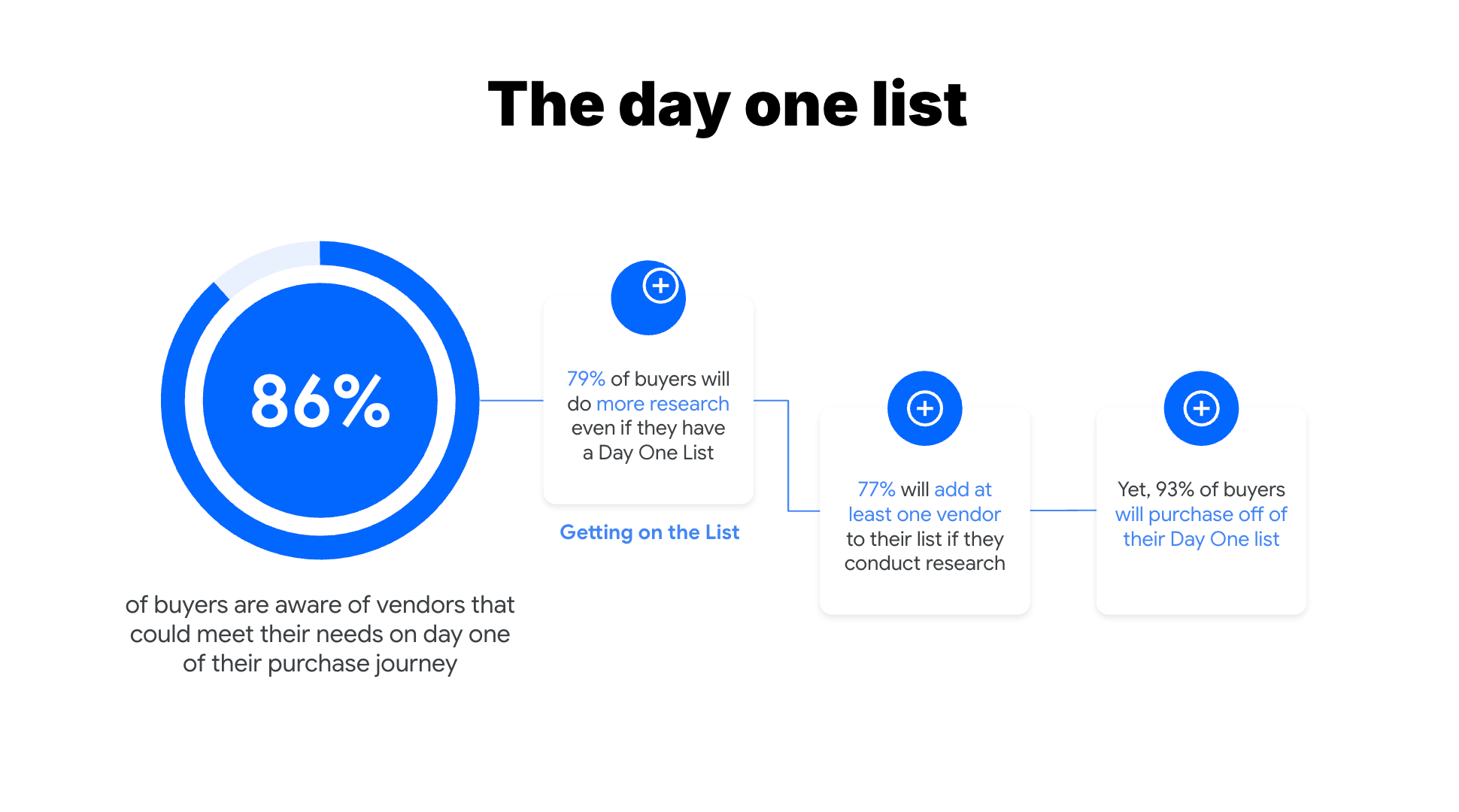
If you are only present in the harvest-demand layer, you are paying premium CPCs to fight for the 7 percent who can still be persuaded late, while ignoring the brand-level work that gets you on the list in the first place.
This is not an argument against paid search. It is an argument for being honest about what role paid search is actually playing in a B2B buying journey that increasingly starts in LLMs, on LinkedIn, in Slack communities, on YouTube, and in industry publications, and only ends on a Google SERP when the buyer is ready to commit.
A framework for deciding your next move
The most useful exercise I have run with B2B clients this year is not to ask “what’s the CPC?” first. It is to ask “what role is this campaign actually playing in the buying journey?”
In a B2B journey shaped by AI search, peer recommendation and multi-month consideration cycles, every paid campaign in your account is doing one of three jobs.
Each job has a different relationship with rising costs, and each deserves a different response. The framework below uses the language of the ‘The Day One List’, because it maps to the psychology of B2B buying.
| Role | Buyer behaviour | Where the work happens | Your response |
|---|---|---|---|
| Day One List Entry
(Getting on the Day one list) |
86% of B2B buyers are aware of vendors who could meet their needs on day one. | Brand advertising, digital PR, original research, LLM citations, podcasts, video, thought leadership. | Invest more.
Authority is the cheapest insurance against rising auction prices. |
| Day One List Defence
(Building visibility in the messy middle) |
79% do further research even when they already have a Day One List. | Mid-funnel keyword targeting + lead gen ads, sponsored review-site placements. | Absorb selectively. Run incrementality tests to find the campaigns that actually shift preference, and protect those. |
| Day One List Conversion
(Being the chosen vendor) |
93% ultimately buy from a vendor on their original Day One List. | High-intent commercial terms, branded search terms, retargeting, sales-enablement campaigns. | Absorb fully. Optimise the post-click experience, not the auction. |
Role 1: Day One List Entry
List Entry is the work that gets your brand into the 86 percent of buyers who already know who could solve their problem before they start researching. In 2026, almost none of it happens inside paid search. It happens through the brand-level content that LLMs cite, the original research journalists reference, the expert commentary in industry publications, and the steady accumulation of brand authority across the surfaces an AI Overview is built from.
As CPC inflation gets worse, the ROI on List Entry work gets better. You are competing on familiarity, not on bid price. The brands holding their margins through 2026 are the ones reallocating part of their paid budget into authority work that lets them win the auction more cheaply when they get there.
Role 2: Day One List Defence
79 percent of B2B buyers will do further research even when they already have a Day One List. List Defence is the work that ensures they find you reinforced rather than displaced.
This is where most of your mid-funnel paid investments sit. Non-brand comparison terms, retargeting, LinkedIn Thought Leader Ads (which typically deliver around 1.7x the CTR of standard company-page ads), and sponsored review-site placements.
Role 3: Day One List Conversion
93 percent of B2B buyers ultimately purchase from a vendor on their original Day One List. List Conversion is the work that makes sure you are the vendor they choose.
This is the cleanest CPC inflation conversation in your account, because the math is the simplest. The lifetime value of a B2B contract dwarfs the CPC, even at 25 percent year-on-year inflation. The optimisation move here is to fix the conversion experience, not to fight the auction.
Where most B2B budgets are misallocated
The trap is the same in account after account. Teams over-fund the bottom of the funnel, because last-click attribution makes it look efficient. They under-fund List Entry, because the ROI is hard to prove in a single quarter. And they treat List Defence as generic non-brand spend rather than the preference-shifting layer it actually is. CPC inflation makes that misallocation more expensive over time.
What diversification actually looks like in B2B
The clients we’re working with right now are moving meaningful budgets out of conversion harvesting and into brand activity designed to get them on the day one list. In practice, this involves:
Building category and canonical authority before AI summarises you out. If LLMs are now the primary surface where vendor shortlists are formed, the work that gets you cited inside those summaries sits upstream of paid search entirely. Original research, definitive explainer content, and the kind of brand authority signals LLMs are trained on are now the foundation that allows your paid search to convert at sustainable cost.
Running incrementality tests, not attribution audits. Last-click reporting is actively misleading in a B2B buying journey that includes AI tools, peer recommendations, and 12-month consideration cycles. Geo-based holdouts, conversion-lift studies, and marketing mix modelling are how you separate mid-funnel campaigns that genuinely shift preference from campaigns that look efficient only because they sit closest to the conversion event.
Moving some demand-capture spend into demand-creation surfaces. Programmatic, CTV, and B2B content sponsorships are not direct substitutes for branded search. They widen the universe of buyers who eventually arrive on your branded search query, which is exactly the lever that makes your acquisition economics work under inflation.
Focusing on experience, not the auction. If branded search costs are climbing, the question is not “how do I get the CPC down?” It is “what would I have to improve about the post-click experience to absorb a 25 percent CPC increase without hurting CAC?” That is a conversion rate, contract value, or sales-cycle question, not a media one.
In summary
CPC inflation is not going away. It is the price B2B brands now pay for a generation of buyers who use AI as their first port of call for vendor research. The brands that protect their margins through this transition will not be the ones chasing the lowest CPC. They will be the ones who built enough authority outside the auction that they can afford to win it when it matters.
If your account is feeling the squeeze, the question worth sitting with is not “how do I get my CPCs down?” It is “what would my paid search look like if it were one of three or four ways my buyers found me, instead of the only one?”