

For a while now, it’s felt like the term “SEO” just…doesn’t quite cut it.
You only have to consider the seemingly endless number of acronyms that’ve reared their heads in recent years (from LLMO, to GEO, AEO, and everything in between) to know that SEO is a very different beast today than the one depicted in the best practice guides of even five years ago.
And let’s be honest, even if we put down our glossaries and ignore the above, for even longer, SEO has traditionally been a synonym for “Google”.
(Sorry Bing).
Google created the world’s most popular browser and search engine. It owns YouTube, the world’s most-subscribed video sharing platform (and second most popular search engine). We use it for ads, for maps, for recipes. “Googling” is even a verb, for God’s sake.
But for the first time, that dominance is under question. The company has now lost multiple antitrust cases: in 2024, a US judge ruled that Google held an illegal monopoly on the search market, and in 2025, a second ruling found it had also illegally monopolised the online ad tech market.
Alongside these accumulating lawsuits, we’re seeing a continuous evolution in AI-driven search and the capabilities of Large Language Models, combined with audiences increasingly spending more time across a wider variety of platforms. All of these scenarios are chinks in Google’s considerable armour, and to remain ahead of the curve, businesses need to tailor their strategies to the platforms where their customers can be found; not just where they expect them to be.
This is where Hallam, and Total Search Optimisation, can help.
What is Total Search?
Total Search is our comprehensive strategy for ensuring a business appears organically in front of its customers across multiple platforms, not just traditional search engines.
This approach considers the rise of AI-driven search, social media discovery, and non-Google search engines, positioning businesses where their audiences actively seek information.
Platforms Beyond Google for Organic Visibility
As Google’s dominance is challenged, businesses must optimise for alternative platforms to remain competitive. Analysis tools exist within the market (such as SparkToro) that audit brands and identify where their demographics spend time online. These programs will act as the new “starting point” for all Total Search strategies to ensure businesses appear wherever their audience is.
Key platforms involved in Total Search include:
1. Alternative Search Engines
- Bing: Microsoft’s search engine, holding 4.5% of the global market share (August 2026).
- Baidu: The leading search engine in China, with 59.3% market share in the Chinese market.
- Yandex: Russia’s dominant search engine, controlling over 70.4% of the market in Russia.
- Naver: One of South Korea’s most popular search engines, with 43.7% market share.
2. Social Search & Visual Discovery Platforms
- Pinterest: A visual discovery platform which receives over 13 million active users in the UK. It enables users to search for ideas and products, making it essential for e-commerce and lifestyle brands.
- TikTok: With younger audiences using TikTok as a search engine for recommendations, combined with a total of 1.194 billion monthly active users worldwide, brands must consider optimising content for in-platform discovery.
- YouTube: As the world’s second-largest search engine, where more than 70% of YouTube watch time is driven by the platform’s recommendation algorithm, video SEO is critical for brands leveraging this platform.
3. Community search
- Reddit: Increasingly a search destination in its own right, with over 80 million people searching directly on the platform every week (Search Engine Land). Reddit threads have long been among the most frequently cited sources in Google’s AI Overviews.
- Quora: With over 400 million monthly active users (DemandSage), Quora has shifted from a traffic source to a “citation asset”, where its answers are frequently pulled into AI Overviews and LLM responses.
4. AI & Large Language Models (LLMs)
- AI Mode & AI Overviews: Google’s AI-generated answers now reach over 2.5 billion monthly users through AI Overviews, while AI Mode passed 1 billion monthly active users within a year of launch (Google I/O 2026)
- ChatGPT: AI-driven assistants like ChatGPT are reshaping how users find information, with weekly active users reportedly reaching around 900 million in early 2026 (TechCrunch).
- Claude: Claude’s traffic has grown faster than any major AI platform’s, with claude.ai drawing an estimated 245 million monthly active users as of mid-2026 (AI Business Weekly)
- Perplexity: An “answer engine” rather than a traditional search tool, Perplexity has scaled beyond its early-adopter roots, with tens of millions of monthly users and annualised revenue surpassing $450 million by early 2026 (Tech Startups).
5. B2B Discovery
Why is Total Search Important?
As well as the aforementioned legal pressures Google is facing, several other trends necessitate search strategies independent of Google:
- AI’s Influence on search behaviour: Google’s dominance in search traffic remains strong, but AI-driven search tools and AI-generated answers are beginning to change how users seek information. 48% of searches now trigger AI-generated overviews directly on search results pages (BrightEdge), and it’s reported that 68% of US Google searches now result in no click at all (SparkToro).
- Changing search landscape: Beyond a rise in LLM usage, users are increasingly using a wider variety of platforms to consume information online. For example, nearly 40% of Gen Z prefer TikTok or Instagram over Google for everyday searches.
- Search visibility isn’t guaranteed: Google’s algorithms are constantly changing, and tactics that work today aren’t guaranteed to work tomorrow. A SEJ article found that ranking volatility increased by 26% in 2024 vs 2023. A strong post on LinkedIn or a helpful answer on Reddit can still be seen months or years later. Google-indexed content, by contrast, is often short-lived if not constantly updated.
- Evolving SERPs harming smaller businesses: With organic listings being pushed further down by AI Overviews and Rich Snippets, rising CPCs, and zero-click searches becoming more common, smaller businesses are struggling to compete.
A Total Search strategy will help diversify traffic across the web and increase conversions by targeting the right audience on the right platforms. It will also leave users less at the mercy of an ecosystem that doesn’t guarantee lasting visibility.
Benefits of Total Search for the B2B Market
Our Total Search approach has a lot of inherent benefits for B2B businesses.
For one thing, B2B purchasing decisions don’t happen purely within Google. These purchases involve extensive research, often across multiple platforms beyond Google, such as LinkedIn, YouTube, and AI-driven search tools. Total Search ensures brands are visible at every stage of the buyer’s journey, from awareness to conversion, by optimising for multiple discovery platforms.
Also, Total Search strategies have the potential to be more cost-effective than Paid Search alone. Many B2B industries face high CPCs due to competition for niche, high-value keywords. By balancing Organic, Paid, and Alternative Platform strategies, Total Search reduces reliance on potentially costly paid campaigns while maintaining strong visibility across multiple channels.
Ultimately, our approach will help B2B businesses stay ahead in an ever-changing search landscape. More professionals use AI-powered tools like ChatGPT and Perplexity AI for industry research and decision-making. Optimising for AI-driven search ensures that B2B brands provide authoritative answers and remain visible in AI-generated responses.
The Total Search Tiering System
So, what does a Total Search strategy look like in practice?
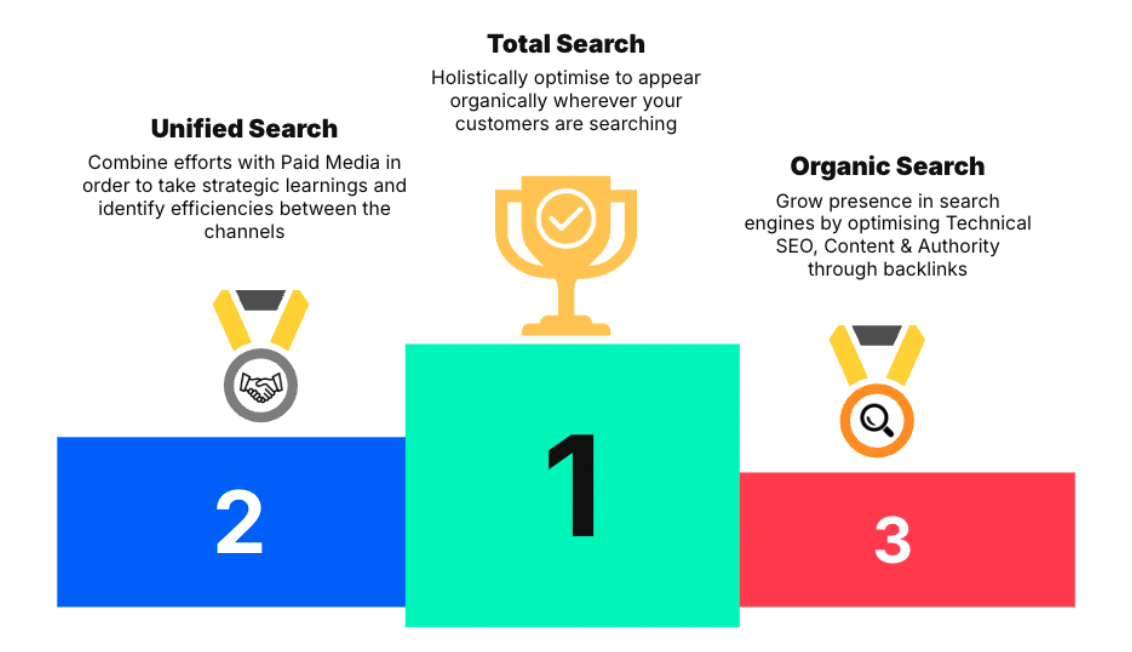
To deliver an effective and scalable strategy, we propose a three-tiered system:
1. Organic Search
- Focuses on optimising a business’ website to rank higher on search engines.
- Includes technical SEO, on-page optimisation, content strategy, and building authority through backlinks.
- Primarily targets Google but also considers other search engines like Bing and Baidu.
This initial stage ensures B2B businesses have mastered SEO fundamentals, both from a technical and content standpoint, before exploring further growth opportunities. Any effective Total Search strategy needs to be based on organic best practices to succeed.
2. Unified Search
- Integrates Organic Search with Paid Search strategies to maximise efficiency
and conversions. - Allows Paid Search campaigns to reduce bidding on high-value keywords when strong organic rankings are achieved, ensuring budget efficiency.
- Focuses on the synergy between SEO and PPC to drive optimal on-site performance.
A collaborative and considered strategy encompassing Paid and Organic allows for shared learnings between channels to strengthen acquisition. For example, Paid data can determine when particular products are in high demand, informing decisions around Organic seasonality. Or, Organic data can be used to support bidding decisions and maximise paid budgets.
3. Total Search
- Encompasses Organic and Unified Search, while expanding visibility beyond traditional search engines.
- Optimises for alternative search platforms, AI-driven discovery tools (e.g. ChatGPT, Claude and Perplexity), and social search (e.g. Pinterest, YouTube, and TikTok).
- Ensures a brand’s presence across multiple touchpoints, adapting to changing consumer search behaviours.
Ultimately, a Total Search approach evolves alongside the changing Google ecosystem, while also recognising its limitations in acquiring the right users for all businesses. It allows B2B businesses to reach users earlier in their journey, build more resilient, future-proof strategies, and drive consistent performance across multiple platforms.
Overall, implementing a Total Search strategy delivers results for our clients. By working with the Safer Food Group to execute a strategy spanning organic content, technical SEO and AI platform visibility, we increased organic revenue from AI platforms by 166.5% across a five-month period (read the full case study here).
Final thoughts
Google isn’t disappearing but it’s no longer the whole picture. Between mounting legal pressure, the rise of AI-generated search, and audiences spending time across platforms Google doesn’t own, businesses that optimise for Google alone are optimising for a shrinking share of how people actually consume information online.
For B2B brands, your buyers are researching on LinkedIn, asking ChatGPT and Perplexity for recommendations, and reading Reddit threads before they even consider completing a contact form. If your visibility stops at Google, you’re missing out on opportunities to get your brand in front of your audience across the web.
At Hallam, our three-tiered approach takes you from strong organic search foundations, through smarter organic-paid alignment, to building a presence across the platforms which matter to your audience.
Ready to move beyond traditional SEO? Contact us to talk to our team about building a Total Search strategy which is tailored to where your users can be found.