

Imagine covering the entire land surface of the Earth in a blanket of books. Twice. That’s the equivalent of what we digitally create every single day, a staggering 402 million terabytes (source).
And the next day, we do it all over again.
We have entered what I call the “Age of Abundance“: a period where artificial intelligence lets us create so much, so easily, that scarcity becomes a relic of the past. This abundance will arrive first in the realm of bits, only later in the realm of atoms.
I argue that the digital world, the realm of bits, crossed into the Age of Abundance in 2023.
In 2023, the sum total of information created, captured, and stored surpassed 100 zettabytes, a figure so large as to be nearly meaningless, yet it represents one trillion gigabytes. The absolute number matters less than the trend, the world’s total data now doubles every four years.
Abundance, if equitably distributed, could liberate humanity from scarcity. Yet it remains unfamiliar territory for our species. Our biological and perceptual systems evolved for scarcity, shaped by millennia of want, not abundance. The consequences of this mismatch are already visible: in the privileged nations of the global North, abundant food supplies have paradoxically diminished rather than improved public health.
This article explores how the Age of Abundance is reshaping digital content, and offers an original framework, PRISM, for standing out amongst the deluge of AI content.
90% of all data has been generated in the last two years
Daily, we generate 403 million terabytes of data (source). For context, the British Library, which contains every book ever published in Britain, holds over 170 million items. We now create 5,700 British Libraries of content every day.
Digital content creation is truly staggering, with an estimated 90% of all global data having been generated in the last two years alone. Projections from IDC suggest this trend will continue, with the world’s total data volume doubling roughly every four years.
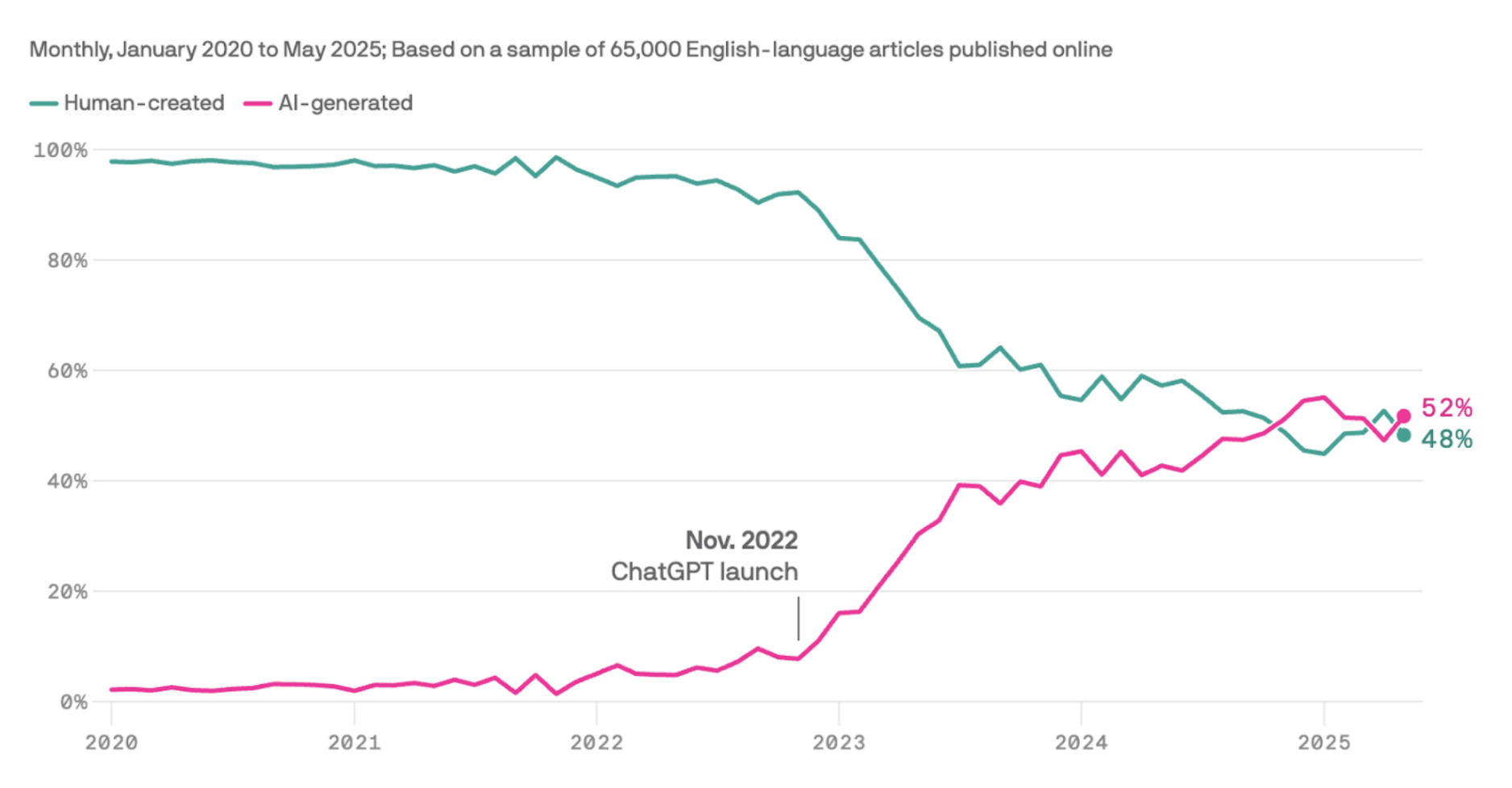
Over 50% of online content is AI generated
Recent estimates suggest over half of all online content is now AI-generated (source).
The graph below illustrates this shift: AI-written articles accelerate rapidly, eventually matching human-written content before levelling off (credit to Axios).
This plateau may not reflect a drop in AI adoption, but rather a rapid convergence of writing styles. A feedback loop is forming: human writers are adopting the style of their AI ghostwriters, while AI is learning to mimic human nuance, making the two increasingly indistinguishable.
Social media posting increases by 50%
Content creation tools have driven a surge in social media activity.
LinkedIn users now publish roughly 2 million posts daily, a number that continues to grow each year, while comments have increased 24%. On Instagram, accounts with over 5,000 followers are posting 50% more frequently since ChatGPT’s launch, according to Statista.
“The ability to create has slipped from the hands of the few into the palms of everyone. What once took teams, budgets, and months can now materialise in moments. The floodgates have opened, and with them comes a deluge of content so vast it defies our ability to comprehend its scale.”
Introducing PRISM
A Framework for Creation in the Age of Abundance
The laws of supply and demand are unforgiving: when content becomes abundant, its value plummets. With at least half of all content now AI-generated, volume no longer matters. Trust is the new currency.
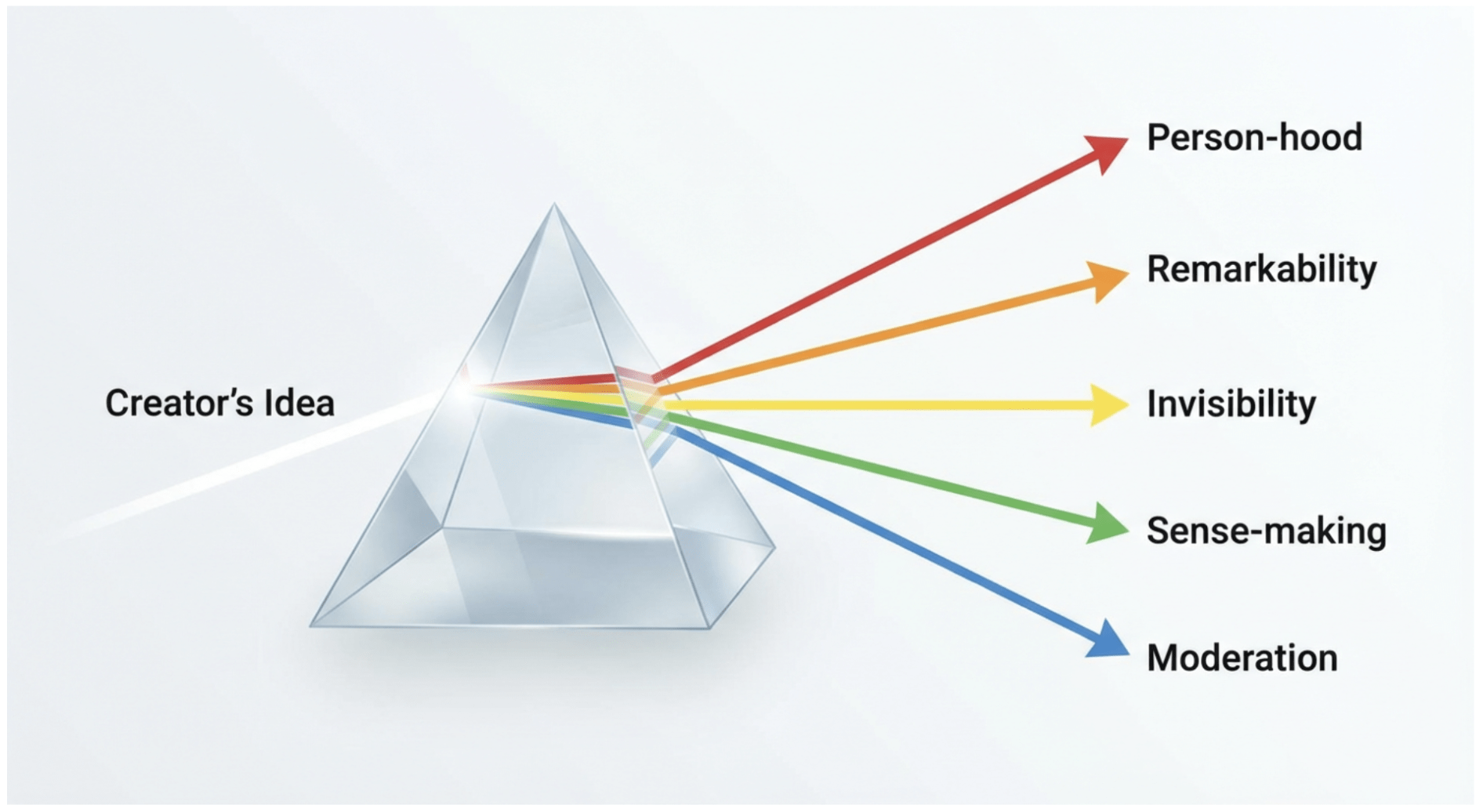
I’ve created the PRISM framework as a lens for creators to enhance the trust and value of their work. It maps what I call “value-flow”, how perceived value shifts within a system. PRISM stands for:
- P Person-hood
- R Remarkability
- I Invisibility
- S Sense-making
- M Moderation
P is for Person-hood
In the Age of Abundance, proof of personhood becomes the primary signal of value.
Would you rather read flawless AI-generated prose or the authentic thoughts of a person riddled with typos?
Most of us choose the messy human version, and not out of nostalgia. We choose it because humans possess what philosophers call “qualia”: the subjective, felt quality of conscious experience. Behind human writing lies a mind that struggles, doubts, desires, and dies. We don’t just want information. We want to know how another consciousness makes sense of existence.
This insight is key for creators. Personal brands will surge while faceless corporate content withers. When information is infinite, its value trends to zero. What becomes valuable is originality, perspective, and proof of personhood.
This explains the flight to video and audio. Written content is trivially easy to automate, but a face, a voice, a hesitation mid-sentence, these signal human presence. They’re harder to fake and more costly to produce, which makes them more trustworthy.
In the Age of Abundance, value flows toward whatever most convincingly proves: a person made this.
R is for Remarkability
In the Age of Abundance, remarkability will be disproportionately rewarded, and the gap will be extreme.
What amplifies this is an idea I call “value-flow”, which describes the dynamics caused by abundance. The First Law of Thermodynamics states that energy cannot be created or destroyed. Value behaves in a similar way, not being destroyed, but transferred.
It would appear that as the supply of content increases, the value would decrease. But this misses what actually happens. A flood of mediocre AI content doesn’t destroy value, it redirects it. As generic AI content becomes worthless, scarce forms of content capture a disproportionate increase in perceived value. Value doesn’t vanish. It flows.
This is why remarkability will be disproportionately rewarded.
Content engagement already follows a Pareto distribution: the top 20% of blogs capture 80% of traffic. But this will compound into a power law, where Pareto distributions nest within each other.
The top 1% of creators will command 90% of all attention.
This reshapes the creator’s calculus entirely. If you have ten hours for content creation, you’re better off producing one remarkable piece than ten mediocre ones. This asymmetric return on effort is amplified by the value-flow dynamic. As generic content floods the system, value concentrates on the exceptional.
The mechanism is algorithmic: platforms reward engagement, and a single remarkable piece will reach more people than ten forgettable ones combined. In a world drowning in content, only the remarkable survives.
I is for Invisibility
In the Age of Abundance, AI usage should be invisible.
The question isn’t whether or not to use AI in creative work, that ship has sailed. What matters is visibility. And I contend that AI should remain invisible.
Humans evolved over millennia to detect patterns; it was a survival mechanism that shaped natural selection. We’re hardwired for it. Today, that ancestral skill manifests in our ability to spot AI-generated content. Research shows that over 50% of people can identify it, with millennials showing even higher detection rates.
Research by MIT into the psychology of AI-generated content reveals a fascinating paradox:
- AI-created material was found to be more persuasive than human-created content (source).
- Learning that something was AI-generated doesn’t diminish our preference for it (source).
- Yet here’s the contradiction: when we independently spot AI fingerprints in content, over half of us immediately disengage (source).
The problem isn’t AI, it’s getting caught.
Obvious AI content feels cheap. In the Age of Abundance, effort itself is the currency and anything that smells mass-produced is treated like spam. Care is legible, and can be felt.
So invisibility must become a cornerstone of your AI strategy.
S is for sense-making
In the Age of Abundance, the ability to make sense of information becomes more valuable than access to it.
Knowledge is now in abundance, which means its value has plummeted. Sense-making, by contrast, remains scarce. The difference is crucial: knowledge can be downloaded, but sense-making must be earned through experience.
Sense-making is pattern recognition hardened into judgment, the capacity to discern not merely what action to take, but whether to act at all, and if so, when and how.
Sense-making manifests in several forms, all of which become disproportionately valuable in the Age of Abundance:
- Curation: A creative director makes sense when they identify which AI-generated concept resonates culturally and which falls flat. The skill is discernment.
- Framing: A thinker makes sense when they provide a lens through which to view a problem. It’s an interpretative layer or a way of organising complexity into meaning.
- Point of view: A creator makes sense when they offer an original perspective on existing discourse. Not more data, but a distinct consciousness processing that data.
These forms of creative expression are fundamentally human acts that tie back to Person-hood. We seek to understand how another consciousness makes sense of existence. A machine can generate knowledge, but it cannot make sense of the world. Only a person can do that.
M is for Moderation
In the Age of Abundance, saying no becomes more important than saying yes.
This ability to moderate applies to both consumption and creation. When information was scarce, competitive advantage came from accessing more of it. Knowledge was power. The Age of Abundance inverts this logic, more information becomes cognitive noise.
I propose the following workflow:
- Curate rigorously. Cultivate a small number of trusted sources rather than surveying the entire landscape.
- Create, don’t consume. Shift your default mode from passive consumption to active creation. Agency matters more than awareness.
- Maintain scarcity. Limit what you produce to preserve quality and attention. Your personal brand is diluted by volume.
Remarkability requires restraint.
Excessive creation diminishes quality and devalues your work. In an age that punishes mediocrity with invisibility, less is more. The creator who publishes weekly remarkable pieces will command more attention than the one who publishes daily forgettable ones. Value flows toward scarcity, and scarcity is now something you must create deliberately.
Becoming the Lighthouse
So we return to the infinite library, the landmass of books that blankets our world anew each day. The Age of Abundance doesn’t ask us to write more, faster, or louder. It asks us to make a choice. Will we contribute to the noise, or will we build a lighthouse?
A lighthouse isn’t trying to out-shout the storm; it offers a different kind of power. It doesn’t chase down ships or scream for attention; it acts as a fixed point of trust, a reliable guide for those who are actively seeking a safe harbour.
The PRISM framework I have offered is meant not as a checklist, but instead the foundations for building that lighthouse. It is a call to the messy but real truth of Person-hood; a dedication to the craft of Remarkability, and the quiet wisdom of Moderation.
The paradox of the AI era is this: the more robotic our tools become, the more valuable it is to be unflinchingly, unapologetically human. The future belongs not to those who add to the deluge, but to those who can stand firm, cut through the noise and offer the lens that makes sense of it all.
Looking to stand out? Get in touch today.