

We saw it coming but ChatGPT ads have finally made it to the UK, making it the first European market to get access. On 6 June 2026, Benji Shomair, VP Monetisation at OpenAI announced the launch on LinkedIn, sending the UK advertising world into a little bit of a frenzy. Japan, South Korea, Brazil and Mexico are apparently next in line over the coming weeks.
Ads within ChatGPT have already been running in the US for a while now, gradually evolving from being rep-assisted into a self-serve platform. In the UK, however, they continue to be in pilot with partners, alongside access through technology partners like StackAdapt.
What are ChatGPT ads?
ChatGPT ads are adverts that appear underneath the LLM response. The format mirrors what’s already been tested in the US. Sponsored placements show up beneath AI-generated answers and are matched contextually to whatever the user is talking about. It’s less “interruptive banner ad energy” and more “if you’re already thinking about this, here’s something relevant” energy – at least in theory.
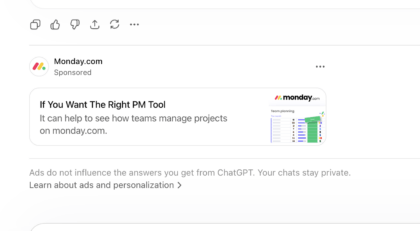
Source: ChatGPT
They only show for users on the Free and Go tiers. If you’re on Plus, Pro or Enterprise, you won’t see them at all, which creates an interesting split between “paid for the product” and “you are the product”, depending on how blunt you want to be about it.
For now, UK advertisers need to register interest directly with OpenAI. The full self-serve Ads Manager that exists in the US hasn’t rolled out internationally yet, which means we’re still in that slightly awkward early phase where the idea exists, but the tooling is catching up. Alternatively, you can go through DSPs like StackAdapt to get early access.
What does targeting look like?
From what’s been shared via partners like StackAdapt, targeting is primarily contextual. That means ads are matched to what someone is actively talking about in the conversation, rather than who that person is as a demographic or behavioural profile. There isn’t much sign yet of traditional audience targeting, lookalike modelling, or the kind of layered segmentation advertisers are used to on platforms like Meta or Google.
So in practice, it’s mostly intent-based. If someone is asking about CRM tools, they may see CRM ads. If they’re discussing travel insurance, they may see travel insurance ads. The system is essentially responding to the conversation in real time.
Ads are bought on a CPM or CPC basis and served underneath ChatGPT responses. The format itself is very familiar if you’ve been in digital long enough: a short headline, a line or two of description, and a small image.
Right now, it’s fair to say the platform is still in its early, slightly stripped-back phase. You have limited targeting, limited reporting and limited controls.
Oh no, another ad platform?
We all knew this was coming. OpenAI was never going to build one of the most widely used consumer products in history and then not monetise it. The price we pay for a ‘free product’ is our attention. The more interesting question is, will ads on ChatGPT change the way users use the platform?
It is only normal as a user to wonder if ChatGPT is going to become untrustworthy, or perhaps less trustworthy, now that ad revenue is involved. According to OpenAI, the platform will continue to give answers that are objectively useful and ads will only support the answer. Relevance of the answer will come first.
You’d hope that would be the case so let’s assume that that will stay true. In that fashion, I do think ChatGPT ads will be super powerful because of how deep into the customer journey the platform is now engrained.
The modern customer journey
There was a time when us marketers liked to pretend the customer journey was linear and tidy. Awareness at the top. Consideration in the middle. Conversion at the bottom. A nice clean funnel you could draw in a deck and present to stakeholders without anyone asking too many awkward questions. The time is long gone.
Today, the customer journey looks more like being on a road trip with someone who is directionally challenged. You set off with a plan, then immediately take a wrong turn, then stop for coffee you didn’t really need, then detour to somewhere completely unrelated, and somehow end up discussing camping equipment despite never having expressed any interest in camping. That’s closer to reality.
People don’t move neatly through funnels anymore. They bounce between TikTok, Reddit, YouTube, Google, review sites, group chats, comparison sites and now AI tools. And they don’t always know what stage they’re in themselves. Sometimes they’re researching. Sometimes they’re procrastinating. Sometimes they’re just thinking out loud in a way that happens to involve a screen. And increasingly, that “thinking out loud” is happening in ChatGPT.
It is important to recognise that ChatGPT is not replacing search, or social, or anything dramatic like that. But it has become a place where people actively work through decisions. Software choices, travel plans, gift ideas, career questions, you name it. With 900 million weekly active users, a lot of whom are presumably on the free tier, ChatGPT ads become a powerful tool in being part of the product discovery and product evaluation.
Why the Google SERP feels noisy and less relevant
One of the core things Smart Bidding on Google offered was intent matching. By analysing trillions of data signals, Smart Bidding entered appropriate ad auctions for you and to maximise the return on your objectives. Simple in theory, incredibly complex in practice. There is no doubt that Smart Bidding still reads trillions of data signals when running ad auctions. However, things do feel just a little different.
Over time, Google’s focus on AI has made it difficult to match user intent and query with an ad. With a push towards Broad Match, AI Max, text customisations, URL expansions, us advertisers have less control over how our ads show up when users have a query. I’m not implying that the use of AI is bad; all I’m saying is that sometimes the result of leaning into broad targeting is Google’s SERP being unable to answer a user query.
Let me walk you through my personal example. I recently searched for “best LLMs for small business”. Now that is a hard query because the intent of my search is not fully visible. Am I researching? Am I buying? Am I comparing tools? Am I trying to understand what “good” looks like in that category?
As you will see in the screenshot below, the ads beneath the AI Overviews were only broadly relevant. Only two out of the four ads even included the word ‘LLMs’. None of them even mentioned small businesses. Most importantly, none of the four brands are actually even LLMs.

Source: Google
So where does that leave me? In the arms of ChatGPT (or a fellow LLM, but for me personally, it’s chatGPT). When users start relying on ChatGPT, especially for research and product discovery, ads in that space start to play a big role.
Should we all start running ChatGPT ads?
Given everything I’ve said above, I wouldn’t blame you if you want to get cracking and get your ads live on ChatGPT. However, before you do that, here are two questions you should think about:
1. How large is your marketing budget?
If you’re already scraping the bottom of your purse to afford Google Ads, maybe don’t instantly run ChatGPT ads. As great an opportunity as they may seem, there is limited targeting and limited reporting within this evolving ad platform. They are also not cheap: in some industries the CPMs are as high as £60. However, if you are a large business, then absolutely run ChatGPT ads. Get those first mover advantages in and build that brand presence.
2. Do you only run lead generation activity and rely on in-platform data to make marketing decisions?
If the answer to the above is yes, perhaps wait this one out then. ChatGPT ads only offer reach and click optimisations so far. And the reporting is very very limited, the platform is still evolving and there is a possibility of bugs and glitches. So if your appetite for upper and mid-funnel activity is low, this platform may not be for you just yet.
To my fellow advertisers I say, where you can, test and learn. If your clients meet the above criteria, absolutely encourage testing the platform. Do your research and understand where ChatGPT sits in the media mix, test the platform, learn from it, and watch it evolve. It is our job to monitor what may become one of the most used ad platforms, as user search behaviour changes with our reliance on LLMs.
Are you looking to advertise in the LLMs? Get in touch today.