

Much brand strategy dies between the workshop and the website. The positioning gets agreed and the research deck gets signed off. Then the copywriter, the designer, the paid team and the sales director each turn it into something slightly different, and six months later the brand is making four arguments instead of one.
A messaging framework is how to stop that happening. It takes everything from the research phase (what customers want, what the client delivers, where competitors leave a gap) and turns it into a single document anyone on the project can write from. I’ve used it on website builds, ad campaigns, content programmes and investor decks. It’s the most useful tool I have for getting strategy to survive contact with execution.
I currently use a framework shared by Maya Shah-Ceccotti in CXL’s brand strategy mini-degree, that I adapted to fit my specific needs. It’s been a foundational element in activities as varied as website projects, advertising campaigns, content marketing and business development.
But how do you create one and how do you use it? Let’s take a deeper look.
What is a messaging framework and why do I need one for my B2B business?
A messaging framework is the internal document that sets out what a brand says, to whom and why: who you are, what you do, who you serve and the proof that you deliver. It isn’t customer-facing copy. It’s the structure that every piece of copy is built from, so a website, an ad campaign and a sales deck all make the same argument.
In my mind, clear messaging is essential to effective marketing. The best organisations create content that is relevant to their customers and engages them with interesting or helpful information. Their content is credible, reinforcing their authority and building trust with their audience. And it’s unique – helping them stand out in a sea of sameness.
Messaging – in all its different formats – is how your customers experience your brand. You can draw people in with clear and compelling messaging or push them away with confusion and complexity. Every interaction is a chance to add value to customers and boost their estimation of your brand.
And as customers move through their buying journey, their mindsets, questions and needs will change. Clear, compelling messaging is what will move someone from one stage to the next.
A key messaging framework:
- Helps summarise who you are as an organisation, what you do, who you exist to serve and how you solve their problems.
- Looks at the key benefits you offer different customer segments, demonstrates the value you provide and how you deliver that to them.
- Consolidates the proof that your solution delivers what customers want or need.
- Demonstrates how messaging can change over the course of the customer journey, from the passive state to the buying trigger, to the exploration and evaluation, and to the moment of purchase and experience of using the product.
Creating a B2B messaging framework
Messaging frameworks are transitional tools – bridging the brand strategy phase and the tactical delivery phase. You create them after you’ve done your research and have a clear sense of your target audience and your positioning for them.
Run a 3Cs analysis
Dr. Kenichi Ohmae, a brilliant Japanese business strategist, recommended looking at three critical elements to build an effective business strategy: Customers, Corporation and Competitors. It’s the foundation of our approach to brand strategy.
It’s essentially asking – what do customers want that you can deliver better than or differently to your competitors?
We hold deep dive interviews with customers to better understand their motivations, pain points, buying journey and brand perception. We run immersion sessions with key stakeholders in our client’s organisation to understand their origin story, what they deliver, and how it adds value to customers. And we research the category to understand the changing dynamics of the players, how they present themselves and where the opportunities are to stand out.
By mapping out these three areas, we start to see the connections and overlap, pulling out key themes and identifying the elements that will go into our framework.
Create the messaging framework
 The four main sections at the top of the messaging framework are the foundational elements.
- The Why – Drawing on Simon Sinek’s Golden Circle or Andy Raskin’s Strategic Narrative, this section summarises why you exist as an organisation. It should highlight a change in the world that makes you relevant.
- The What –You need clear, compelling messaging about what your product is and what space you play in. You want to call out what your unique selling point is – whether that’s doing something new or doing something familiar in a new way.
- The Who – There are a few ways you can think about segmentation here – for a vertical within your industry or a specific use case (also referred to as Jobs to Be Done), for a specific buyer persona or for specific solutions you sell.
- The How – This is product-focused messaging about the specific attributes and value of how you deliver for customers, including the sequence or workflow. It’s often found in mid-funnel messaging to show how you meet the needs and requirements of your customer segments.
The next section provides messaging for the outcome pillars – the themes we identified in our research review. I often link this to the segments called out in the WHO section. If it’s a Job to Be Done, a buyer persona or a specific solution, I’ll put that into the top box and complete the key messaging elements for each one.
- The benefit – This is about what you allow them to do
- The value – This is about why that’s important to them
- The delivery – This is the feature or capability that delivers on your promise
- The proof – This is how you demonstrate that you’ve delivered on your promise (quotes, stats, testimonials, etc.)
And then for each outcome, I think through the customer funnel and what messaging would apply at each stage to try to get them to move from one stage to the next. We’ve adapted our funnel from Google’s Messy Middle with the following stages:
- Passive state: Research has shown that up to 95% of customers aren’t in the market at any given time. So during this passive state, your messaging is simply about creating familiarity and linking your brand name to the positioning you want people to remember.
- Buying trigger: When people encounter a buying trigger, they move into an active purchase state, and you want your messaging to be tightly linked to the specific triggers your customers experience so that they think of you first.
- Exploration / Evaluation: As people toggle between these two states they are finding new solutions and testing them to see if they’d meet their needs; your messaging needs to relate back to the core problem they’re trying to solve or the benefit that they’re seeking.
- Purchase: When they’re ready to buy, your messaging needs to prove that you can deliver on the promise – show how you’ve done this for others like them.
- Experience: Don’t forget this step! How do you help them see value in your product / service quickly? How do you delight them once you have them onboard? This will inform how they talk about you to their friends and colleagues.
Validate the messaging framework
Remember that the messaging framework is a living, breathing document. It needs to be constantly refined. And the best way to do that is to test the messaging for resonance with the target audience and then to iterate your framework as the results come in.
There are a number of platforms that allow you to do concept testing when it’s at an early stage of development. But you can also use real deliverables in AB tests to identify which variant performs best with your customers.
Advertising assets are a great place to start and can help you get feedback quickly, but you can also look at key landing pages on your website and test new copy to see which converts best as well as testing out new messaging on your sales decks to find out what resonates most with prospective customers.
As you find out what works, make sure you go back to your messaging framework and keep it updated. It’s also useful to refresh these annually or when you expand to new markets or introduce new customer segments.
Messaging frameworks in action
For our B2B client Infodesk, the 3Cs work kept returning to the same theme. The value wasn’t in the intelligence itself; plenty of competitors could supply information. It was in what customers could do with it. That showed up in the framework as “intelligence activation”: accurate, but a working label rather than something you’d put in front of a buyer.
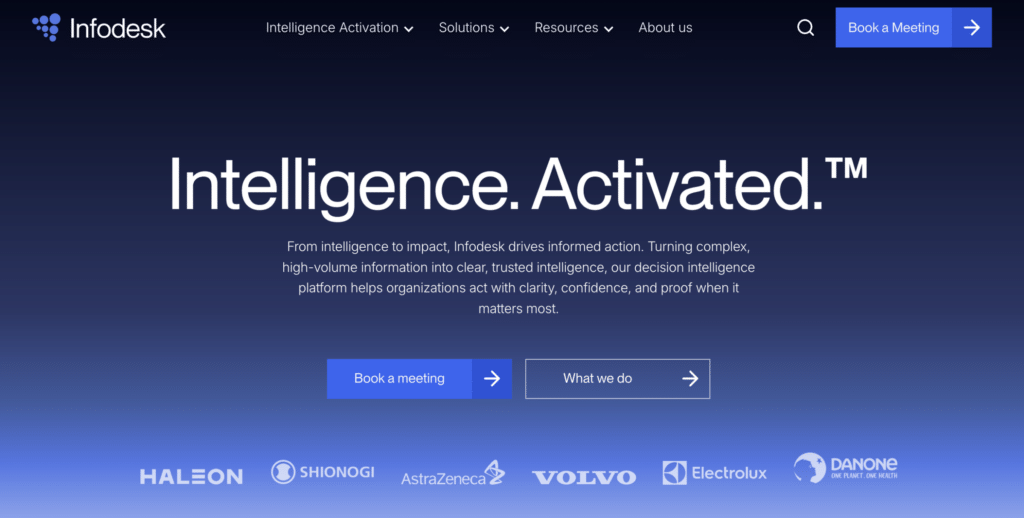
The finishing touch was small. Split it in two and add a full stop, and “Intelligence. Activated.” stopped being a description and became a statement. It now runs through everything from the homepage to the sales deck, which is the whole point of the framework: one argument, made consistently.
Infodesk followed some of the directions below, which we’ve used across a variety of projects. For example:
- Website copy – We built a new website for one of our professional services clients, and started with the 3Cs analysis and a key messaging framework. As we moved from wireframes into higher fidelity UI, our copywriting team took the core elements of the messaging framework and applied them to the homepage and service pages.
- Advertising concepts – We worked with an energy client launching a new public-facing brand to the marketplace. Our extensive 3Cs analysis and messaging framework was used to build out brand- and product-level advertising concepts to launch the brand.
- Content marketing – One of our retained clients in the accessibility space launched a new D2C brand to the marketplace. We’re using the messaging framework to create content to introduce the brand to customers and partners in a way that will resonate with them.
- Business development – We worked with a fintech client who, pre-launch phase, wanted to bring on partners and investors ahead of launching their innovative app to the marketplace. The message framework helped us sharpen their brand proposition to two key audiences and was implemented across their investor and business development decks.
Models and frameworks can be powerful tools that can help bridge the gap between strategy and execution. The key messaging framework is one I’m having a lot of fun putting into practice for our clients.
If you’d like to learn more about how we can help your brand, get in touch today.