

Let’s be honest: organic traffic is a vanity metric.
For years, B2B marketers have been sold the dream that capturing high volume keywords and driving thousands of monthly visitors is the ultimate goal of SEO. You log into your analytics dashboard, see a massive spike in sessions, and celebrate a job well done. But fast forward to the end of the quarter, and the sales team is asking why their pipeline is completely dry.
The hard truth is that in the B2B world, search volume doesn’t pay the bills; pipeline does.
A spike in traffic means very little if it doesn’t translate into Sales Qualified Leads (SQLs). Imagine ranking number one for a broad, top-of-funnel (ToFu) keyword like “what is compliance software?”. It might look fantastic in a boardroom presentation, but if those visitors are students researching a paper or junior employees looking for a quick definition, they are never going to convert into six-figure enterprise contracts.
This is where your strategy needs to pivot. Instead of casting the widest net possible, successful B2B SEO focuses on capturing buyers who are actively ready to purchase. By targeting high-intent, bottom-of-the-funnel (BoFu) keywords, such as “compliance automation alternatives for enterprise ops teams”, you intercept the buying committee exactly when they are comparing solutions.
That long-tail query might only have 50 searches a month, but it drives highly qualified traffic straight into the hands of your sales pipeline.
In this guide, we are going to break down how to stop chasing vanity metrics and start building a B2B SEO strategy that directly influences your bottom line. We will explore how to uncover the long-tail keywords your buyers actually use, align content with search intent, and prove real organic ROI to leadership.

Why traffic doesn’t always equal revenue
While B2C buying journeys have their own complexities, consumers still read reviews, compare prices, and shop around before buying a pair of running shoes, the final decision usually rests with a single person and happens within a relatively short timeframe. Because of this, driving a high volume of targeted traffic in B2C often has a predictable correlation with revenue.
In B2B, that dynamic is entirely different. You aren’t selling to a single consumer; you’re selling complex software or heavy machinery to a buying committee, which Gartner notes typically involves 6 to 10 stakeholders per decision, and the sales cycle can span anywhere from three to twelve months.
Because of this complexity, treating organic traffic as your primary KPI is a dangerous trap.
Imagine you sell a £100,000-per-year enterprise cybersecurity platform. Your marketing team writes an ultimate guide on “what is a firewall”, and thanks to great on-page optimisation, it ranks on page one. Your traffic spikes by 10,000 sessions a month.
However, your bounce rate is 95%, and zero visitors request a demo.
Why? Because the search intent was entirely informational, these visitors were likely IT students or junior developers looking for a quick definition. They are not Chief Information Security Officers (CISOs) holding a six-figure budget.
Conversely, consider a highly specific, BoFu query like “CrowdStrike vs SentinelOne alternatives for mid-market”. This search term might only generate 20 visitors a month. But those visitors are active buyers in the consideration phase, heavily researching vendors before making a purchase. They are infinitely more likely to become SQLs and eventually generate pipeline.
To win at B2B SEO, you have to stop optimising for the masses and start optimising for the margin.
What are high-intent keywords in B2B?
In simple terms, search intent is the “why” behind a user’s query. Are they looking for a broad educational overview, or are they actively comparing vendors with a budget approved?
In B2B SEO, keywords generally fall into three categories: informational, navigational, and commercial/transactional.
Informational keywords sit at the top of the funnel (ToFu). Think of queries like “what is a CRM” or “benefits of accounting software.” While these terms generate the lion’s share of search volume, the intent to purchase is incredibly low.
High-intent keywords, on the other hand, sit firmly at the bottom of the funnel (BoFu). The user already understands their problem and knows the type of solution they need. Now, they are simply trying to decide which vendor to trust.
These high-intent queries often take very specific shapes:
- Comparisons: “Salesforce vs HubSpot for enterprise”
- Alternatives: “Market leading competitors to [Tool X]”
- Category + Modifier: “Best accounting software for UK manufacturing
- Pricing/ROI: “[Software Y] pricing tiers” or “ROI of [Software Y]”
Notice how granular these searches are. A high-intent keyword is almost always a long-tail phrase, and because it is so specific, the monthly search volume will naturally be lower. But this is exactly where the pipeline lives.
An Operations Director searching for “cloud ERP alternatives for healthcare” has a mandate to find a new system. If your content successfully answers that query, you are acquiring a highly qualified lead actively looking to buy.

How to find and map keywords to the B2B buyer journey
Traditional SEO campaigns often begin by exporting massive spreadsheets from standard keyword tools. While these platforms are fantastic for gathering broad data, relying solely on them leaves you fighting for the exact same competitive, low-intent terms as everyone else.
To find trending keywords in your industry and uncover the hidden gems, you need to map your research directly to the real-world buyer journey.
Mine Voice of Customer data
Your most powerful keyword research tool is your sales and customer success teams. To uncover what buyers are truly searching for, you need to tap into Voice of Customer (VoC) data, a strategy championed by top B2B agencies to bypass competitive, low-intent terms. This means finding the exact language your ideal customers use when they describe their pain points.
Actionable ways to gather VoC data:
- Listen to recorded sales demos on platforms like Gong or Chorus.
- Read through customer support tickets and live chat transcripts.
- Interview your top-performing Account Executives to understand the most common objections they face.
When a prospect asks, “How does your platform handle GDPR compliance for multi-region databases compared to [Competitor]?”, you have just found a high-intent, BoFu keyword phrase that no traditional SEO tool will provide.
Middle & bottom of funnel (consideration & decision)
While ToFu content builds brand awareness, your keyword strategy must pivot heavily toward commercial and transactional queries in the middle and bottom of the funnel. You want to intercept the buying committee as they evaluate you against the market.
Focus areas for BoFu keywords:
- Category leaders: “Best [Software Category] for [Specific Industry]”
- Direct comparisons: “Is [Your Brand] better than [Competitor]?”
- Implementation queries: “How long does it take to deploy [Specific Solution]?”
- Pricing research: “Average cost of [Software Category] in 2026”
Mapping these phrases ensures your brand provides the answers exactly when the committee is ready to sign a contract.
Aligning content formats with search intent
Identifying the right BoFu keywords is only the first half of the battle. The second half is serving those keywords with the exact content format the buyer expects. If an Operations Director searches for “Salesforce vs HubSpot for mid-market,” they do not want to read a 2,000-word philosophical essay. They want to see feature sets, integration capabilities, and clear distinctions.
To convert high-intent traffic, your content format must perfectly mirror the search intent.

Competitor comparison pages
When buyers pit two solutions against each other, they are usually days or weeks away from signing a contract. Creating dedicated “Versus” or “Alternatives” pages allows you to control the narrative. In fact, industry data shows that dedicated ‘Versus’ pages drive up to 2.5x more conversions than generic category pages.
Be objective, not aggressively biased.
B2B buyers see right through marketing fluff. Instead of simply trashing a competitor, acknowledge what they do well. State that Competitor X is excellent for small businesses with basic needs, but your platform is purpose-built for enterprise teams requiring complex custom integrations. This candid approach builds immediate trust and filters out bad-fit leads.
Pricing pages and ROI calculators
B2B buyers need financial transparency. When they search for “[Software Category] pricing,” they are actively trying to build a business case to present to their CFO. If your pricing is bespoke, do not leave a blank page with a “Contact Sales” button.
Provide interactive value
Offer an interactive ROI calculator. Let the buyer input their team size and current hours wasted, and output a projected cost saving. You satisfy their intent for financial data while simultaneously capturing a highly qualified lead.
Deep-dive case studies
When buyers search for industry-specific terms, they want proof that you understand their highly regulated environment. A generic landing page won’t cut it.
Showcase the transformation, not just the product
Serve these queries with in-depth case studies that detail the exact problem a similar client faced and the quantifiable results. A case study proving you saved a competitor £500,000 in supply chain waste is the ultimate conversion tool.
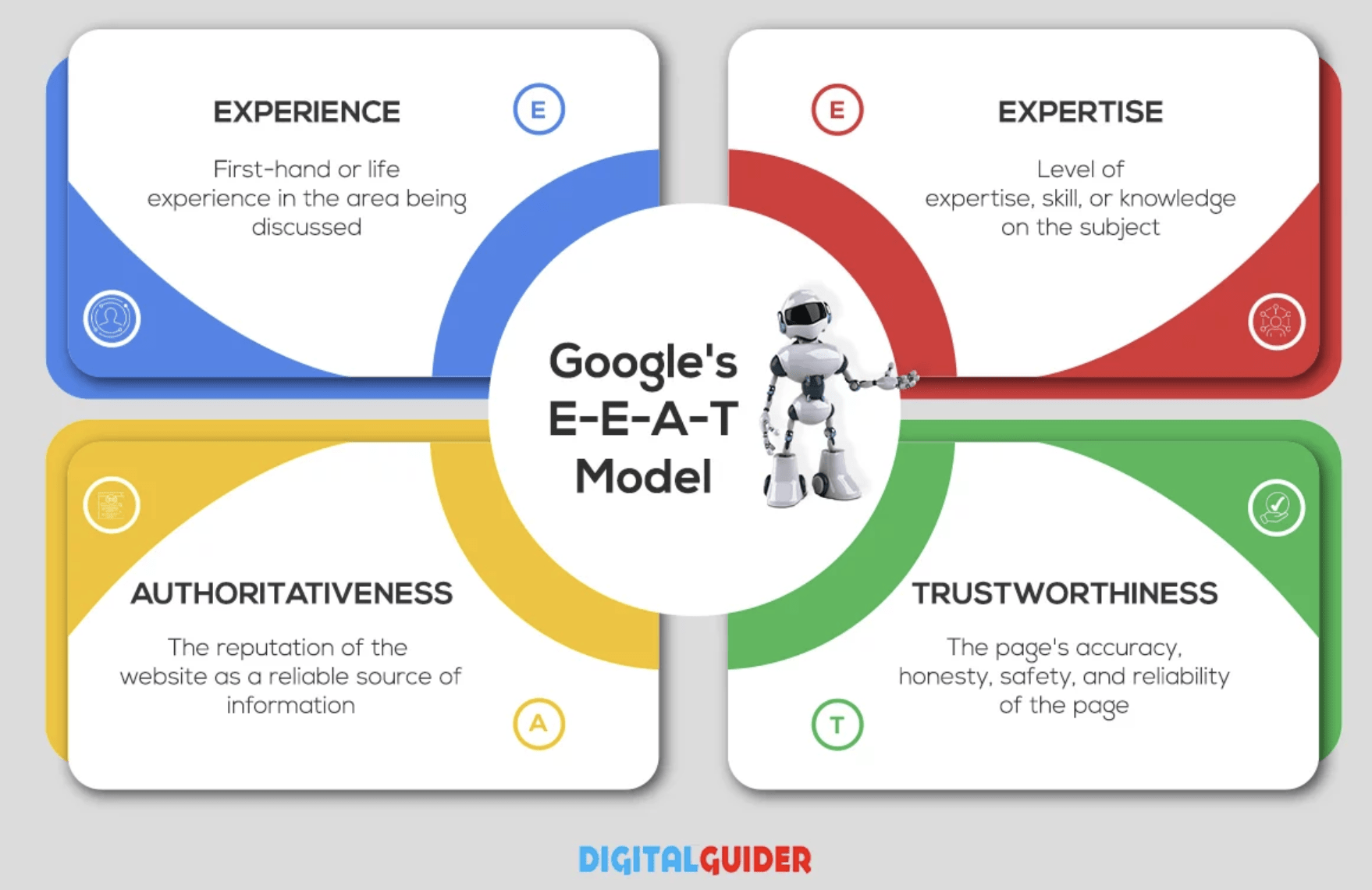
Establishing trust and E-E-A-T in the era of AI Search
The B2B buying journey has radically changed. Prospects are no longer opening ten different tabs to compare vendors manually. With recent data from Buttered Toast revealing that 89% of B2B buyers now use generative AI to evaluate vendors and justify purchases, the qualification journey is rapidly collapsing into a single search session inside an LLM.
Because buyers are asking AI models highly specific questions, your strategy must evolve to ensure generative engines accurately represent your brand’s expertise. As Steve Toth highlights in his 2026 Surfer Academy Webinar with Michał Suski, this requires a ‘Trust Alignment Framework’ focusing on omnipresence and retrievability. Here is how to establish E-E-A-T for both human buyers and AI models.
Answer the ‘deal breakers’
While broad discovery keywords might bring in traffic, high-value B2B buyers use AI to ask immediate deal-breaker questions. They are asking LLMs things like:
- “Is this platform SOC2 compliant?”
- “How long does implementation actually take?”
- “Are there hidden API rate limits?”
Demonstrating true expertise means answering these highly specific, technical questions upfront in your content, leaving no ambiguity for the buyer or the AI.
Cultivate omnipresence
E-E-A-T extends far beyond your own website. LLMs frequently pull citations and verify trust using third-party platforms like LinkedIn, Reddit, and niche Facebook groups. Ensuring your brand is actively discussed and positively represented across these external channels is critical for establishing industry authority and improving your retrievability in AI answers.
Leverage recency and clear structure
Trust requires up-to-date information. When building BoFu competitor comparison pages, include the current month and year; these recency signals actively help with LLM retrieval. Furthermore, AI models understand the beginning and end of your content much better than the middle. Ensure your introductions are highly compact and descriptive, and use structured data like tables in the middle of your posts so that formatting aids extraction.
Measuring pipeline over vanity metrics
You’ve mapped your keywords, created targeted BoFu content, and optimised your site. But how do you actually prove your strategy is working to your leadership team?
While a 20% increase in organic sessions is an excellent top-of-funnel marketing metric, it is rarely the metric your Sales Director or CFO are looking for. They care about commercial growth.
To secure budget, you must abandon vanity metrics and align your reporting directly with sales outcomes.
Shift your KPIs from traffic to revenue
As SparkToro’s research on the zero-click era highlights, organic traffic is becoming harder to win, making revenue the number one metric for marketing teams. Stop reporting on the volume of people visiting your site and track the metrics that actually impact the bottom line.
- Organic sourced pipeline: Measure the total monetary value of all open sales opportunities that originated from an organic search click.
- Organic influenced revenue: A prospect might research you via ChatGPT, visit your site, leave, and convert three weeks later via a paid LinkedIn ad. When evaluating whether PPC or SEO delivers the best ROI, the answer is usually both working together. Implementing self-attribution (asking “Where did you research us?” on your lead forms) is now mandatory to ensure SEO gets the credit it deserves for assisting the final sale.
- Lead-to-close velocity: Organic leads usually close faster because they are already actively looking to buy. Proving that SEO shortens the sales cycle is a highly persuasive metric for the C-suite.
Connect your SEO data to your CRM
You cannot track pipeline if your SEO data lives in Google Analytics and your sales data is locked inside a siloed CRM. Integrate your systems by ensuring website forms pass “lead source” data directly into your CRM, whether that is Salesforce or HubSpot.
When a sales rep marks a deal as closed won, trace that revenue back to the exact high-intent blog post the buyer landed on. Implementing multi-touch attribution reporting allows you to see exactly how your organic content supports the entire buying committee from discovery to contract signature.
Stop chasing traffic, start driving pipeline
B2B SEO is no longer a numbers game; it is a precision game. If you continue to measure your search success by the sheer volume of visitors hitting your site, you will consistently struggle to prove your value in the boardroom. By shifting your focus to high-intent, BoFu keywords, you stop competing for fleeting attention and start competing for tangible revenue.
This approach requires a deeper understanding of your buyer’s journey, mining real Voice of Customer data, and structuring your content for modern AI search engines. The organic traffic you generate might be significantly lower, but the commercial impact will be undeniably higher.
If you are ready to transition your search strategy from vanity metrics to pipeline generation, our specialist SEO team can help. Get in touch with us today to discuss how we can align your content with your buyer’s intent.