
Today, B2B decision-makers are increasingly turning to Large Language Models (LLMs) like ChatGPT and Gemini to conduct their early-stage research. They ask these tools to compare vendors, summarise complex reports and build initial shortlists long before they might ever visit your website.
If your brand isn’t visible within the model’s knowledge base, you simply don’t appear in that critical early process. For a growing number of buyers, your brand effectively doesn’t exist.
This new reality requires a new measure of authority: Share of LLM (SoLLM).
SoLLM measures the proportion of LLM-generated responses that actively mention, cite or draw on your brand’s content. It is the truest reflection of your authority in an AI-driven environment.
And here is the new, pivotal truth for every B2B marketer, SEO specialist, and Digital PR professional: our research shows that branded web mentions are up to three times more influential than backlinks in driving LLM citations.
The era of transactional link-building is fading; the age of brand reputation is here.
Redefining authority: why LLMs trust your brand more than your links
For decades, the backlink was the core signal of authority for traditional search engines. It was a vote of confidence. However, an LLM operates not just as a ranking engine, but as a trust engine. When it is asked to generate a response, it is acting as an expert and experts rely on a much broader, more sophisticated set of trust signals than just a link profile.
LLMs go beyond looking at simply who is linking to your website, and try to understand how your brand is perceived online in order to assess the full digital footprint. They are looking beyond pure keyword relevance and technical factors to understand the true purpose of a user’s query. This is why brand mentions (credible media coverage, expert commentary, consistent third-party mentions) are now so critical.
If your brand has a high volume of positive, high-quality, non-linking mentions across the web, Large Language Models perceive a higher level of real-world authority and credibility. Conversely, a lack of brand presence or social activity signals a brand that is not trusted enough to be cited.
This makes Digital PR a central, non-negotiable pillar of modern organic strategy. Building a strong and consistent narrative around your brand is now your most efficient route to securing a top position in an AI-generated shortlist.
The correlation and the crucial gap
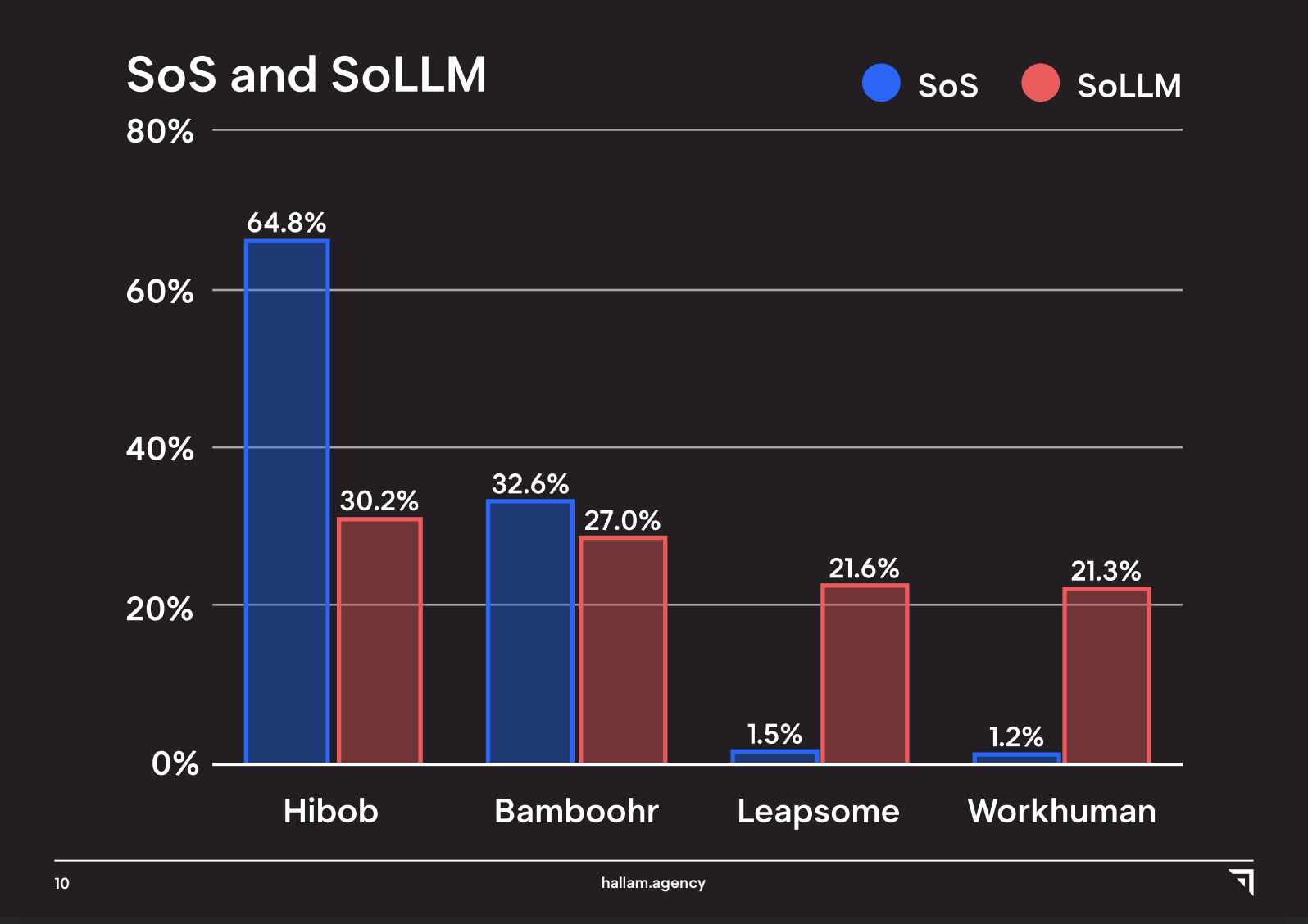
Our analysis across four B2B sectors (HR software, Fintechs, Manufacturing, and Digital Transformation) shows a clear relationship between SoS and SoLLM. Brands that dominate search generally have the strong content ecosystems, engagement, and trust signals that LLMs recognise. Existing search equity still delivers dividends in AI environments. Across all sectors, brands in the top half for Share of Search were 2.5 times more likely to also rank in the top half for Share of LLM.
However, the correlation is not a guarantee.
The Digital Transformation sector exposes the gaps where search dominance fails to translate. In this category, the clear leader in Share of Search, PA Consulting, only ranked third in our Share of LLM.
This divergence proves that SoLLM relies on more than awareness alone. While SoS measures how often people search for you, SoLLM rewards the depth and diversity of relevant content. A brand may win in search, but if its content doesn’t address the full range of long-tail and transactional topics that buyers are asking LLMs about, it will be outperformed by brands with richer, more authoritative content ecosystems.
Optimising for AI authority: from fragments to ecosystems
To win in the new B2B buying journey, you must appeal to both robot and human alike. This means radically changing your approach to content and technical SEO.
- Embrace E-E-A-T as a framework for LLM credibility. E-E-A-T (experience, expertise, authoritativeness and trustworthiness) is no longer just Traditional Search principle; it’s the standard for LLM credibility. Models favour content that demonstrates genuine expertise, cites reliable sources and is regularly maintained. A scattered or opportunistic approach to content creation simply won’t perform well.
- Build a coherent content ecosystem. Your content should operate as a coherent ecosystem, not a series of isolated pages. Internal linking plays a central role here. It helps LLMs and search engines understand how your topics relate to one another and signals that your brand has a meaningful, structured point of view. Clear structure (one H1, logical H2s) and appropriate schema are still essential foundations.
- The middle ranks matter most. Unlike search, where a single brand might capture 70% of interest, LLM visibility operates within tight ranges, making overwhelming dominance almost impossible. Every brand is visible and the competition is closer than ever. In many sectors, the real battleground now lies in Positions 2 and 3. Consistent performance across a broad set of topics (breadth) can outperform isolated peaks of dominance and secures the stability and lasting visibility required to win in SoLLM.
The rise of LLM-powered research marks a defining shift for B2B marketers. The new goal is not just to be seen, but to be trusted. Brands that understand how they are represented within LLMs are the ones who will make smarter content investments and capture market share in this new era of visibility.
Download our full whitepaper Share of Search vs Share of LLM: The new measure of authority for B2B brands here.