

I’ve been working in Organic Search for over 10 years and it’s fair to say that a lot of content plans have crossed my desk. From keyword and competitor research to TOFU, MOFU, and BOFU, evergreen content and topic clustering, Organic Content strategy has always been a huge part of my role.
As part of this, one of my favourite types of content to develop has been around ‘predicting’ what the reader might want to know about, regardless of whether there is search volume or not. This is not new and of course it’s deeply rooted in understanding your audience and creating content users will care to read and engage with.
In the context of Organic Search, however, the focus of ‘predictive SEO’ is on figuring out what people will be searching for in the future. The goal is to be the first to create that content, gain topical authority, and rank ahead of the curve, ready to capture user intent when demand spikes.
What is predictive SEO?
Like any good article, let’s start with a clear definition. The premise of Predictive SEO is simple: anticipate your audience’s needs and create content for the questions they may have around your product or services. This is a forward-thinking strategy that involves analysing various data signals to forecast future search trends and user behaviour. Instead of reacting to what people are searching for today, focus on identifying trends and capitalising on topics that are likely to become popular in the future.
Proven ways to predict content topics, gain organic visibility and achieve first-mover advantage
1. Know your audience
If you are launching a new product or a service, chances are people will have questions about it in the future so you can confidently create informational content that supports your main offering. For example, if you are launching a disruptive service, there is an immediate need for ‘What is X’, ‘How does X work’ type content. Years ago I worked with a company that provided air and ground source heat pumps. The content team worked on informational pieces that were covering the whole funnel, regardless of the search volume. We wrote articles targeting keywords for which there wasn’t any interest yet, but we knew demand will be there in the future. Whilst we didn’t pick up any traffic to begin with, when these products became popular and demand surged, so did our traffic and conversions. It paid off to think ahead.
2. Conduct industry research
Research any upcoming trends and changes in your industry. If new policies are introduced and your customers are being impacted, you should be a trusted source of information. In the B2B world this could be anything from regulatory changes to introduction of new laws. For example, we worked on creating content around upcoming policy changes with one of our clients and the content pieces that were created based on this premise have performed incredibly well from an organic point of view and have also resulted in conversions. Know your industry.
3. Analyse seasonality
Seasonality is simple, I hear you say. After 10 years in the space, I still see companies get this wrong. Let’s unpack this.
- Seasonal events – if you are operating in the B2C or D2C space, you already know what the big commercial moments are. Christmas sales and planning does not start in November, it actually starts in September. If you are not planning your content strategy in August, you will be missing out on opportunities to be part of the Christmas planning journey for some customers.
- Pages that receive traffic only at certain times of the year – if you have informational content that is receiving traffic only in May, then ensure you are planning ahead and are updating this content piece in March. You can also conduct technical and hygiene audits for seasonal pages during their off-peak time to ensure there are no issues when demand spikes.
- B2B spikes – whilst B2B has a less pronounced seasonality, you can still review your keyword data to understand when the demand for your services peaks. I worked on research for the HR SaaS space earlier this year and we could see that the search volume for ‘hr software’ peaked in January. From an organic point of view, you need to be planning your optimisation strategies and building content at least four months in advance in order to be in a position to capture this intent.
4. Recognising trends
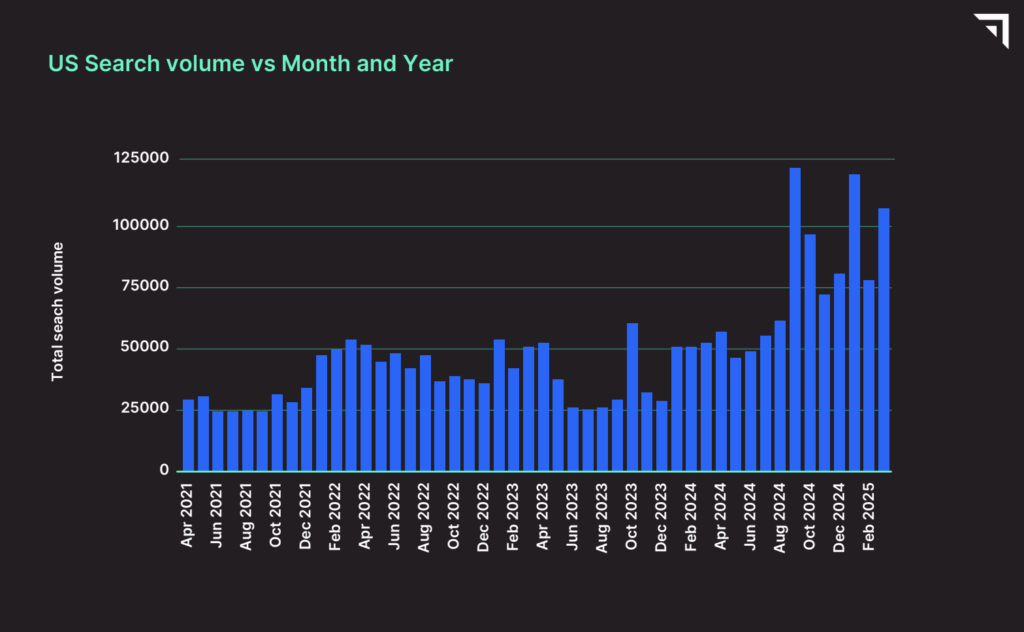
There are ways to recognise upcoming trends and my colleague Calum Whittingham goes into great detail about how you can do just that in his article on how to find trending keywords in your industry. There are a lot of tools that will help you see trending topics but it’s worth mentioning that keyword research tools will experience a delay in capturing the demand. When chatGPT launched and overnight everyone around the world was using the platform, keyword research tools showed search volume at very low numbers.
5. Monitor keywords with rising impressions in Google Search Console
You should be monitoring your Google Search Console data regularly, but in the case of predictive SEO, you need to be looking for keywords and categories that are gaining new impressions MoM or YoY. If you are noticing that your site is picking up impressions for topics that you don’t yet have content on but are still relevant to your audience, it could mean that a new category is forming. To do so, use the ‘Performance’ report and filter by ‘Queries’, looking at the Impressions metric in particular to new topics.
6. Reddit discovery
By now you would have heard about the valuable insights that can be found on Reddit. The platform offers unfiltered views from your industry and audience. It’s a great way to spot trends, understand the problems your audience is facing and use these insights for content creation.
7. Bonus tip
Avoid optimising and putting a lot of effort into terms that have declining search trends. Earlier in the year, Ahrefs released a study on the lifecycle of keywords which perfectly depicts the phases keywords go through. Ensure you are aware whether the topics you are optimising still generate a lot of interest or have plateaued.
The shift from reactive to predictive and how Hallam can help
Predictive SEO is a strategic pivot away from reactive and keyword chasing content approach. The focus is on gaining deep understanding of your audience and their content needs and building an optimisation strategy that speaks to their pain points and questions, regardless of search volume. Organic Search has seen its biggest disruption yet, and we must evolve to look beyond keyword metrics – learning to spot trends both within our internal data sets and the industries we operate in.
For more information on how Hallam can support your Organic Search strategy, speak to our team.