

Traditionally, off-page tactics were the overlooked “middle child” of SEO strategies.
First, you have technical SEO. Grown-up. Respectable. A strong, indexable website is the basis of everything else, and getting it right guarantees your Mum will frame your Core Web Vitals scores on the mantlepiece.
Even so, on-page content is the favourite, the younger sibling that everyone boasts about. New and exciting, it’s best friends with AI, and ranks for heaps of vanity metrics. You can’t go wrong with content.
But off-page was typically passed off as difficult to measure, and marketers often leave it behind because of the difficulty with attributing it to pure ROI – links = ££.
But things have been looking up over the past few years, with the complexities of EEAT pushing them back into the limelight. The emergence of AI in particular has shown SEOs the importance of employing off-page strategies beyond simply building links, and the need to invest meaningfully in digital PR.
What is Digital PR
Digital PR is a marketing strategy that employs traditional public relations tactics to boost a brand’s online authority and reputation. It goes beyond conventional linkbuilding, aiming for coverage in reputable publications relevant to the target and their users, to boost visibility and performance.
Some of the key aspects of digital PR are:
- Linkbuilding: While digital PR has evolved from the spammy, link-farming practices of yesteryear, it still aims to drive quality backlinks to key pages on a brand’s site
- Building media relationships: Successful DPR strategies rely on support from journalists and influencers to help spread the word about a brand and its offering. Press releases and “reactive” commentary are a great way to achieve this
- Content creation: There’s no such thing as a free lunch link; creating quality, first-party content with insights people can’t find anywhere else helps digital PR professionals drive interest and backlinks
- Social media outreach: Platforms like Facebook, Instagram and Reddit are a great way to promote a business’s USPs to real people. If done correctly, social media can do a lot of the heavy lifting when it comes to brand-building
- Reputation management: Nothing is ever lost on the internet, and brands can utilise digital PR to respond to commentary and online mentions, as well as promote core messages
How does digital PR differ from traditional PR?
When you think about Public Relations, your brain probably conjures images of celebrity publicists putting out fires, or the slick, silver-tongued caricatures from shows like Mad Men.
While exaggerated, these images at least capture the key goal of PR – to paint something in the best light possible. Digital PR is no different, looking to leverage the tactics mentioned above to improve a brand’s authority and visibility online.
While they have similar goals, traditional and digital PR differ in a few key areas:
- Channels: Traditional PR relies upon print and broadcast channels to drive engagement, while digital PR is concerned with websites, blogs and social media platforms
- Audience: Offline PR often targets a wider, less targeted audience through mainstream media, while digital PR has a narrower focus on specific audiences and demographics
- Measurement: The reach and success of digital PR is often easier to measure through online analytics, relating to backlinks, traffic and authority
How has digital PR changed over time?
Backlinks are vital to SEO performance – each one from a reputable source is essentially a vote of confidence to Google that your site is worthy of ranking.
But, we’ve already referred to them as both “spammy” and “dodgy” in this post, and that’s because the methods SEOs historically used to secure them haven’t always been the most ethical.
Like the practice of “keyword stuffing”, which allowed early SEOs to add every conceivable keyword to a page in the hope of rankings, backlinks could be similarly gamed through “link farms” offering irrelevant signals to bolster domain authority.
If that didn’t work, then links could always be bought, too.
Luckily, Google’s a smart cookie these days (despite what early AI Overview responses would have you believe), with consistent algorithm updates making these black-hat tactics ineffective and obsolete.
Google’s Penguin update in 2012 sought to penalise websites using these practices to deceptively inflate their authority, leading to drops in traffic and visibility for the worst offenders.
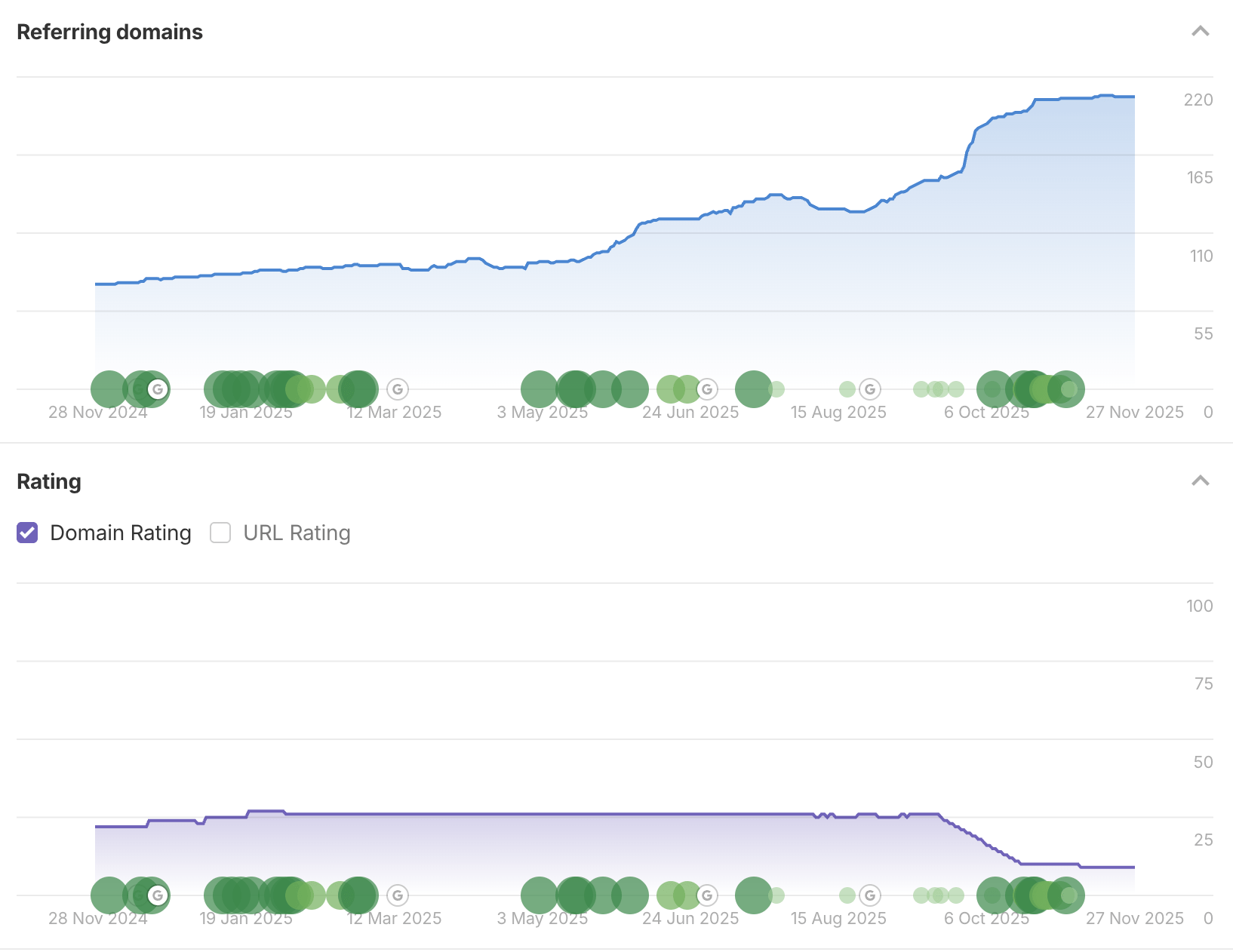
Since Penguin, Google has only gotten better at punishing dishonest backlink profiles, and the Ahrefs graph below shows how an influx of irrelevant links can now harm a site’s domain rating:
With the old ways out the window, SEOs looked toward more wholesome and legitimate methods of linkbuilding, with digital PR being born out of necessity.
Common Strategies in Digital PR
A successful digital PR strategy requires a range of tactics to drive legitimate backlinks to a website; some of which we’ve touched upon already. While there’s no one-size-fits-all approach, we’ve listed the most common one below.
Digital PR Campaigns
Digital PR campaigns aim to capture the attention of potential customers and industry experts through compelling stories and insightful content. A great way to do this is through data-led campaigns that use internal or survey data to craft intriguing narratives that encourage links back to the client.
We employed this strategy for our client Protrade, launching two national campaigns to position them as a leading voice in the construction sector. These reports examined how worsening climate events are disrupting the construction industry, as well as shifting trends in the uptake of apprenticeships.
As a result, we drove 116 pieces of industry coverage, resulting in 67 links with an average Domain Rating of 45.

These campaigns can also be more creative, forgoing data and insights in favour of large stunts and humorous angles. An example of this is the Million Dollar Whopper Campaign launched by Burger King in 2024.
Reactive Digital PR
Reactive PR uses the news cycle to its advantage, monitoring headlines and trends to “hijack” a story and provide a new angle relevant to a brand.
Suppose your brand has a unique perspective on developing news or a spokesperson primed to provide invaluable insight. In that case, reactive PR is a powerful and consistent tool for driving quality backlinks and brand mentions.
We utilised reactive PR for our client Cabin Master, leveraging the best angles to boost online visibility and position them as experts in the garden living space. Our reactive approach drove 38 brand mentions and pieces of coverage, improving their organic visibility.
Proactive Digital PR
Proactive digital PR involves reviewing seasonal events and awareness days relevant to your client, and planning campaigns to coincide with them. Think of it like a longer-term version of reactive PR, where you anticipate the news angles before they happen.
Any angle you can create that links to common holidays like Christmas or Valentine’s Day, or wider events like governmental budgets announced in advance, will provide you with a solid calendar of proactive PR pieces.
Thought Leadership
Thought leadership is crucial to digital PR, as it cements a client’s authority through unique perspectives and commentary on important issues.
This is particularly good for brands in niche industries and verticals where there’s a lack of general knowledge and awareness. If you can be the voice everyone trusts, the links will come flooding in.
Case Studies
What’s the point in building up a brand if you don’t get to brag about it?
Case studies connect with journalists and customers because they demonstrate real results that often speak for themselves.
Here at Hallam, we love a good case study too.
Measuring Digital PR Success
I’m going to be straight with you.
“Selling” the benefits of digital PR to stakeholders can be difficult.
If we return to the laboured “middle child” analogy, the other pillars of SEO wear their benefits more distinctly on their sleeves. It’s easy to explain why a site needs to be technically sound, just as it’s easy to correlate content changes with keyword and traffic improvements.
Even where we can clearly show an influx of backlinks off the back of a campaign, the benefit of these links isn’t as black-and-white. As a result, companies have been historically hesitant to invest in digital PR to the same degree as other channels.
But measuring its success is not only possible, but essential. Some of the metrics you can use to show return on digital PR investment are:
Total Links
This one seems obvious, but an increase in links following a campaign shows it did its job. It’s important to remember that the number of links isn’t as important as the quality of them. Remember that Ahrefs graph from earlier?
Referral Traffic
Referral traffic is any traffic that came to your site using an external link. It’s one of the common channel groupings within Google Analytics, meaning you can see the sessions, events and revenue attributed to it.
Keyword Rankings
These aren’t only useful for traditional SEO. Backlinks are a confirmed Google ranking factor, so building links to the pages you care about is a surefire way to aid SEO efforts and help a page climb the SERPs.
Brand Mentions
Not all coverage results in a link to your website. Sadly, that often isn’t the case, with link reclamation (manually asking a site to provide a link to your content) being a tactic digital PR professionals are all too familiar with.
You can use tools like ahrefs’ content explorer to look for mentions of your brand across the web, to get a better understanding of your presence independently of your backlink profile.

Why is Digital PR important in 2026?
Backlinks and authority have always been important to SEO, with a site’s backlink profile and domain authority directly influencing ranking position.
But, rather than diluting its value, the emergence of AI and LLMs in search has only made digital PR more vital, due to the increased emphasis on EEAT (Expertise, Experience, Authority and Trust).
AI search assembles answers from a variety of sources, putting less relevance on a single result. This means that the real-world signals behind a brand have never been more important to visibility within SERPs.
AI Overviews and LLMs prioritise reputable sources
Google’s AI features (such as AI Overviews and now AI Mode) compile their answers from websites and brands with the most authority. Driving quality backlinks and mentions through considered campaigns is now essential to being cited as a source within AI responses.
Entities are important
Large Language Models don’t work in the same way as search engines, prioritising “entites” over keywords.
Google’s own definition of an entity is “a thing or concept that is singular, unique, well-defined and distinguishable.” This could be a person, a place, or anything with a distinct identity that Google can recognise to build contextual information around a query.
The work digital PR does in establishing a brand as an entity ensures it will appear in the right searches and responses – even as traditional SERPs get more crowded and competitive.
Ranking factors are evolving
While backlinks to a page are still a sign of authority, the nature of AI search means the emphasis is shifting away from individual pages. Check any website, and you’ll see a list of “top pages” that drive the most traffic and/or links, with the rest of the site adding little of value.
Digital PR strengthens visibility at a brand level, with links and mentions from authoritative sites solidifying your reputation beyond your top-ranking pages.
Visibility before the click
Recent data from SparkToro shows that 59.7% of searches in Europe now end without a user clicking through to a website.
Which, to SEOs, is more than a little troubling. Since the dawn of search engines, we’ve been doing our utmost to appear as one of those 10 blue links, and now doing so doesn’t guarantee…anything.
With AIOs answering user queries directly within SERPs, brand visibility needs to start long before the click. Digital PR gets your brand noticed and cited across the web, not just within search engines, helping to combat the rise of 0-click searches.
PR campaigns are unique
If I told you I’d written this entire blog using AI, I hope you’d be surprised. Because if I’ve spent this much of my day writing this, and it’s indistinguishable from a glorified word generator, I might have to go and cry in a corner.
But the uncomfortable truth is that AI is getting smarter every day, and as such, it’s not always easy to see what’s real and what’s generated. But as smart as it is, it’s still only “generative”, meaning it can just make its best guess based on what’s already out there.
Each sentence is essentially a complex evolution of autocomplete, with no capacity for AI to create something entirely new.
The kind of campaigns that work so well in digital PR are also the kind that AI can’t replicate. Valuable, insightful pieces based on first-party data are sure to resonate and drive engagement, benefitting your brand long term.
Hopefully, the benefits outlined above will help convince stakeholders concerned about the implications of AI to invest meaningfully in digital PR alongside other channels. Let’s not forget that the best strategies rely on a range of channels working together to improve visibility online.
How Hallam can help
Digital PR isn’t just the awkward middle child anymore. It’s an essential part of your strategy that proves you’re real, reputable and worthy of citation. As Google leans harder on authority signals over traditional vanity metrics, brands that invest in PR will be the ones showing up, being cited and staying relevant.
At Hallam, we create digital PR campaigns that work. Get in touch, and find out how we can help build your authority to achieve your digital goals.